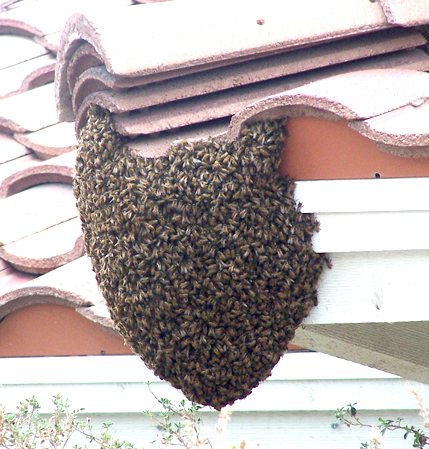
ABOUT.(Researched from UC Irvine Dept. of Entomology web site)
Africanized Honey Bees are the same species as the familiar European honey bees (EHB) used to produce honey and pollinate crops, but a different subspecies. They are called "Africanized Honey Bees" (abbreviated AHB) because they are the result of interbreeding between European bees and bees from Africa inadvertently released in Brazil in the 1950's. They have also been referred to as "Killer Bees" in the media because of their increased defensive behavior. They are about 3/4 inch long, brownish, and a little fuzzy. Their nests are normally hidden in cavities. Less fuzzy insects with bright yellow and black markings, or with gray paper nests are probably wasps, not bees. Larger bees are not honey bees.
WHERE TO SPOT THEM. Africanized bee colonies are likely to be more common than European bees have been, and they swarm more frequently. They nest in places European bees did not, including small cavities near the ground like water meter boxes or overturned flower pots.
WHAT YOU CAN DO:
Bee proofing: Look for cracks and holes in your house that might lead to wall voids or other cavities a colony could occupy. Screen or caulk these holes, or fill the cavity with insulation, and bees will not move in. Clean up debris (tires, pots) that might provide nesting sites on your property.
Be alert: Look before disturbing vegetation. Many bees coming and going from a single spot (not just many bees at flowers) may indicate a nest.
Get help: Contact trained and equipped personnel if you discover a honey bee colony. Don't try to remove them alone.
If stung: First, get away, run to shelter of a car or building, and stay there even if some bees come in with you (there are more outside). Do not jump in water (bees will still be in the area when you come up). Once safe, remove stings from your skin, it does not matter how you do it, as quickly as possible to reduce the amount of venom they inject.
BLACK LIGHT HOME INSPECTION
Scorpions are a native of the valley and are still a residents of Las Vegas. To ensure that your family and you are safe in your own backyard, Skelly offers a black light inspection that can determine the presence of scorpions in your backyard or home. Call for an inspection today.
|