DO YOU KNOW THAT...

01. When a vampire bat attacks a human being, its target is the big toe and not the throat. The bat will approach his sleeping victim, alight on the ground, and then walk or run to the target. It has such sharp teeth, it can make an incision in the skin and drain the blood without waking the victim. The bat lives entirely on fresh blood of humans and animals. It's a most dangerous creature found only in tropical and central South America.

02. The porpoise has a higher potential I.Q. than man. Some scientists believe this to be so. The porpoise has a big and highly developed brain with a cell count per cubic centimeter the same as that of man. Porpoises have been tamed and taught to do marvellous tricks.

03. Tigons and Ligers really do exist. A Tigon is a cross between a Tiger and a Lioness. And a Liger is a cross between a Lion and Tigress. The Liger is the rarer of the two, but both animals are only bred in captivity and not in the wild.

04. Skunks don't smell. A Skunk has no body smell. It is only when it is angered or annoyed that it produces a fluid with such a strong and terrible smell, it can be detected from a radius of half a mile. This fluid is ejected with great force and accuracy to a distance of 12 feet. If it hits the eyes, it can cause blindness.

05. The cheetah can reach a speed of 71mph over a hundred yards. Over a short distance, the cheetah is easily the fastest mammal in the world. It's acceleration is almost as great as that of a Formula 1 racing car - 45mph in two seconds. But it cannot sustain this terrific speed over a long distance.

06. The horn of the Rhinoceros is really made up of its hair. The horn is actually a collection of hardened hair-like fibres growing from the skin. It grows throughout the life of the animal. The rhinoceros keeps it shiny and clean by rubbing it against the trunks of the trees.

07. Camels don't store water in their humps. But the excess food and water which the camel does not need is converted into fatty tissues and passed to the hump. When the camel has not enough to eat or drink, it draws it's nourishment from this store of fatty tissue and a lot of water is produced in the process. That's why the camel's hump is firm and plump when it has lots to eat and drink, and it reduces in size when it is starved.

08. Bulls are not angered by red colours. Bulls and cows, and in fact most mammals except man, apes and monkeys are colour blind. So it's not the red colour of the bull-fighter's cape that angers the bull. Colour does not play a very important part in their lives. Most mammals hunt at night when it is not very necessary to see colour.

09. Whales can communicate with each other by sending out clicking signals which they can hear up to 100 miles apart.

10. The world's largest carnivore is the kodiak bear of Alaska. The average nose to tail length is 8 feet.

11. The only true wild horse is found in the remote regions of Mongolia. It is known as Przewalski's wild horse.

12. The South American armadillo was so called by the Spanish conquerors because they thought it resembled a suit of armour.

13. The African elephant eats up to about 225kg of grass, foliage and other vegetation a day and drinks up to 136 litres of water at a time. They can walk faster than a human, maintaining a steady speed of 4-6km/p for hours on end. A herd on the march can easily cover 80km a day. When water is scarce t he African elephants will dig in the sandy bed of a river that has ceased to flow. It uses its feet, tusks and trunks to obtain water for itself and the rest of the herd. The largest African tusk ever recorded was 3.1m long and weighed nearly 105kg.

14. The giant anteater's sense of smell is 40 times more powerful than a human's. Their body temperature is only 32.5-35�F. This enables them to cope with the low calorie content of its food. An early form of anteater was known to have existed some 20 million years ago. A giant anteater will sleep for up to 15 hours in every 24.

15. The only wild monkeys in Europe are the Barary Apes of Gibraltar?

16. Fox does not chew its food. Instead it uses its carnassial, or shearing teeth to rip the meat into chunks it can swallow.

17. Tigers are capable of dragging prey that would take more than a dozen men to move. The healthy diet of the tiger consists of 9-10kg of meat a day. It is capable of eating 50kg of meat at one time.

18. The hippo does not sweat, but produces a pinkish fluid from pores in the skin. This may help keep tis body cool. It is also thought to have antiseptic properties, and to protect the hippo's sensitive skin from the sun's ultraviolet rays, although the animal spends most of its life in shady cover.

19. The koala bear rarely drinks, but gets all the liquid it needs from eucalyptus leaves. 'Koala' is an Aboriginal word meaning 'no water'.

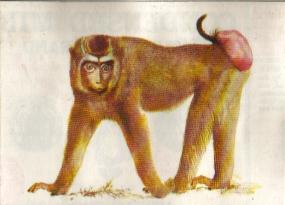
13. Pig-Tailed Macaque

This is a large thick-set monkey with a very short tail which is usually carried arched over its back. It is often found roaming on the ground in jungle and swamps. It can be destructive pest in rice fields and coconut plantations. Malay villagers catch them and train them to pluck coconuts.


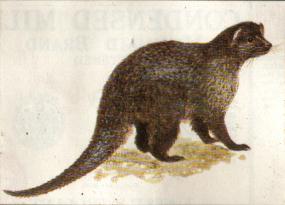
14. Large Indian Mongoose

Several kinds of Mongoose live in Malaysia, but none are found in great numbers. They prey on any small animals they can catch and are celebrated for their readiness to attack and kill snakes of all types - venomous or otherwise. Their speed of attack keeps them out of harm's way.


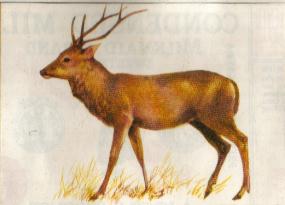
15. Sambhur

This is the larger of the two kinds of true deer found in Malaysia. It is about 4ft. tall at the shoulders. It is usually found alone or in parties of two or three. The males have large antlers, bearing up to three prongs. The Sambhur loves to frequent salt licks and caves. It has a very acute sense of smell and hearing but very poor eye sight.


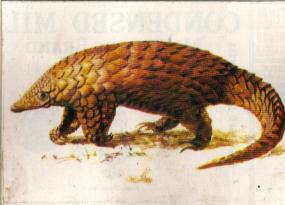
16. Pangolin (Scaley Anteater)

The Pangolin is not related to any Malaysian mammal. It is a stoutly built animal. Fully-grown it is about 3�ft. long. It lives entirely on a diet of ants and termites, licking them up with its long, thin tongue. It has no teeth and its mouth is very small. It is a powerful burrower. It sleeps during the day and comes out at night.


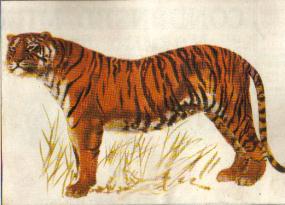
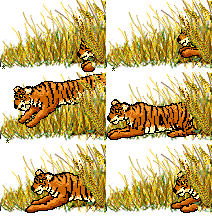
17. Tiger

The largest and most formidable of the Malaysian cats. An immensely powerful beast for its size (the body is seldom more than 5ft. long). It is quite capable of killing a buffalo and is known to attack elephants. Most tigers avoid men. But if wounded or if their cubs are disturbed they become dangerous killers.


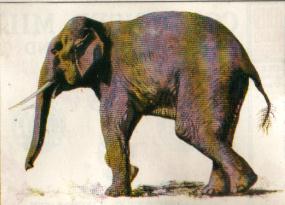
18. Malayan Elephant

The elephant is the biggest of all the land animals. They are herbivorous animals. Wherever they stop to feed, they cause great damage, pulling branches off trees and trampling underfoot anything that stands in their way. The females and babies usually move around in herds. The old males live a solitary life, and visit the herds only occasionally.


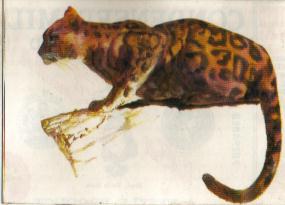
19. Clouded Leopard

The Clouded Leopard is another member of the Malaysian cat family. It is smaller than the Tiger. Fully-grown the Clouded Leopard is about 4ft. long, and weighs 24-37lbs. It confines itself to the deeper parts of the forest and lives in nests in the tree tops. It preys on monkeys for food.


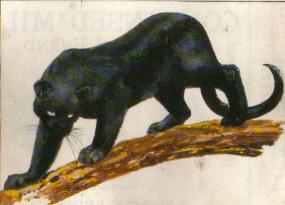
20. Black Panther

The Black Panther is merely a dark leopard. If you look closely at it you can see its spots showing through the black. It's slightly smaller than the Tiger. It is a good climber. Its favourite prey are pheasants, jungle fowl and mouse-deer.


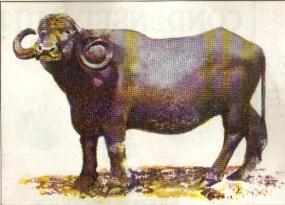
21. Water Buffalo

The Water Buffalo is the most common beast of burden in Malay kampongs. It's a big animal, almost 5ft. tall at the shoulders and weighing about half a ton. The horns have a distinctive shape - long, flattened, and triangular in cross section.


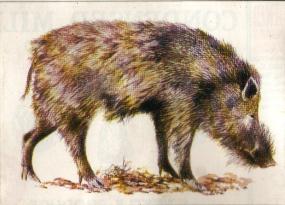
22. Bearded Pig

Two species of wild pig are recorded in Malaysia. The Bearded Pig is the largest, weighing up to 182lb. It moves around in large herds sometimes hundreds strong, covering a large territory. They usually keep to the deep forest, wandering long distances in search of fruits and other kinds of food. They particularly relish the fruits of the Malaysian oak tree.


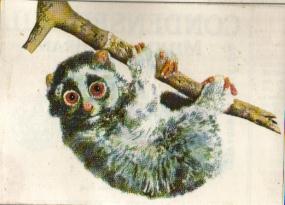
23. Slow Loris

A quaint-looking little animal about the size of a small cat. It moves very slowly and deliberately. It never jumps and will not let go of one branch until it has a firm grip of another. It feeds on fruit, eggs, lizards and insects grabbing them with an unexpectedly quick movement with one of its hands. It is a nocturnal animal.


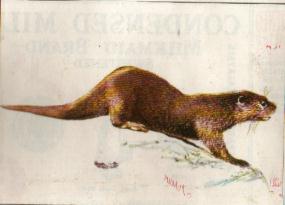
24. Small-clawed Otter

This is the smallest of the species of ottes found in Malaysia. Fully-grown it measures 22 inches long and weighs about 2 lbs. It is usually found around hills and streams as it feeds mainly on river mussels, crabs and snails. It is very well adapted for this kind of food as it has long heavy teeth.


On the Brink of Extiction
Wildlife Rerserves

Hosted by www.Geocities.ws

1