|
|
|
|
|
|||||
|
This site can also be accessed at http://environmentalists.educations.net or http://important.as/environment |
|
Newmont draws outcry Indonesians protest the use of protected forests for mining by Heather Draper, Rocky Mountain News, July 23, 2003 Denver's Newmont Mining Co. again finds itself a target of protest, this time in Southeast Asia. In the past 10 days, environmentalists, academics and the government officials of some Indonesian provinces have protested the push to allow multinational mining companies onto protected forest lands. [continued] |
Mine in
Approximately 100
miners have shut themselves in the undergound Mavres Petres mine in
Stratoniki, northern
|
|
As a new high court decision in Greece puts an end to mining underneath the village of Stratoniki, Greek and Turkish anti-mining activists join forces against giant mining companies. On December 6, 2002, the Greek State Council officially announced its ruling against the base metals mine belonging to the Canadian TVX Gold Company in the village of Stratoniki, in Northern Greece. TVX, whose planned goldmine at Olympias was banned by an earlier State Council decision on March 2002, was being touted as the largest foreign investor of the last fifty years in Greece. The announcement of this high court decision against the base metals mine in Stratoniki has coincided with the visit of Greek anti-mining activists Tolis Papageorgiou and Maria Kadoglou to Bergama, Turkey. Papageorgiou and Kadoglou visited the villages in the immediate vicinity of the Newmont/Normandy goldmine in Ovacik, Bergama, they met with Oktay Konyar, the spokesperson of the villagers resisting the mine, and with other Turkish anti-mine activists. The anti-mining struggles in Greece and Turkey have followed a parallel course. But while the March ruling of the Greek State Council has put an end to the plans for a TVX gold mine in Olympias, a 1997 State Council ruling in Turkey against the Bergama goldmine was disregarded by the Turkish government, and the mine started full production in April 2002, with a special parliamentary decision that has no legal validity. Despite the high court rulings, gold mining projects have strong governmental support both in Greece and in Turkey. In Greece there are proposed gold mine projects in Thrace, in Kilkis (Northern Greece) and on several Aegean islands. In Turkey, there are close to 600 sites already ear-marked for gold-mining. The use of cyanide in the extraction of gold from the ore, and the inevitable activation of the heavy metals that are normally inert in the soil, make gold mining an activity that poses severe environmental risks. Now, citizens resisting mining projects on both sides of the Aegean Sea have decided to work together to prevent ecological disasters in a region of great beauty and historic importance. Since Turkey fervently wants to join the European Union, and Greece is already a member, Greek and Turkish activists have decided to apply together to the European Commission to bring Turkey’s disregard for its own high court ruling to the attention of the Commission, and to ensure that laws are enforced in Turkey, as they are in Greece. For more information: Maria Kadoglou, [email protected] Ustun Reinart, [email protected] |
|
|
International Arbitration, Sovereignty and Environmental Protection: The Turkish Case
by Aykut Çoban There have long been debates about the challenges of ‘globalisation’ to state sovereignty. Two dominating perspectives can be identified. The first emphasises that sovereignty is in terminal decline by virtue of the dissolving effects of globalisation on national economic policies and the increasing influence of international organisations and NGOs on governmental decisions (Bauman, 1998: 64-8; Booth, 1991: 542; Taylor, 1999). The second argues in favour of continuity by suggesting that as the international norms concerning sovereignty have guided the development of the state in the sense that each state recognises the others as having sovereignty within their own borders, and as even the biggest multinational company cannot be a rival of states in terms of control of the means of violence, ‘the history of the past two centuries is thus not one of the progressive loss of sovereignty on the part of the nation-state’ (Giddens, 1990: 67; see also James, 1999). Environment–sovereignty relations are also discussed from within the decline–continuity duality (Conca, 1994: 701-2; Litfin, 1998). Global environmental degradation is not merely regarded as testimony to the inefficacy of the sovereign state but as a challenge to the concept of sovereignty. On the other hand, the emergence of international institutions for environmental protection is seen as expanding states’ capacity to deal with the problem, thereby consolidating sovereignty. [continued -HTML format] [continued -pdf format, requiring Adobe Acrobat Reader] |
|
|
Newmont-owned illegal goldmine
provokes murder
by Ustun B. Reinart, August 24, 2002 |
VIOLENCE BY NORMANDY WORKERS CAUSES MURDER IN BERGAMA 23.08.2002, Izmir The argument about the
illegal gold mine in Bergama, Turkey, caused one person |
It is with great sadness that I report to you that the unwanted and illegal Normandy/Newmont goldmine in Bergama, Turkey, has provoked a murder in a village named Pinarkoy near the mine.
On Wednesday, August 22, a family whose members work at the mine attacked the home of 35-year-old Turan Kilinc, who has been active in the resistance against the mine, and shot him dead.
During more than ten years of resistance to the mine, the residents of the 17 villages within a 10 km radius of the mine in the fertile northern Aegean region of Bergama have scrupulously avoided violence. They used the Turkish courts (and won at every level of the court system), and they performed creative and determined acts of civil disobedience.
The Turkish government violated its own laws last spring, by issuing a special permit to the goldmine. Just last week, I visited the region where most villagers were bitterly complaining that Newmont was buying out powerful villagers to break the resistance. Now, enraged and grief stricken, they say the mine is destroying not only their lands but also their communities.
As you know already, Bergama is the site of an ancient Roman city named Pergamon, ironically dedicated to Asclepios, the god of Health. With its olive groves, nut-bearing pines, cotton fields and fig orchards it is - was - a Garden of Eden. Today, the pine-covered hill that rises above the village of Ovacik is a bald wound on the earth. The greenish tailings dam full of cyanide-contaminated mud grows larger every day. And now, a family is mourning a man shot dead in the prime of life.
The script of the documentary by Olivia Rousette (SBS TV)
Asterix and the Turkish Gold
July 31, 2002
To western Turkey, where thousands of villagers are doing battle against an
Australian-built gold mine. Their champion is a charismatic former bank
manager dubbed ‘Asterix’ by the Turkish media. It is
Turkey`s longest-running environmental dispute, and it has pitted the indomitable peasants
against the forces of globalisation, and some heavily armed Turkish police.
Despite numerous court victories, the backing of prominent scientists and a wonderful flair for
publicity, the villagers look like losing out to a government desperate for foreign
investment. Olivia Rousset reports on Asterix and the Turkish gold.
[Click
to read the fulltext]
Ustun Reinart, May 10, 2002
The Newmont goldmine threatens the villagers’ livelihood. The villagers who are independent, and who today produce fruits, olives, vegetables and cheese will no longer be able to feed themselves. They have nowhere to go – except to the squatter neighbourhoods of big cities. [Full text of the article]
|
||||
February 26, 2002 It is reported that a new gold mine is to be opened in Antalya, major touristic city in the south of Turkey. |
The
Peasants of Bergama Form a Union
by Oktay
Konyar, the spokesman of the peasants of Bergama For a
long time now, there have been discussions about the future of
the peasant’s movement in Bergama.
The peasants have accomplished a great deal.
Now, it is time for them to enter the political arena
in a more organized fashion. We have considered joining a political party but the peasants
have traditional party loyalties.
Even if a political party has never supported them,
they don’t abandon the political party supported by their
fathers. It’s
important to respect their freedom. It would not be right to
call on them to join a particular party. |
|||
On a rainy December afternoon, we drive past the Normandy gold-mine at Ovacik, in the Bergama Valley of the Northern Aegean region of Anatolia. Olive groves suddenly give way to barren land, dug up and surrounded by rolls of barbed wire -- a wound on the land. Further up, the tanks and pipes of the mine tower above the huge pit where mud contaminated with cyanide will collect and remain forever toxic. |
||||
|
Cyanide
mining hazards endanger community, environment
Community groups and NGOs in Europe and the United States today issued a report exposing the danger of unregulated cyanide compound releases from mines around the world. Decoding Cyanide: an Assessment of Gaps in Cyanide Regulation at Mines reveals that current government and industry regulations and procedures fail to test for many of these potentially toxic agents. They also fail to address the issues that are of most concern to the public - protecting communities, human rights, and land and water resources. The report was provided to the European Union (EU) Commission as input for its February 22nd Brussels meeting on cyanide leach mining. [Click here to read the full text of the article] |
||||
|
|
Come
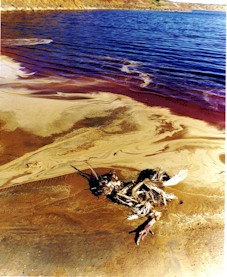
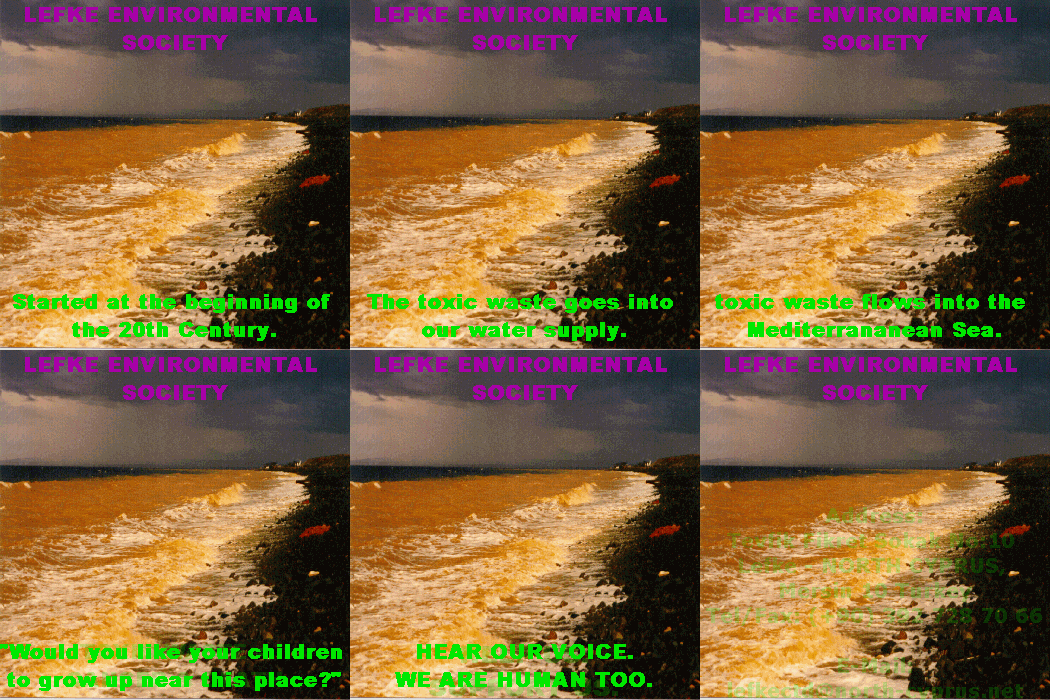
and See... Those who claim that cyanide is not harmful to the environment and to human beings are requested to come to Lefke and see what cyanide has done here. No living creatures exist here around the mining area today. For more information, please visit the site about the Lefke case. (by Enver Bıldır) |
a request from a reader |
| To whom it
may concern, My name is Samuel Mayer. I am making a research project on cyanide contamination for an OAC class in School. This project involves me going out to the field and doing experiment with a cyanide testing kit. My only problem is finding a sight in Canada to perform my experiments. And any information and pointers would be very useful. Thanks beforehand. Samuel Mayer |
|
"Cyanide was the poison used in Nazi concentration camps. Now an Australian company has unleashed it on the rivers of Europe and their inhabitants." |
Cyanide
Leaching in Gold Mining Across the World and Some
Facts
Cyanidation process in gold mining has led to environmental disasters in many countries across the world such as the United States1, China2, 7, Canada3, Guyana4, Bolivia, Philippines, Zimbabwe5 and Ghana6. |
| The
harmful effects of cyanide leaching range from the
release of other toxic chemicals, such as arsenic, lead,
cadmium and mercury, permanent damage to some species of animals,
deforestation, soil erosion, land slides, to the
contamination of underground water. As the effects of
cyanide are getting more obvious, the opposition to
cyanide leaching in gold mining is also rising. Many
organizations in such countries as the United States,
Canada and Turkey to start a movement towards banning
cyanide leaching in mining have been lalready formed.
As a result of such movements, the use of cyanide has
recently been banned in Czech Republic. Other countries
are expected to follow the same path.
Why Should Cyanide Leaching in Gold Mining Be Banned? When the related sites on the right column are checked, detailed answers to this question can be found. However, a short summary is given below:
Siyanürle Altın Madenciliği ve Gerçekler Anasayfası'na gitmek için burayı tıklatın. (Click here to go to the page in Turkish.) |
||||||||||||||||||||||||||||||||||||
|
© 2000, Uğur Altunay |