Before the construction of
the Great Wall in the 17th century, the northern border was protected by
a sporadic and crumbling series of walls that did little to intimidate
invaders. In response to hostile incursions by barbarian tribes,
the Ming dynasty undertook the construction of the Great Wall--a feat of
engineering unequaled in the history of mankind. The exact motives
for constructing the wall are unknown, but it provided many benefits:
- A barrier against barbarian attacks
- A fortified highway for moving troops along the
northern border
- A physical boundary between China and the barbarian
lands to the north
- A signal to barbarians of China's territorial
claims
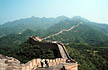
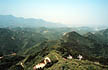
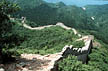
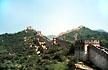
The wall begins at the western shore of the Yellow Sea
and snakes several thousand miles into the central Asian desert.
Most of it has suffered serious damage, especially in the east, where
erosion and theft has claimed large chunks. The Bandaging section
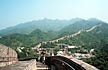
of the wall, where it comes closest to Beijing (about 70 kilometers) was
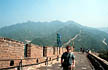
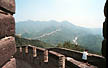
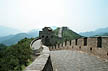
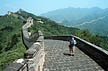
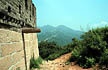
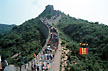
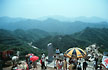
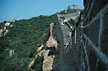
recently restored in 1957. Here it is about eight meters high and
six meters wide, snaking along a scenic area of rugged mountains.
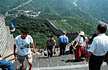
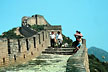
Visitors begin at the base of a valley and choose whether to ascend
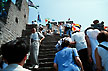
either the north or south mountain. The climb is so demanding that
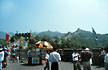
the crowds thin out after a few hundred meters. However, the
souvenir sellers will follow you every step of the way. The 1957
restoration only extended about a kilometer in each direction.
Visitors are not permitted to continue into the unrest red sections.
The climb is very demanding in the summer heat (unless
you take the cable car to the top, which spoils the experience).
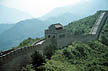
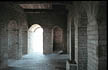
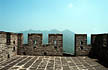
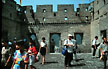
However, the guard towers are uniquely constructed so that the cool
mountain breezes naturally air condition the interior. Weary
travelers can literally "chill" in the guard towers before
continuing along. Souvenir sellers also camp out inside for the
same reason.
Tip: bring plenty of bottled water and use the
restrooms before ascending the wall.
Note: Contrary to popular belief, the Great Wall
cannot be seen from space with the naked eye. It is long, but very
thin. |