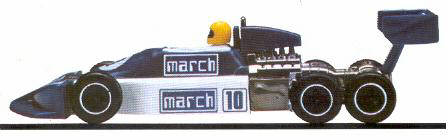
In 1979 the 2-4-0 concept was revived by British Hillclimb specialist Roy Lane. Lane had bought a 771 chassis and with Robin Herd's blessing was loaned the 2-4-0 transmission unit. The fact that the 2-4-0 was originally an inexpensive workshop conversion of the standard March F1 chassis meant that Lane was easily able to fit the unit to his car. Taking advantage of that incredible six-wheel traction, Lane won several British hill-climbing events in the 771/2-4-0 that year.
But if success is measured in international race wins, the March 2-4-0 was surely a failiure. Having said that, it is still believed that the 2-4-0 concept had its merits. Perhaps if the March team could have pursued a weight-shedding program using high-tech materials and developed and improved the car's suspect handling (it never ran in the dry in testing!), the 2-4-0 could have been a major success story. The concept would certainly have adapted well to "ground-effect" which was the coming technology in F1.
The William team must have agreed because they built a "2-4-0" style six-wheeler (designated FW08B) in 1982 but, despite the added complications, couldn't make it go any faster than their four wheel FW08. Finally, any hope of seeing a "2-4-0" race car was finally consigned to history when the FIA banned four-wheel drive. The FW08B remains in William's museum.
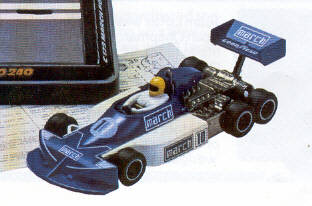
The March 2-4-0 story was not without a silver lining. As Max Moseley had surmised, the car was a huge publicity magnet for the company. In actual fact, it was the most profitable car they ever built - Scalextric bough the rights and produced a hugely popular slot-racing model of the car. March also made a small fortune from hiring the car out to trade shows and exhibitions�
|