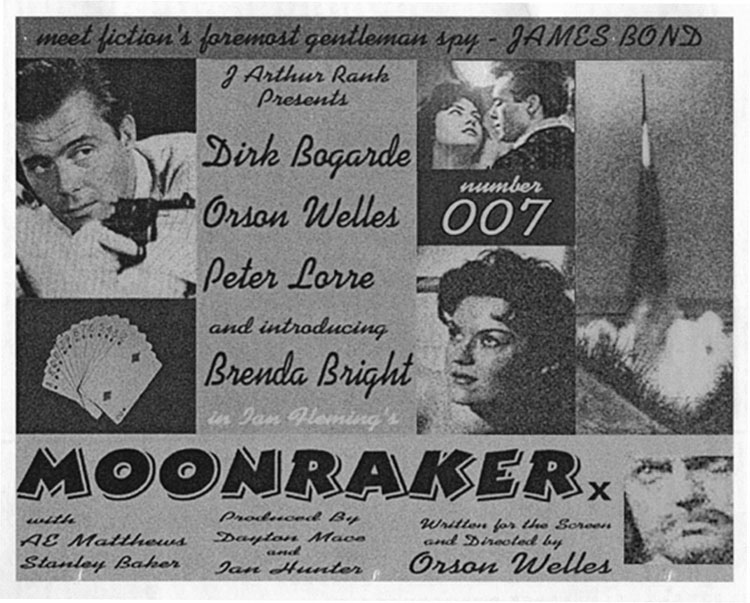
Cinematographer Conrad Dwight is the proud owner of a 1956 Moonraker lobby card, quite possibly the only one left in existence. "Pretty cheap-looking, huh?" chuckles Dwight. "But bear in mind, this kind of layout was considered pretty cutting-edge back in '56. And incidentally, did you notice how Orson's moustache seems bigger in that little photo of him in the corner? That's because he originally wanted to wear one of those big bushy British things, what they used to call, I think, a 'handlebar', but Dayton didn't like it, and made him scale it down. But Orson would sometimes stick on a different-sized or coloured moustache and shoot an extra take, just to get Mace mad when he saw the rushes. We had a great time with that, the whole crew, and it accounts for any discrepancies you might spot in, shall we say, the generosity of Orson's facial hair when you view the footage. And the funny thing is, on the lobby card, Dayton used a shot of Orson with one of those joke 'taches. Just don't ask me why."
Personally designed by Dayton Mace (who, despite his continual interference and "backseat directing", settled for a modest credit, wisely highlighting the better-known names), the lobby card anticipated that the finished film would receive an adults-only X-certificate from the British censors. The producer's intention was to send out these cards to all Rank cinemas together with a teaser trailer. "Some chance!" Dwight grins. Rank, of course, would have none of it, and no copies of either lobby card or trailer were ever distributed. "You see," Dwight goes on to explain, "Mace was always talking about making a movie with 'real balls', keeping faithful to Fleming's vision - the sex, the snobbery, the sadism. Orson certainly wasn't against that, as such, nor Dirk, but they knew where to draw the line. Mace did too, but we're talking about one stubborn bastard. Stubborn and in love. I'm sure, if not for Mace's obsession with getting his girlfriend's tits on the screen, we would have been able to finish the picture and get it released. But that's what Mace thought Bond was really all about - the sex. If he'd produced Dr No, we'd have seen Andress come out of the sea naked, like in the book. But anyway, as for what the cinemagoing public would've made of James Bond in 1956 - a tough, serious, adult Bond - was the world ready? Well, your guess is as good as mine."
My guess, for what it's worth, is that the Welles/Mace Moonraker would have suffered more or less the same fate as Charles Laughton's Night Of The Hunter, i.e. critical disdain, public indifference, gradual cult status, and then, decades later, rediscovery and universal acclaim. Both films were low-budget efforts shot in academy-ratio monochrome at a time when Cinemascope and Technicolor were all the rage. Stylistically, both harked back to German Expressionism, considered passe by the mid-'50s.
And Dirk Bogarde may have been the "idol of the Odeons", the pin-up boy of '50s British cinema, but would his legions of fans have accepted him as this ruthless, shadowy Secret Serviceman who drinks and smokes to excess, "carries on" with married women - more than one at a time, it's clearly implied - worships his crusty old boss, and, most importantly of all, doesn't get the girl at the end of the picture. (According to cameraman Dwight, they never got round to shooting the last scene, but the actor pencilled in to play Gala Brand's fiance was, ironically enough, the young Patrick McGoohan, who was to find fame as clean-living spy John Drake.)