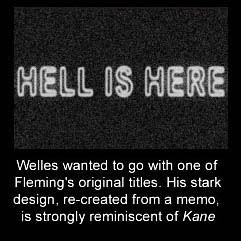
 It's difficult to imagine the '56 Moonraker as anything more than a one-off. For one thing, an X-rating would have done the film few favours at the box-office. For another, it seems unlikely that Bogarde would have been either willing or able to embark on a Bond series in parallel with his Doctor comedies; he was a restless actor, and boredom would soon have set in. And while Welles might not have been above signing up to direct at least one sequel - he always needed the money - he too would probably have found the world of 007 starting to lose its lustre after a time, and his lack of interest would, no doubt, have become increasingly apparent onscreen.
For devotees of the Eon franchise, with its groan-inducing puns, wall-to-wall stunts, globe-trotting scenarios and outlandish gadgetry, Welles' "ripe old slice of blood-and-thunder" might seem like tame stuff indeed. No invisible Astons, not even so much as an ejector seat. Just the one nocturnal car chase culminating in Bond's Bentley being wrecked by rolls of newsprint. Precious little spectacular action, but as much authentic Fleming as those early Eon instalments, when Connery was a sleek, dangerous shark, not the flabby middle-aged businessman his Bond eventually came to resemble.
The secret, Mace and Welles and Bogarde all plainly understood, is STYLE STYLE STYLE, not just stunts stunts stunts. And style we get, all the black-and-white style and atmosphere you could wish for. Cool and chic as 007's cigarette case. For Fleming purists, connoisseurs of the literary Bond - or at at least anyone who thinks the Eon films started going downhill even before Bond stopped sporting a trilby - this forgotten, unfinished Bond-that-might-have-been is a revelation. Never has the weird hermetic dreamworld of Ian Fleming been evoked, in its original '50s designscape, with such astonishing precision and panache.
� Simon Bermuda