| Mythical Creatures: Dragons |
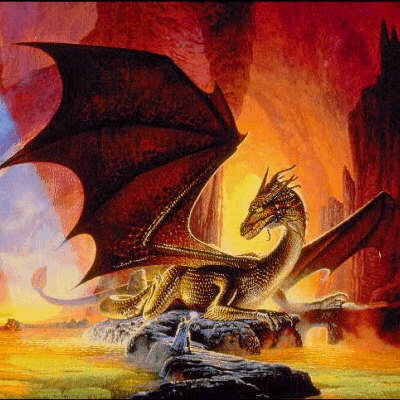 |
| Dragons have been found throughout mythology. In muggle legends they are often creatures of evil, kidnapping princesses and being slain by mighty heroes. Saint George, the patron Saint of England was reknowned for slaying a dragon. A dragon is also found in the Christian bible, representing the Devil in the book of Revelations. Babylonian legends portray the Queen of Darkness as a multiheaded dragon, and even in the child's fairytale, Sleeping Beauty, the evil fairy does battle in the form of a dragon. The truth behind these myths are unknown, although the muggles have certainly put these numerous sightings down to very mundane reasons. Dragons probably got their reputation through their ferocity and size. Throughout the world are hundreds of species of Dragon, each varying in size, shape and colour. They are all, however, defined by their ability to breathe fire to variable distances - the record is sixty foot (though we cannot be sure that this is the very limit)! They are also lizard-like, perhaps the descendants - or even the ancestors - of ancient dinosaurs. Dragons themselves, however, have been around since the beginning of time. It deeply intrigues me how well Muggles have captured the essence of the Dragon; the pictures they draw resemble them remarkably well for a society which refuses to believe in such beings. Dragons are often linked to wisdom; the Greeks and Romans believed in huge, winged reptiles that knew the worlds mystery. The Word of the Dragon is amazingly widespread - it's myth seems to have penetrated all nations - from England to China! The above picture shows the size that a Dragon can reach; this one is a Volcano Ardorbelua, as the name suggests they are found lurking in volcanoes. They can grow to the size of mountains, and when a volcano errupts it is often them spouting flames, or causing a disturbance to the earths crust by moving around. Fortunately, Dragons are known to keep away from people, and sitings of the creatures are rarely taken seriously among muggles. Dragons are usually solitary creatures, though they have strong maternal instincts. Usually two mates part as soon as the eggs are laid. Beliefs that dragons are evil are usually unfounded, as they have little to do with human activity. Interestingly, several studiers of the Dragonkind have found indications that some of this magnificent species are linked to the myths of muggles. The thought that the Dragon is more magical and wise than any of us is profound, yet these respectable scholars have found evidence indicating that this idea is not altogether unfounded. In myth, the dragon knows the earth's secrets. The dragon is a teller of riddles, a deceiver and extremely intelligent. Other names for a dragon include Wyrm, or Great Wyrm, simply Worm, or indeed Winged Serpent (the Serpent is also noted as a symbol of Evil). Perhaps related to the Dragon is the Hydra that in Ancient Greek mythology Hercules defeated. I remain amazed at the diversity of dragon-mythology. It has stretched throughout time, from the time of the Old Testament, to modern day myth and fairytale. The fact that it has touched so many cultures in different ways is also remarkable. Perhaps the common dragons of every day, relatively mundane, as far as any magical creature can ever be, is not the same as the Great Wyrm of myth and legend. A very interesting website is http://www.polenth.demon.co.uk/dragon/fav.html which offers a complete list of all dragons in mythology and fantasy literature, as well as (I believe) films and TV. I definitely recommend it for those interested and with time on their hands. |
 |
 |
 |