What we know about St. Ninian comes from two sources.
The first is St Aelred (Ethelred) of Rievaulx 1110-1167 AD.
The second is the Venerable Bede 673-735 AD

St Aelred was a Cistercian monk, abbot and historian in medieval Briton and France. The Venerable Bede was an English scholar who wrote about early history and produced an encyclopedia called Ecclesiastical History of the English People. in which can be found excerpts from Pliny the Elder (23-79 AD) Pliny was a Roman scholar and encylopedist.
St Ninian also known as the apostle of the northern Britons and Picts. He was born in Galloway and educated in Rome. He had a thirst for knowledge and this brought him to the attention of the Pope, St Damasus, he decided to train the young man himself. When Damasus died he was succeeded by St Siricus, he made St Ninian a bishop and asked him to return to Britain to preach the faith.
On the journey back to Britain he heard of the great work being done by St Martin de Tours (316-397 AD) at his abbey in Marmoutiers. St Ninian visited St Martin and stayed for some time he was encouraged and helped in his work by St Martin who left a lasting impression on him. In spite of enjoying his stay with St Martin, Ninian knew it was time to go home. he returned to Scotland to start his mission.
The first thing to do with the help of some stone masons from St Martin Monastery was to begin work on the church, which was to be the base where he and his monks evangelized the neighbouring Britons and Picts. The church he built in Scotland (397AD) was the first north of Hadrian's wall and it was said to be a whitewashed stone building not like most at the time that were wooden. He named the church Candida Casa (the White House) which became translated by the Picts as "Hwit Aerne" hence the name Whithorn. St Ninian was know for his miracles among them the curing of a chieftain of blindness these miracles lead to many conversion. Following his death the work done by him allowed Christianity to grow in strength.
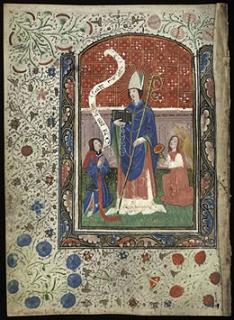
St Ninian preaching to the Picts from the Book of the Hours of the Virgin and Saint Ninian.
A cathedral was built to house the saints remains. His shrine and church became a place of pilgrimages. His shrine in Whithorn has had many visitor including Mary Queen of Scots in 1563, also her father James V had visited and her grandfather James IV who was said to visit often. The cathedral is in ruins, but pilgrimages are still made.
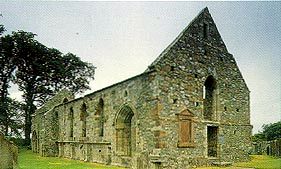
The ruins at Whithorn.
 |
 |
 |

For some lovely web graphics visit Eos just click the link above
for some lovely Celtic designs visit Aon just click the link above