2nd December 1848 - 13thth January 1915

Mary was a Scottish missionary to Nigeria.
Trusted by the locals she was able to spread Christianity and promote women's rights.
Mary Slessor was born in Gilcomston, a suburb of Aberdeen. The second child of seven children. Her father Robert Slessor was a shoemaker by trade and her mother a very religious woman with a sweet nature. In 1859, the family moved to Dundee in search of work. Mrs Slessor became a member of the Wishart church. Mary's father became an alcoholic and was unable to continue work as a shoemaker. He finally took a job in the mill as a labourer. Mrs Slessor was determined that her children had a proper education, Mary as a child not only attended church but also became a "half-timer" at Baxter Brothers Mill. This meant that Mary spent half her day at school which was provided by the mill owners and the other half was spent working in the mill. These were long hard days for a young girl of 11 years but they set Mary in good stead for the harsh work ethics which would later be her life. By the time Mary was fourteen she had become a skilled jute worker. The life of a weaver was a hard one, now working full time, Mary would be up at 5am to do some housework. Mary then started work at 6am and worked until 6pm.
Mary was lucky to have the benefit of her education, she had become increasingly interested in the church and when a mission open in Quarry Pend near to Wishart church, Mary volunteered to become a teacher. This was to start a period in Mary's life where she learned to cope with many hardships. A story is told of how one day she faced a local gang and stood her ground. The gang swinging lead weights on ropes nearer and nearer to Mary's face, this brave young woman stood up to the gang and made an arrangement that if she did not flinch, then all the tormentors would join Sunday school class. Mary won and gain some experience that she would later use when facing tribes during her work. Although Mary lacked confidence in her abilities often describing herself as "wee and thin and not very strong" she eventually applied to the Foreign Mission Board of the United Presbyterian Church. After a brief period of training in Edinburgh Mary set sail on the SS Ethiopia on 5th August 1876 and arrived in West Africa just over a month later full of enthusiasm.
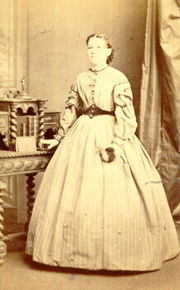
An old photo of Mary Slessor
Mary was there at a troubled and turbulent time, she had arrived not long after Britain had seized the area in order to preserve her trading interests. The cultures and customs of her new flock were mainly centered around witchcraft and superstition. Human sacrifice was still routinely done after the death of a high standing villager and the ritual murder of twins was still carried out to Mary's horror. Her effortless work to stop this irrational superstition was to prove a major success. In this primitive society women were treated lower then cattle, Mary was so successful in raising their standing that you could also say that Mary was one of the pioneers of women's rights in Africa. She spent time learning Efik and soon became fluent in the language. By doing this she was able to use humour and wit as well as sarcasm to reinforce her points and arguments. Unlike most missionaries she lived like a native and not only learnt the language she learnt about the customs and culture and the day to day living. Unfortunately it was not the danger from aggressive natives or wild animals that faced missionaries, Mary and many other missionaries came from reality healthy Western Europe and they arrived in a country where diseases and infections were common place. It was not until 1902 that Sir Ronald Ross who was awarded the Nobel prize for his work on Anophelos Mosquito and how they carried the deadly Malarial Parasite, this knowledge was to late for Mary and her colleagues. The ones that survived would often have fevers and ill health for the rest of their lives. Most missionaries that have survived would normally return home but Mary continued here work despite these bouts of ill health. Mary was always asking the Foreign Mission Board of Edinburgh to fund extensions to her work in the interior. Gradually the money was forthcoming and as new missionaries arrived to take over Mary's work, she was able to move further into the heartland. The illness and hardships that Mary faced was matter of course for her but they had all taken their toll. By 1915, her strength had declined and a woman that spent many a night trekking through the Rain Forests was reduced to travelling in a hand-cart. On the 13th January 1915 after a long bout of fever Mary died.
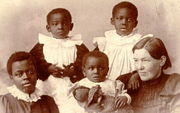
Mary Slessor Pictured with her adopted children
The grave of Mary Slessor , marked with a cross of Scottish granite, is in the heart of the country she served so well. She was accorded a state funeral but the finest tribute was from those of her own who knew her the best. To them she was "Mother of all the people" or simply "Ma"
 |
 |
 |

For some lovely web graphics visit Eos just click the link above
for some lovely Celtic designs visit Aon just click the link above