| HOME | COMM. IN APES | COMPLETED WORK | PUZZLE OF INTENTIONS | SOCIAL CARNIVORES |
Gaze & Point
|
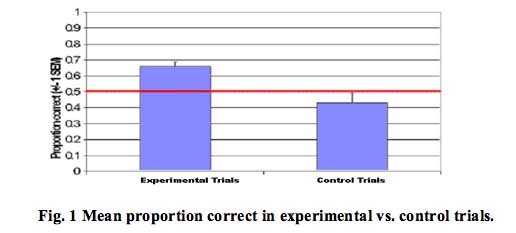
Already Completed Work I received clearance form UCLA's Animal Research Committee (ARC) in 2003 and again from April of 2004-December of 2005, and I have replicated work done by Hare et al. (1999) in two different experiments on dogs as well as replicating this work on domestic cats. My results in replications so far are very similar to those reported by Hare et al. (1999) and others (Miklosi et al., 2004). If one compares the experimental group to the control group, it is fairly obvious that as a group, dogs are performing above chance (with an aggregate 175 correct choices and 89 incorrect). See Fig. 1 below.
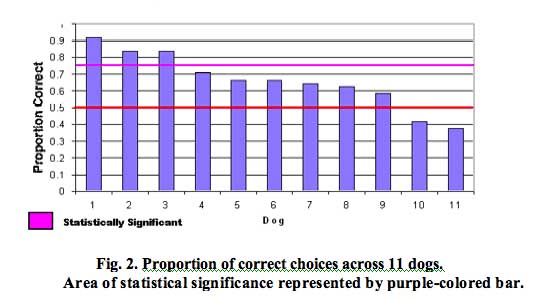
Since phylogenetic comparisons alone can often leave the question of the origin of an adaptation sometimes nebulous, the work by Hare et al. (e.g., 1999, 2002), and others (e.g., Miklosi et al., 2004) has been excellent, but it has also left important questions still unanswered. Unless comparative experiments are done within ecologically meaningful contexts, results may remain inaccurate. This proposed research will pave the way for new and important efforts. In addition to shedding light on the cognitive evolution of inference in humans and domestic canids (both of which have arguably developed similar adaptations to similar ecological pressures), the experiments that I propose to undertake will address several different hypotheses about the design of the mechanism. One hypothesis already appears to have been ruled out by previous research. Namely, the domain-general hypothesis suggests that dogs have been selected to be "smarter" than wolves, across the board. In fact, wolves have been shown to outperform, or perform as well as, dogs on a variety of tasks (e.g., Frank & Frank, 1985). The hypotheses I will address, then, is concerned with what cues the mechanisms involved in point-and-gaze inferences are evolved to use, i.e., the domain specificity of these mechanisms. Conspecifics versus heterospecifics: Is the key change in dogs a change in the category of the individual that is attended to as a source of cues to food? My own data on cats, for example, shows that domestic cats perform similarly to dogs, if the experimenter giving reference cues is quite familiar to the cats (such as the owner). This suggests that though domestication may yet be the selective agent favoring reference ability in cats, the category of the reference-giver may be important. For wolves, the human as reference-giver is most likely not salient. Hypothesis: Wolves do attend to cues given by conspecifics, but not (or to a lesser degree) humans. Dogs have been selected to treat humans as conspecifics in this regard. Intentional cues (reference) versus non-intentional cues (gaze as a cue to attention): There is a difference between cues that unintentionally index the presence of food for example, an individual might look at locations where it knows food is hidden, without specifically intending to provide this information to others and intentional cues, or true reference, such as pointing, in which an individual intends to show another where food is hidden. Only intentional cues, are truly cooperative, and these might be rare in animals such as wolves, but common in both humans and in human-dog interactions. Hypothesis: wolves only use unintentional cues, but dogs use both. Individual differences in skill: Hare et al.'s (e.g., 1999; 2002) results, and my own replication of Hare et al's studies, show significant individual variation in success at the gaze and point task (see Fig. 2 below).
|