| HOME | GAZE & POINT TESTS | PROSODY VS. NATURAL SPEECH | DOGS |
Current Work
|
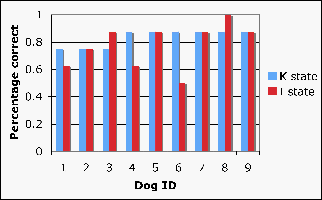
Do Dogs have Knowledge of Knowledge States? After first replicating the Gaze & Point tests on domestic dogs, puppies, leash-trained adult wolves and adult pet cats (see above for links), with similar results in all, I wanted to start exploring just how much animal subjects, in particular dogs actually "understand" with regards to reference. Can dogs mark an informants mental state when it comes to "knowing" or perspective? In this endeavor, I tested 9 dogs across 144 trials with two blocks each. In half of their trials dogs would see, as in the standard gaze & point test, an experimenter hide food behind two bowls, leave only to comeback and point to a bowl. In the other half of their trials dogs observed the experimenter leave and be replaced by another experimenter who came and pointed. Crucially, though they were familiar with the second experimenter, this experimenter was absent at the time the hidden food was placed. In this way I tested whether dogs distinguish between knowledgeable (baiting experimenter) and ignorant (absent experimenter). My initial results suggested dogs cannot or do not make such distinctions, or at least, if they are able to so, do not privilege human informants in this way. My P value was .34. See Fig. 1 below.
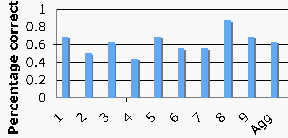
I then however, followed these trials with a follow up study. In the second set of experiments, I decided to test dogs in forced choice experiments designed to distinguish between ignorant and knowledgeable informants. In these, I tested 9 dogs again across 144 trials, this time with the experimenter who hid food walked away, only to come back with the other experimenter (who was absent at the time of food placement). In this way, each experimenter, whether "knowledgeable" or "ignorant" would stand behind and point to a separate bowl. In these tests, dogs did well, with most dogs being above chance and an aggregated score of .63%. (see Fig. 2 below.)
|