 |
| Jaguar |
 |
 |
| 1927 Austin Seven Swallow |
| By 1953, Jaguar engineers had worked in conjunction with Dunlop on a completely new type of brake that had, as yet, only been used on aircraft. The new development was the disc brake and was to be Jaguar's secret weapon upon their return to Le Mans in 1953. With their fade-free brakes the C-types could decelerate at the end of the three and a half mile Mulsanne Straight from speeds of around 150 mph time after time with complete confidence and could leave their braking far later than their rivals. The result was a complete walkover, the Jaguars finishing first, second and fourth. |
 |
 |
|
|
 |
|
| However, the C-type was about to be superseded by the D-type. The D-type was to break fresh ground as it was of largely monocoque construction. The new D-types were taken to Le Mans in 1954 with high hopes pinned upon them. Engine problems early on in the race were traced, rather suspiciously, to the presence of a fine grey sand in the fuel supplied. Further frustration was experienced when one Jaguar was pushed off by a slower competitor and the heavens opened to almost flood the track. After many hours of driving as fast as they dared, during which the D-type ran faultlessly, Jaguar finished just one minute and 45 seconds adrift of the winning Ferrari after 24 hours. Revenge was gained a few weeks later when Jaguar won at the 12 hour race at Rheims. |
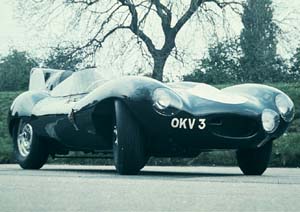 |
| 1954 Racing D - Type |
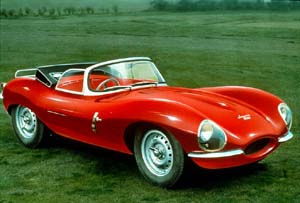 |
| 1956 XK - SS |
| Around this time the very exciting XK-SS, a road-going version of the D-type with refinements, was produced. Amazingly, this was to use up D-type parts which were surplus because of poor sales of that model! However, XK-SS production was abruptly halted after just 16 had been made due to an enormous, and potentially catastrophic, fire at the factory. Luckily damage was reasonably restricted, and with marvellous co-operation from workforce and suppliers, normal production was resumed remarkably swiftly. But the vital jigs for the D-types and XK-SS's had been destroyed. |
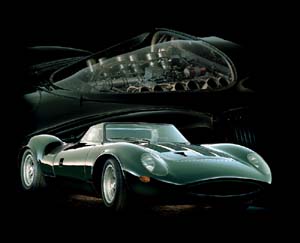
| In 1965, with the Lightweight E-types uncompetitive, a small team including Malcolm Sayer and Mike Kimberley, later to head Lotus Cars, drew up plans for a mid-engined sports racing car. To power it, they designed a four cam V12 of 5 litres. The car, the XJ13, was built in great secrecy in 1966 but there was an unfortunate lack of urgency about the project. It was eventually run in 1967. Sadly it was never to race and has become a museum piece for enthusiasts. The shape was another Sayer masterpiece. Of obvious ancestry, it was one of the most beautiful cars ever conceived, and a lasting tribute to this brilliant man who prematurely died in 1970. |
 |