 |
|
| Jaguar |
 |
 |
| In the British seaside town of Blackpool, a young motorcycle enthusiast named Bill Lyons, not yet 21 years of age, met William Walmsley, who was building a rather stylish sidecar which he was attaching to reconditioned motor cycles. As soon as William Lyons came of age, the Swallow Sidecar Company was formed in September 1922, with a bank overdraft of �1,000. Pioneering the use of aluminium, the very stylish sidecars were immediately popular and production expanded rapidly. |
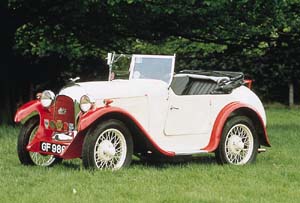
| In 1927, Herbert Austin introduced his baby car, the famous Austin Seven. Intended to bring motoring to the masses, the tiny Sevens were cheap, easy to drive, reliable, but lacked individuality. Lyons saw another opportunity. He created a two-seater body which was mounted on the Austin Seven chassis. An order for 500 was obtained from one of the main London garages and production commenced. At �175, or �185 with a hinged hardtop, the splendid little Austin Seven Swallow proved most popular. |
 |
| Building bodies on other people's chassis constrained William Lyons' creative desires and restricted him to products which were stolid rather than sporting. Although Lyons and Walmsley needed to create their own chassis to suit their ends, the industry was scattered with failures and a cautious approach was necessary. Consequently, Lyons arranged for the Standard Motor Company to build a chassis to Swallow's design but fitted with Standard engines. Thus, the SS I and SS II Coup�s were presented at the 1931 London Motor Show |
| 1927 Austin Seven Swallow |
| In 1935 the 'Jaguar' name sprang upon the scene with a completely new saloon and sports car range having a new chassis, engine unit and a fresh body style. Indeed so different were the new models that it was felt that a new model name was needed. The Company's advertising agency suggested 'Jaguar' and though Lyons took some persuading, it was finally adopted. |
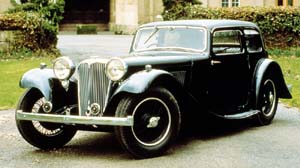 |
| 1935 SS I Saloon |
| After the Second World War, it was decided to drop the SS name (which had acquired an unfortunate war-time notoriety) and to simply call the company Jaguar Cars. Also, soon after the war, the sidecar division was sold. |
| Unveiled at the 1948 Motor Show, the XK120 was destined to become one of the greatest sports cars of all time. The name was based on its top speed, which made it the fastest production car in the world. |
| The Mark VII saloon was unveiled at the 1950 Motor Show. Such was the demand that a larger factory was required and the company moved to the present manufacturing plant at Browns Lane, Coventry in 1951/52 |
| By 1953, Jaguar engineers had worked in conjunction with Dunlop on a completely new type of brake that had, as yet, only been used on aircraft. The new development was the disc brake and was to be Jaguar's secret weapon upon their return to Le Mans in 1953. With their fade-free brakes the C-types could decelerate at the end of the three and a half mile Mulsanne Straight from speeds of around 150 mph time after time with complete confidence and could leave their braking far later than their rivals. The result was a complete walkover, the Jaguars finishing first, second and fourth. |
| In 1951 was born the XK120C (or as the car is more generally known, the C-type). Three C-types were finished just in time for Le Mans. The Jaguars were an unknown quantity and the crowd were watching the Ferraris, Talbots and Cunninghams. However, an amazing 1,2,3 looked possible until an oil pipe flange broke on one car. Then a similar fate befell another car. The third car's luck held however and Peter Walker and Peter Whitehead recorded a remarkable victory first time out for the C-types. |
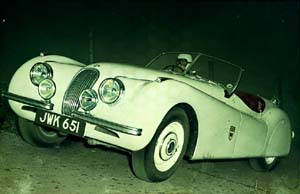 |
| 1949 XK 120 Aluminium Super Sports |
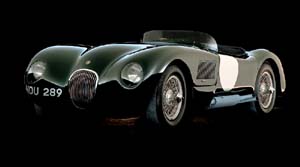 |
| 1951 C-Type |
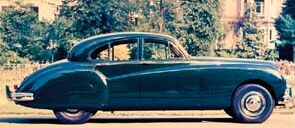 |
| 1950 Mark VII Saloon |
 |
 |
 |
|
|
|