 |
|
| Alfa Romeo |
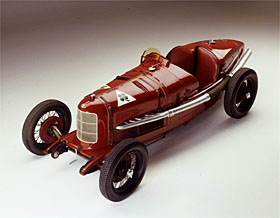
| Engine: inline 8-cylinder, volumetric supercharger Capacity: 1987 cm3 Power: 155 bhp at 5500 rpm Top Speed: 225 Km/h Brief history The legendary P2 was designed by Vittorio Jano and is considered one of the best grand prix racing cars of the 20s. Wins In 1925, Gastone Brilli Peri won the first Racing car World Championship in a GP P2. |
 |
| 2. The Legendary Cars |
| Engine: inline 6-cylinder, 2-lobe supercharger Capacity: 1752 cm3 Power: 102 bhp at 5000 rpm Top Speed: 170 Km/h Body: Zagato Brief history The 1750, designed by Vittorio Jano, was produced in several racing and touring versions. Wins The 1930 Mille Miglia was a memorable victory. Alfa Romeo 1750s swept the top four positions. |
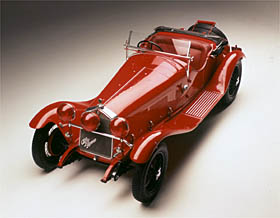 |
| 6C 1750 Gran Sport, 1930 |
| Gran Premio P2, 1924 |
| Engine: inline 8-cylinder, Roots supercharger Capacity: 2654 cm3 Power: 215 bhp at 5600 rpm Top Speed: 232 Km/h Brief history The Tipo B, better known as the P3, was designed in 1932 by Vittorio Jano. This single-seater is considered one of the most beautiful grand prix racers of all time. Wins The Tipo B is a milestone in the sporting history of Alfa Romeo. It remained undefeated from its debut at the 1932 Italian Grand Prix (with Tazio Nuvolari at the wheel) until 1933. |
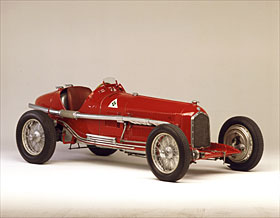 |
| Gran Premio Tipo B (P3), 1932 |
| Engine: inline 8-cylinder, two superchargers, triple carburetors Capacity: 1479 cm3 Power: 425 bhp at 9300 rpm Top Speed: 305 Km/h Brief history The 159 is an evolution of the GP 158 single-seater. Featuring mechanical improvements and sporting a new badge, this car was dubbed the Alfetta because of its smaller size. Wins The 159 won the F1 World Championship in 1951 with Juan Manuel Fangio at the wheel. |
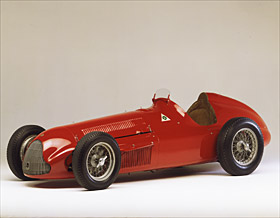 |
| Gran Premio 159, 1951 |
 |
 |
 |
|
|
|