AMERICAN FOOTBALL
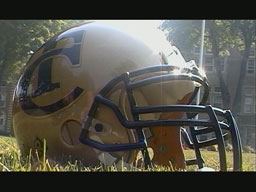
Image Copyright ©2002 Thiel College.
Used with Permission.Introduction
Men of square frame with solid helmets were crushing massive shoulders together in the mud. What are they doing on the field?! Have you ever wondred what American football and its rules are all about? Do you understand why there are so many stops in the game? Why do the players wear protective gear? Why are different players participate in different plays? If you are a foreigner, you might wonder what American football is all about, like me . This paper is definitely for you. The purpose of this paper is to define what American football is all about. I will explain the history, the basic rules, and the equipment.History
In the beginning~~
According to the football website football.com (2002, ¶ 2), the story of football began sometime during the 19th century in England when a soccer player frustrated at using only his feet to play the ball, decided to simply pick it up and run with it. Althought it was clearly against the rules of soccer, other players soon found a new way of playing soccer, and thus, the sport of rugby was born.Nationalizing the Game~~
According to the websites, NFL.com : History and basics (2002, ¶ 2), they said" The first football game between McGill University and Harvard University took the appearance of a rugby game. College football matured through the 1800's in a league of its own until the beginning of the twentieth century when professional football team began appearing. When 1920 arrived, there more than 10 professional teams across the United States. Organizers from the teams decided to meet in Canton, Ohio to form the American Professional Football Association (APFA) which later became the National Football League (NFL)."This is the histroical course of the football association, and college football team started to play origin of American football.The equipment
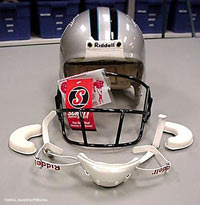
The majority of the football gear the players wear serves one purpose protection. Although most of the pads worn are required by the rules, I will explain each part of the equipment as seen in the picture. The equipment can be categorized by head protection, body protection, and leg protection. I referred to this information from the website, football.com (2002).~Head Protection~
Image Copyright ©1998-2002. HowStuffWorks, Inc.
Used with Permission.is the most important part of the player's equipment. Essentially, the helmet provides protection to the each part of the head.
- The helmet
:Its provides protection to the mouth and teeth from crushing blows to the head, and prevents a player from being knocked out during the game. The mouth piece is form fitted and inserted into the mouth. It is usually attached to the face mask. I will explain about face mask to you next.
Mouth Piece Face Mask :You can see that there is some net thing in front part of the helmet. The face mask protects the player from accidental contact to the face.Face mask style varies depending on player's positions.Jaw Pad :It can be seen in front of the face mask in the picture above, and its purpose is to provide cushioning between the helmet and the jaw area. These pads are attached directly to the helmet.~Body Protection~
When you see players on T.V, don't you think they are enormous?! I thought so, but they wear several sturdy body protection to cover almost whole their bust.Neck Roll : protects the head from whiplash during contact. Shock Pads: provides additional cushion and is worn under the shoulder pads.They absorb some of the impact during contact with their shoulders. Rib Pads : Rib pads are wore to provide protection to the rib area. Basic Rules
There are three units of players that a football team has: 1) the offense , 2) the defense and 3) the special teams. Each team may only have 11 players on the field at a time. The offense has 11 and defense has 11 for a total of 22 players on the field for every play. Pro Football games are divided into four 15-minute quarters, separated by a 15-minute half time break ; there is a 12 - minute intermission called " half time" for players and spectators to rest. Progress in a football game is measured in yards. Any time a team is on offense, it is given four chances or downs, to gain 10 yards. If it advances the ball this distance or more, the team makes a first down, keeping the ball and wins the right to four more downs. A team that fails to make a first down in three tries usually punts the ball down field on fourth down, and the other side gets its chance to go on offense.
OFFENSE : The offense is the team that is moving the ball up the field. Their goal is to score points.
DEFENSE : The defense is the team that doesn't have the football and their job is to keep the other team from scoring. They also can try to take the ball away from the offense by causing the other team to drop the ball or by catching a pass.
SPECIAL TEAMS
Punt (offense team)-- The offense gets four plays to either score or make 10 yards or more for a first down. If after three plays they haven't done that, and they aren't close enough for a field goal, most teams choose to kick the ball back to the other team. This is called a punt.
--- (defense) When offense is punting the ball, the defense becomes the offense. Once the ball is punted and passes the line of scrimmage, the defensive team takes possession.
Field Goal-- In the offense scores a touchdown, they get a chance at a short kick for an " extra point." The same players will come on to the field if the offense is close to the end zone, but can't score a touchdown before reaching 4th down. This is called a field goal and is always worth three points.
--- (defense) When the offense makes an attempt at a field goal or extra point, the defense has two jobs; try to block the kick, and watch for fake kicks that could gain a first down or reach the end zone.Current outgoing research
According to a recent survey of 22 people on American football (Shiho, 2002), almost 92% of people know the rules, and about 60% of people are from the U.S. Although, about 30% of people come from other countries, and I should point out the 26% people don't know the rules. The results seem to indicate that countries except U.S are less interested in the game than people from th U.S. A more detailed survey should provide a better picture of this.CONCLUSION
As I finished writting this paper, I felt the coplexity of American Football again. I tried to explain the rules in an easy to understand way, and i hope you understand the game more. According to my survey, most U.S people like to watch games without regard to age or gender. I probably should say that American Football has became a favorite with Americans, with the introduction of the television which greatly increased football's accessibility to more parts of the United States. Because have been involed in learning about football, I look forward watching the new season. Thank you for visiting my research paper, and Please enjoy watching the games next time.References
Thiel College.edu (2002). Retrieved March 14, 2002, from the World Wide Web: http://www.thiel.edu/athletics/football/01%20JV%20sched.htm.Cawthorne, N. (1987). WORLD PRO FOOTBALL. New Jersey: Chartwell Books, Inc.
Boyer, D.J. (2002). The equipments. Retrieved March 14, 2002, from the World Wide Web: http://www.football.com/equipment/index.shtml.
Boyer, D.J. (2002). Football.com. Retrieved March 6, 2002, from the World Wide Web: http://www.football.com/rulesabc/origins.shtml.
Howstuffworks,inc (1998-2002). How NFL Equipmet Works. Retrieved March 3,2002, from the World Wide Web: http://www.howstuffworks.com/fb-equip2.htm.
Harvard University (2002). History. Retrieved March 8, 2002, from the World Wide Web: http://www.fas.harvard.edu/~athletic/football/history.html.
NFL Enterprises (2001). History and the basics. Retrieved March 5, 2002, from the World Wide Web: http://www.nfl.com/nflforher/history_basics.html.
NFL Enterprises (2002). Football Basics. Retrieved March 16, 2002, from the World Wide Web:http://www.playfootball.com/footballfacts/lesson3.html.
Sports Line.com, Inc (2001). History and basics. Retrieved March 8, 2002, from the World Wide Web:http://www.nfl.com/nflforher/history_basics.html.
Shiho,H (2002). American Football. Retrieved March 14, 2002, from the World Wide Web: http://www.createsurvey.com/cgi-bin/graph?s=3002&magic
.