Paralysis
Neurosurgery is the branch that deals with the injuries of brain
and spinal cord. Here, I would like to explain about paralysis of spinal cord in
details.
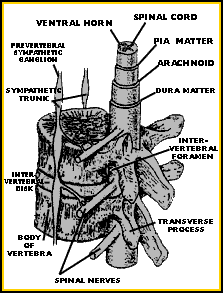 There
are two main types of paralysis, namely, Paraplegia and Quadriplegia. Spinal
Cord Injury (SCI) is some sort of damage to the spinal cord that results in loss
of function, such as, mobility or feeling. Many causes of spinal cord injury are
extreme trauma, such as, car accidents, gunshots, and falls or disease, such as
polio, spina bifidia, and Friedreich's Ataxia.
There
are two main types of paralysis, namely, Paraplegia and Quadriplegia. Spinal
Cord Injury (SCI) is some sort of damage to the spinal cord that results in loss
of function, such as, mobility or feeling. Many causes of spinal cord injury are
extreme trauma, such as, car accidents, gunshots, and falls or disease, such as
polio, spina bifidia, and Friedreich's Ataxia.
With SCI, your injury can be classified as complete or
incomplete. A complete injury means there is no sensation or voluntary movement
below the region of injury. With an incomplete injury sensations and movement of
a limb may be possible under the region of injury. Because advances have been
made in treatment of SCI, there are more and more cases of incomplete injury
rather than complete injury.
A misleading fact of spinal cord injury is if a person breaks
his or her back, it does not necessarily mean that they have merely broken the
bones that protect the nerves within the spinal cord. In this situation,
permanent paralyzation is very rare.
Depending on where a person injures his or her spinal cord,
paraplegia or quadriplegia will occur. Still depending on what exact section of
the spinal cord, you can still have control of different muscles and body parts.
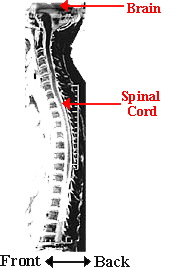 Quadriplegia
involves paralyzation of both arms and legs, while paraplegia effects at least
your legs, but can also effect more than your leg.
Quadriplegia
involves paralyzation of both arms and legs, while paraplegia effects at least
your legs, but can also effect more than your leg.
If a person injuries their cervical nerves, quadriplegia more
than often occurs. Even worse, injuries above the C-4 level may require a
ventilator to breath.
Injuries to the thoracic nerves result in parapelgia and effect
the legs and chest. Injuries to lumbar and sacral nerve regions usually only
result in loss of function in the hips and the legs.
Other effects of SCI are Dysfunction of bowel and bladder, the
loss of involuntary functions including the ability to breathe, low blood
pressure, inability to regulate blood pressure effectively, reduced control of
the body temperature, chronic pain and the inability to sweat below the region
of the injury. another effect that occurs in men and very rarely women is
decreased fertility ability.
Men and women that have suffered from a SCI can have a wonderful
life after recovery. It all depends on the determination of the patient. But,
after SCI, the need to take care their bodies even more than before. They have
to give up certain bad habits. This is because the body is not as strong as
before and it will never be again. An example of a bad habit is smoking.
There are about 450,000 people living with SCI in United States
alone and there are about another 10,000 new victims each year. 82% of these
victims are males between ages of 18 and 30. the main causes of these injuries
are car accidents at 36%, violence at 28.9% and falls at 21.2%.

