One of my other major grips that I had with the article is that while it blast actors like Will Smith, Whoppi Goldberg and Morgan Freedmen for similar crimes, he mentions nothing about his employers, Viacom, (Viacom owns MTV, VH1 and BET) they put extremely stereotypical images of black women on the screen with no remorse. On almost all the channels, Viacom owns, they dedicate hours a day to the mainstream patriarchal gangsta rap. I wonder why he is not stirred by that. You might be saying to yourself, well BET is black owns so it is black people putting black images on the screen. Well if you think that, you are wrong. BET is no longer black owned and black management is less dwindling. Even if it was still black people, putting these images out it still is not right. Maybe you say well the audience for the movie will be mostly white and Black people watch the gangsta rap programs. Wrong again. Gangsta rap is
I also found it odd that when looking at all the reviews that Mr. Hill has done for BET.com he only once mentioned that a movie or show has negative stereotypes in it but he excused it. In his article that can be found here he was lamenting the termination of the drama Platinum. I found this show to be everything that we shouldn�t want on the air. The charters were wooden and stereotypical , the conniving white lawyer, the sassy black women, the thug and the weak white woman. Mr. Hill poo poos this by saying �But the real question is not the representation �� He says that if the show wasn�t glorifying them then it was okay. I ask did Bringing Down The House glorify mammy??? Mr. Hill goes so far to defend these charters saying of one �And while Grady (Sticky Fingaz), a quick-tempered, weed-smoking thug, seemed like more of what we're trying to avoid, "Platinum" gave him layers he wouldn't normally have in the hands of, let's say, "Law & Order." Beneath the gangsta pose, Grady was a caring brother to his younger, perhaps wilder sister and, despite appearances, worked harder than his bourgie brother to get new business. Grady was a clear example that positive images sometimes take longer to develop.� He never mentions that this character uses a rivals wife for sex to get back at for dating his sister, while he is in a relationship with a woman that knows it but has a one-time-cheating is okay policy. How is this character good, no matter how he might come off on other shows , on this show he was a protagonist that used woman and drugs with no responsibility. Is not this one of the terrible stereotypes of Black men? Why is that okay? Then again looking at this patriarchally this character is great; he is dripping with machismo, showing his rival he�s more of a man by having sex with his wife and protecting the virtue� of his sister. The article never mentions the other cast members and their interactions with each other. This lead me to think, when a male dominated show is stereotypical it�s not important, but when the female driven projects contain any stereotypes at all they are awful scourges to our community. Seems like a double standard to me. Then of course the stereotypes in say Platinum are patriarchal women are pawns in power games, men can be violent and abusive without reprimand and all women are decoration. So of course, let�s let that slide.
The main reason that I defend Bringing Down the House is because I do not think that the mammy stereotype was portrayed or glorified. The scenes where racist things were said were not said to try to get the audience to agree with them, all the characters except the racist were disgusted. I think James Hill�s assumption that Queen Latifah was supposed to be large black ugly image I think is also wrong. He is going by a very old definition of beauty to deduce that , he must also believe himself to assume that the audience would a assume so as well. In closing I would like to say that Queen Latifah is one of the few artist today that has ever made black feminism a priority in her music ,books, or even on her talk shows . I can see why her feminist beliefs would lead her to the role. Nevertheless, don�t take my word for it see the movie for yourself.
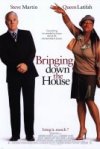
 The movie �Bringing Down The House� opened for wide release on March 7, 2003, yet on December 20, 2002 there were already critics attacking the movie , critics that had yet to even
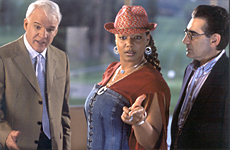
  James Hill reviewed the movie twice, first months before the movie was released based solely on the trailer, and the second when he saw the entire film. One of the things that I noticed in his piece is that as he was showing all the stereotypes he found in the movie he had this sense of being the all knowing of blackness. He also seems to be agreeing to a point with one of the stereotypes. The big black woman + human emotion toward non black people = mammy. Throughout the piece he again and again called Latifah�s character an updated mammy, in case you do not know what that refers to he gives a definition, �large, often dowdy, usually darker, all-knowing, all-seeing, all-hearing, all-understanding" figure whose life is "built around nurturing and nourishing those in the Big House. Because the mammy traditionally worked in the house with White men known for raping slaves, the mammy had to be "desexed . . .lest she appears as a threat or rival to the White [woman] . . . thus her large size and darker color." If you have seen the movie you might find a problem with his accusation, Queen Latifah�s character is not all knowing at all, she�s not a good cook, not good with children, and is not asexual. I also was slightly insulted that he would suggest that a rivalry be common place. Leads one to ask over whom these women are fighting over. Later he recants saying that Queen Latifah is given some sexuality. He is referring to the very embarrassing Eugene Levy, who is very attractive to the much younger Latifah and tries to woo her with Hip Hop lingo he must have picked up from his grand kids. In his Dec,20th review he makes the mistake of assuming that the two character will play the courtship up for comedy because she would �clearly not interested in his advances.� He is wrong, Latifah is at first somewhat grossed out by him but they end up a couple in the end after the Levy character risks his life to help Latifah�s character. Of course he does not comment on the raunchy scene where Latifah�s and Martin�s characters get romantic in the first review. When he does see it he dismisses it as saying �Charlene acts as a surrogate humping-dummy for Martin's libido when she literally offers her bountiful breasts for him to exercise his limp libido on. And why not, we all know nothing genuinely sexual will happen between them. Charlene is Black, after all. Oh sure, the movie plays it off by saying Martin is too distracted by his love for his ex-wife to entertain sleeping with the beautiful Charlene. But cast Julia Roberts as Charlene and Sanderson's ex-wife would be a distant memory.� By saying this is he not feeding off the stereotype that black women can never be attractive to the masses, this must be the effect of the scene because god forbid a black woman be a prize to anyone. I don't really agree that it has to be white woman , if it was any of the young slim black actresses in Hollywood today I'm sure a gritty love scence would have followed. I also think that he fails to see that the Martin character is obviously obsessed with his wife as the woman he set out to meet that is the catalyst to the events in the movies looks just like her. I must say that I don�t agree with his mammy stand point on this film, mostly because she did not bond with the children in the film, or care for the family at. In fact when Martin asks Latifah�s character to pretend to be a maid so he won�t lose his job she is offended by the idea of it, and when she has to do it she extracts revenge by putting ex-lax in his food. I see her as more of an anti-mammy she was indifferent toward the children ( giving a young boy his father's porn to scorn Martin) and was only there to suit her own purposes. She is not slow witted at all, she gets her way despite what the assumed superior Martin wishes. I think there were grievances to make with the movie but he didn�t really make any other than the mammy accusation.
  These videos run unedited on BET; late at night, they play adult videos that are more about the soft pornographic images than the songs. BET airs the videos they do not air on the other channels because of their graphic content. What is his employers trying to say that the mostly presumed mostly young white viewers of MTV should be shielded from certain images and words but the presumed young black audience of BET should not? I think that would be a far more worthy cause for Mr. Hill.
Links
