Water
Filter
Source: O'kelly, Elizabeth, Simple
Techniques for Rural Women in Bangledesh
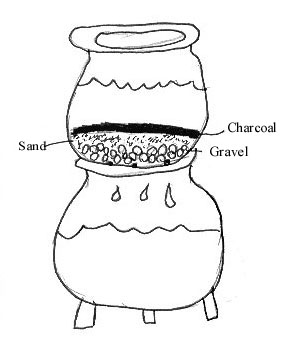
This is a simple water filter. The cloth, rocks and sand screen out particles while the charcoal absorbs other impurities. The sand and rocks should be cleaned, which is probably best done by boiling them for a few minutes. Make sure there is nothing hazardous mixed in the sand, such as manure. Also, it is a good idea to wash out the sand and rocks and replace the charcoal periodically.
Materials:
1 clay jay with holes in the bottom or other large container
1 intact clay jar to catch water from the first jar
clean rocks
clean sand
charcoal
cloth to cover the top
Take the jar with the holes in the
bottom and line the bottom with the clean rocks. On top of the rocks, add
a layer of sand. Finally top this with a layer of charcoal.
Place the jar with the hole on top of the intact jar.
Cover the top jar with the cloth and secure the cloth in place.
To use:
Simply pour the water through the
cloth on top and into the upper jar. Allow the water to collect in the
lower jar and then treat chemically before use.
Nebedayo
Water Purification
Source: Sandhu, Rudy, and Sandler,
Joanne, The Tech and Tools Book
The inner seed
of the Moringa Olifera tree can be used to kill bacteria in filtered water.
One seed is needed per liter of water to be purified. The seeds must be
those that have been collected during the dry season. Wet season seeds
don't contain enough polyelectrolyte to effectively treat the water
You begin by pounding or grinding
the seed into a powder. The powder is mixed with the water, one seed per
liter. The water is stirred for 12 minutes, first quickly, but then slowly.
Let the water then sit undisturbed for and hour. After the hour has passed,
remove the water from off the top and discard the settled sentiment.
Water that has been treated this
way needs to be consumed within a day. If not, then it has to be retreated.
After filtering
Peace corps recommends using 2 drops
of bleach per liter of filtered water. Wait for 30 minutes to an hour before
drinking to make sure enough of the offending microbes have been killed.
If no filter is available
Peace corps recommends adding 6
drops of bleach per liter of unfiltered water if there is an emergency
and a water filter is unavailable. Again, you need to wait half an hour
to an hour before drinking.
If you village doesn't have a closed
well, you can help to prevent water born illnesses by pouring bleach into
the open well. Local sources recommend adding two attaya glasses (about
one cup) every week, or by adding a liter every month. However, even if
these methods are used in your village, it is still necessary to filter
and treat your own drinking water.
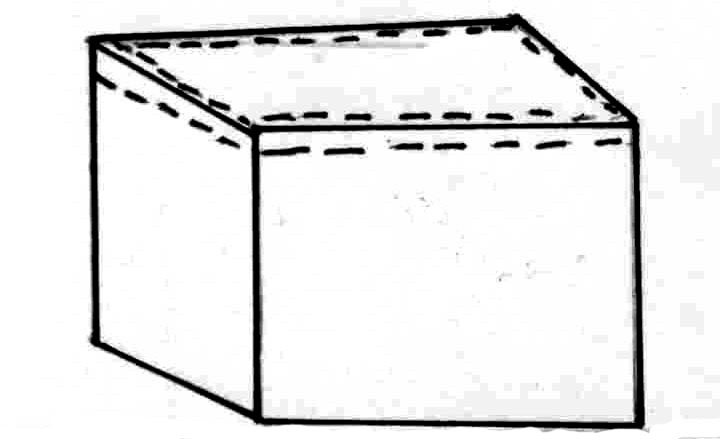
It is possible
to use passive solar power to kill the microbes in untreated water. A blackened
pot, filled with water and covered, can be placed in a clear plastic bag
or a solar box oven. The bag or
oven is needed to block heat loss caused by blowing winds.
My initial concept idea for a solar water distiller looked complex and futuristic. Unfortunately, I forgot a cardinal rule of small scale of appropriate technology: when you focus on looks, you sacrifice function.
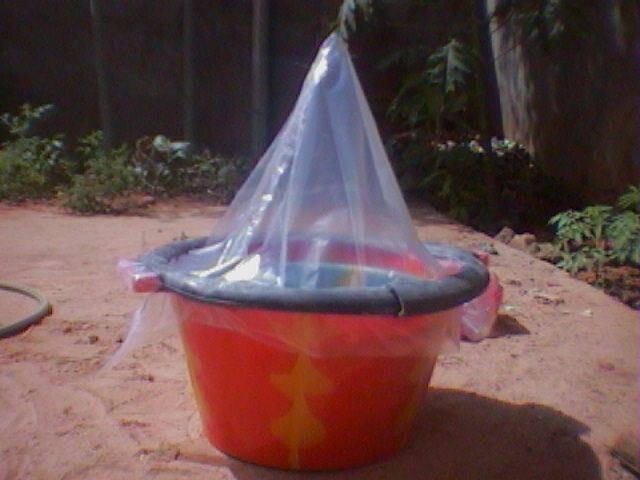
Original Design
It never got more than a tablespoon to be distilled. Though the concept was sound, I had the structure backwards.
A solar water distiller uses sunlight
to slowly heat untreated, dirty water to the evaporation point. The water
collects on the outer structure, condenses and collects in a secondary
container. The water collecting in the second container will be almost
pure water, no toxins, no disease. Impurities are left in the original
container.
This distiller is comprised of two
plastic wash basins, one fitting inside the other. A sheet made of clear
plastic is fastened on top, with a stone or other small weight causing
it to dip inwards. Light enters through the sheet, heats the water, which
collects 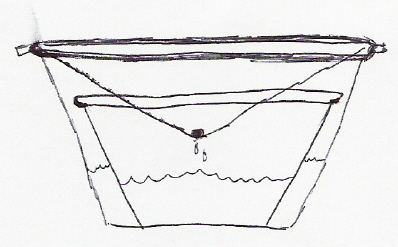 on
the sheet and runs into the smaller, inner basin.
on
the sheet and runs into the smaller, inner basin.
This is easily constructed.
Place the small container inside the larger conatiner. Fill the space
between the two containers with water. Place a clear plastic sheet on top
that is large enough to cover the larger container with a bit of inward
sagging. Make sure the sheet is on securely. Place the rock in the center
and stick it into the sun. check it every few hours.
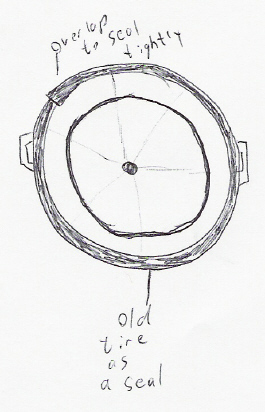
An easy way to secure and seal the sheet onto the containers is with
an old bicycle tire inner tube.
Make sure the inner tube is clean. You may need to scrub it down a
few times.
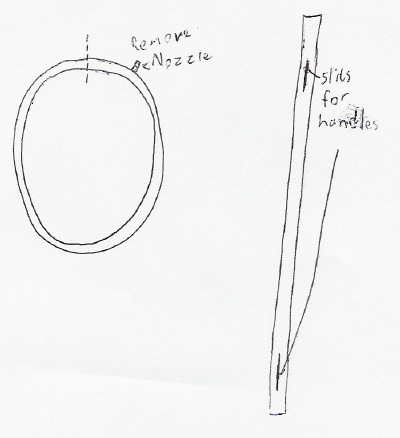
Cut the inner tube to make a long, curved tube. Remove the air nozzle,
and slit the tube along the inner diameter.
If the container you are using has handles along the rim, you can use
the handles to secure the tube onto the system. Cut a slit long enough
for one handle. Wrap the innertube around until you get to the second handle
and cut a slit. since you want this to fit snugly, you may want to actaully
make the cut 1/4 to 1/2 inch short of the handle, so you can stretch the
tire that extra 1/4 to 1/2 inch for a tighter fit. Continue to wrap the
tire around the outer container. If it overlaps, that is good, because
the seal is better. If it overlaps enough to reach the first handle, make
a third slit and attach it to the first handle for a really tight seal.
The great thing about solar
water distillation is that since salt lowers the evaporation point of water,
the distillation process would work exceptionally well with salinized water
sources.