THE DHAMMAPADA
(An Anthology of Verses)
An anthology of 423 Buddhist verses embodying ethical and spiritual precepts arranged by subject.
Translated from Pali by John Richards.
Copyright (c) 1993 John Richards, Pembrokeshire (UK)
The Dhammapada - Information
The Dhammapada is an anthology of verses, belonging to the part of the Theravada Pali Canon of scriptures known as the Khuddaka Nikaya, and consists of 423 verses.
Something like a quarter of the verses are to be found in other parts of the Pali Tipitaka, particularly in the other verse parts of the Khuddaka Nikaya such as the Sutta Nipata and the Thera- and Theri-gatha.
The Dhammapada is probably the most popular book of the Pali Canon, with the possible exception of the Satipatthana Sutta, or the Sutta on the Turning of the Wheel of the Law (Dhamma-cakka-ppavattana Sutta). It is certainly the most frequently translated portion.
Teachings
of the
Buddha
The Dhammapada
He whose victory is not relost, and whose victory no-one in the world can take away, that Buddha, whose home is in the infinite, pathless as he is, by what path will you lead him? 179
He who has no entrapping, clinging desire to lead him in any direction, that Buddha, whose home is in the infinite, pathless as he is, by what path will you lead him? 180
Those wise men, who are much given to meditation and find pleasure in the peace of a spiritual way of life, even the devas envy them perfect Buddhas and recollected as they are. 181
A human birth is hard to achieve. Difficult is the life of mortals. To hear the true teaching is difficult, and the achievement of Buddhahood is difficult. 182
To abstain from all evil, the practice of good, and the thorough purification of one's mind - this is the teaching of the Buddhas. 183
Long-suffering patience is the supreme ascetic practice. Nirvana is supreme, say the Buddhas. He is certainly not an ascetic who hurts others, and nor is he a man of religion who causes suffering to others. 184
Not to speak harshly and not to harm others, self restraint in accordance with the rules of the Order, moderation in food, a secluded dwelling, and the cultivation of the higher levels of consciousness - this is the teaching of the Buddhas. 185
There is no satisfying the senses, not even with a shower of money. "The senses are of slight pleasure and really suffering." When a wise man has realized this, he takes no pleasure, as a disciple of the Buddhas, even in the pleasures of heaven. Instead he takes pleasure in the elimination of craving. 186, 187
 Driven by fear, men take to many a refuge, in mountains, forests, parks,
sacred groves and shrines, but these are not a secure kind of refuge. By
taking to this sort of refuge one is not released from suffering. He who has
gone to Buddha, Dhamma and Sangha for refuge, though, and who with
true wisdom understands the Four Noble Truths of Suffering, the Origin of
Suffering, the End of Suffering and the Noble Eightfold Path, leading to
the Elimination of Suffering, this is a secure refuge, this is the
ultimate refuge; by taking to this refuge one is indeed released from all
suffering. 188, 189, 190, 191, 192
Driven by fear, men take to many a refuge, in mountains, forests, parks,
sacred groves and shrines, but these are not a secure kind of refuge. By
taking to this sort of refuge one is not released from suffering. He who has
gone to Buddha, Dhamma and Sangha for refuge, though, and who with
true wisdom understands the Four Noble Truths of Suffering, the Origin of
Suffering, the End of Suffering and the Noble Eightfold Path, leading to
the Elimination of Suffering, this is a secure refuge, this is the
ultimate refuge; by taking to this refuge one is indeed released from all
suffering. 188, 189, 190, 191, 192
A truly thoroughbred man (a Buddha) is hard to find. He is not born anywhere, but where that seer is born, the people prosper. 193
Happy is the attainment of Buddhahood, happy the teaching of the true Teaching, happy is the concord of the Sangha, happy the training of those in concord. 194
When a man venerates those worthy of veneration, be they Buddhas or their disciples, who have transcended all obstacles and passed beyond sorrow and tears - venerating such as these, whose passions are extinguished and for whom there is no further source for fear, no one can calculate how great his merit is. 195, 196
Happy indeed we live who are free from hatred among those who still hate. In the midst of hate-filled men, we live free from hatred. 197
Happy indeed we live who are free from disease among those still diseased. In the midst of diseased men, we live free from disease. 198
Happy indeed we live who are free from worry among those who are still worried. In the midst of worried men, we live free from worry. 199
Happy indeed we live who have nothing of our own. We shall feed on joy, just like the radiant devas. 200
A victor only breeds hatred, while a defeated man lives in misery, but a man at peace within lives happily, abandoning up ideas of victory and defeat. 201
There is no fire like desire. There is no weakness like anger. There is no suffering like the khandhas. There is no happiness greater than peace. 202
Hunger is the supreme disease. Mental activity is the supreme suffering. When one has grasped this as it really is, nirvana is the supreme happiness. 203
Health is the supreme possession. Contentment is the supreme wealth. A trustworthy friend is the supreme relation. Nirvana is the supreme happiness. 204
After enjoying the taste of solitude and the taste of peace, one is freed from distress and evil, as one enjoys the taste of spiritual joy. 05
It is good to meet with the saints. Living with them is always sweet. By not meeting fools one can be happy all the time. 206
A man who keeps company with a fool, will suffer for it a long time. It is always painful to live with fools, like with an enemy, but a wise man is good to live with, like meeting up with relatives. 207
Therefore, if he is a man of understanding and penetration, learned and habitually moral, devout and noble, one should cultivate the company of that just and wise man, in the same way as the moon keeps to a path among the stars. 208

He who applies himself to what is not really an appropriate subject for application, and fails to apply himself to what is, missing the real purpose to grasp after what appeals to him, may well envy the man who does apply himself. 209
Never have anything to do with likes and dislikes. The absence of what one likes is painful, as is the presence of what one dislikes. 210
Therefore don't take a liking to anything. To lose what one likes is hard, but there are no bonds for those who have no likes and dislikes. 211
From preference arises sorrow, from preference arises fear, but he who is freed from preference has no sorrow and certainly no fear. 212
From affection arises sorrow, from affection arises fear, but he who is freed from affection has no sorrow and certainly no fear. 213
From pleasure arises sorrow, from pleasure arises fear, but he who is freed from pleasure has no sorrow and certainly no fear. 214
From sensuality arises sorrow, from sensuality arises fear, but he who is freed from sensuality has no sorrow and certainly no fear. 215
From craving arises sorrow, from craving arises fear, but he who is freed from craving has no sorrow and certainly no fear. 216
Well may people hold dear the man who is endowed with morality and insight, who is well established in righteousness, a seer of the truth, and applying himself to his own business. 217
He whose longing has been aroused for the indescribable, whose mind has been quickened by it, and whose thought is not attached to sensuality is truly called one who is bound upstream. 218
When a man who has been away a long time at last comes home safely from far away, his family, friends and acquaintances rejoice to see him back. In the same way, when a man who has done good goes from this world to the next, his good deeds receive him like relations welcoming a loved one back again. 219, 220

17. Anger
Abandon anger, give up pride, and overcome all fetters. Suffering does nor befall him who is without attachment to names and forms, and possesses nothing of his own. 221
When a man governs his rising anger like a chariot going out of control, that is what I call a charioteer. The rest are just holding the reins. 222
Overcome anger with freedom from anger. Overcome evil with good. Overcome meanness with generosity, and overcome a liar with truthfulness. 223
Speak the truth, don't get angry, and always give, even if only a little, when you are asked. By these three principles you can come into the company of the devas. 224
Those sages who do harm to no-one, and who are always physically restrained, go to the everlasting abode, reaching which they will face no more suffering. 225
Inflowing thoughts come to an end in those who are ever alert of mind, training themselves night and day, and ever intent on nirvana. 226
It was son of old, Atula. It is not just so today. They criticise him who sits in silence, they criticise him who talks a lot. They even criticise him who speaks in moderation. There is not a man in the world who is not criticised. 227
There never has been, there never will be, and there is not now any man exclusively criticised or exclusively praised. 228
If a wise man of unblemished behaviour and endowed with wisdom, morality and stillness of mind, is praised by the discriminating after day in day out acquaintance with him, like a pure gold coin, then who is fit to find fault with him? Even the King of the devas praises him. 229, 230
Guard against physical unruliness. Be restrained in body. Abandoning physical wrong doing, lead a life of physical well doing. 231
Guard against mental unruliness. Be restrained in mind. Abandoning mental wrong doing, lead a life of mental well doing. 232
Guard against verbal unruliness. Be restrained in speech. Abandoning verbal wrong doing, lead a life of verbal well doing. 233
The wise who are restrained in body, speech and mind - such are the well and truly restrained. 234
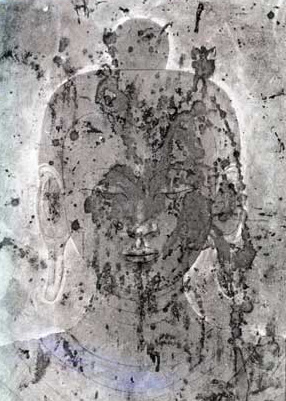
 You
are now like a withered leaf. Death's messengers themselves are in
your presence. You are standing in the jaws of your departure, and
provisions for the road you have none. 235
You
are now like a withered leaf. Death's messengers themselves are in
your presence. You are standing in the jaws of your departure, and
provisions for the road you have none. 235
In such a case, build yourself an island. Make the effort quickly and become a wise man. Cleansed of your faults and now without blemish, you will go to the heavenly land of the saints. 236
You are now at your life's conclusion. You are in the presence of the King of Death. There is no stopping off place on the way, and provisions for the road you have none. 237
In such a case, build yourself an island. Make the effort quickly and become a wise man. Cleansed of your faults and now without blemish, you will come no more to birth and aging. 238
Little by little, moment by moment, a wise man should cleanse himself of blemishes, like a smith purifying silver. 239
Just as the rust which develops on iron, derives from it but then proceeds to eat it away, so a person of unrestrained behaviour is drawn to hell by his own actions. 240
Lack of repetition is the blight of scriptures. Lack of repairs is the blight of buildings. The blight of beauty is laziness, and carelessness is the blight of a guard. 241
The blight of a woman is misconduct. The blight of a giver is meanness. Bad mental states are indeed blights in this world and the next. 242
But the supreme blight, ignorance, is the blight of blights. Destroying this blight, be free of blights, bhikkhus. 243
Life is easy enough for the shameless, the crow-hero type of man, offensive, swaggering, impudent and depraved. But it is hard for the man of conscience, always striving after purity, alert, reserved, pure of behaviour and discerning. 244, 245
When a man takes life, tells lies, takes what he is not entitled to in the world, resorts to other men's wives and indulges in drinking wine and spirits - such a man is digging up his own roots here and now in this world. 246, 247
So understand this, my man - Unrestrained men are evil. Don't let greed and wrong doing subject you to lasting suffering. 248
People give according to their faith, or as they feel well disposed. If one is put out for that reason with other people's food and drink, then one will not achieve stillness of mind in meditation, day or night. But he who has destroyed that sort of reaction, has rooted it out and done away with it - he will achieve stillness of mind in meditation, day and night. 249, 250
There is no fire like desire. There is no hold like anger. There is no net like ignorance. There is no river like craving. 251
Other people's faults are easily seen. One can winnow out other people's faults like chaff. One hides one's own faults though, like a dishonest gambler hides an unlucky throw. 252
When one notices the mistakes of others and is always finding fault with them, the inflow of one's thoughts just increases and one is a long way from the cessation of this influx. 253
Just as there is no path in the sky, there is no man of religion outside. Other people take pleasure in multiplicity, but the Buddhas are free from it. 254
Just as there is no path in the sky, there is no man of religion outside. There are no lasting functions of the mind, but there is no oscillation of mind for the Buddhas. 255
One is not righteous if one decides a case without due consideration, but the wise man who takes into account both for and against, and comes to his decision about others with due consideration - such a man of discrimination who keeps to the truth, he is to be called righteous. 256, 257
One is not a learned man by virtue of much speaking. He who is patient, without anger and fearless, he is to be called learned. 258
One is not a bearer of the teaching by virtue of much speaking, but he who, even if he has only studied a little, has experienced the truth in person, he is indeed a bearer of the teaching, who has not forgotten the teaching. 259
One is not an elder by virtue of having white hair. One is just advanced in years, and called "grown old in vain". He in whom there is truthfulness, non violence, restraint and self control, however - that wise and faultless sage is to be called an elder. 260, 261
It is not just by fine speech or by flower-like beauty that one is admirable, if one is envious, mean and deceitful, but when that sort of behaviour has been eliminated, rooted out and destroyed, that faultless sage is said to be admirable. 262, 263
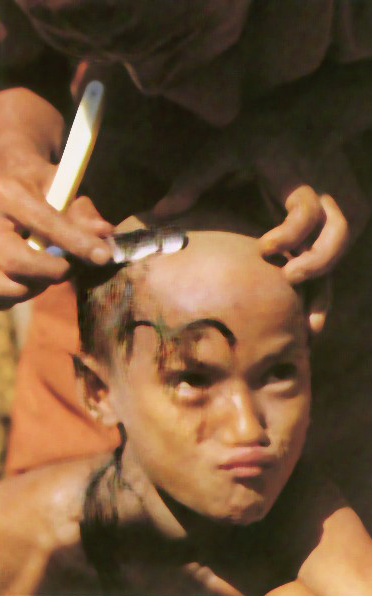 A
shaven head does not make one a man of religion, if one is irreligious and
untruthful. How could a man full of desires and greed be a man of
religion? But when a man has put aside all evil deeds, both great and
small, by that putting away of evil deeds he is indeed called a man of
religion. 264, 265
A
shaven head does not make one a man of religion, if one is irreligious and
untruthful. How could a man full of desires and greed be a man of
religion? But when a man has put aside all evil deeds, both great and
small, by that putting away of evil deeds he is indeed called a man of
religion. 264, 265
One is not a bhikkhu by virtue of taking alms from others. By taking up any old teaching, one is not a bhikkhu on that account. But he who has here and now ejected both good and evil, and in leading the holy life lives in accordance with reason - he is indeed called a bhikkhu. 266, 267
Silence does not make a sage if he is stupid and ignorant, but when a man avoids evil as if he were choosing something of value on the scales - he is a sage. That indeed makes him a sage. He who discriminates in both worlds is for that reason called a sage. 268, 269
One is not noble if one harms other living creatures. It is by non violence to all forms of life that one is called noble. 270
It is not just by means of morality and religious observances, not by great learning nor by attainments in meditation, nor by living alone, nor by thinking," I am enjoying a spiritual happiness which ordinary people do not know" that a bhikkhu achieves peace if he has not achieved the elimination of inflowing thoughts. 271, 272