
WINE PAGE
There are 57 wine regions that extend over Australia. Each has a unique climate and environment however all enjoy a common trait - the desire to produce high quality Australian wine that in the envy of the world, and they are succeeding. Here you will find all you need about the most popular wine regions of Australia. There a few dominate regions in Australia, and these are Coonawarra, Barossa Valley, Hunter Valley, Yarra Valley, McLaren Vale and Maragret River. There are others but these are the main ones to look out for and they are all displayed further on:
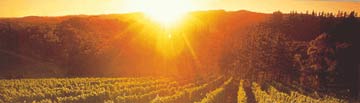
It is easy to underestimate the brilliance of the Barossa Valley, Australia's premier wine region. The wonderful character of the region is mainly due to the influences of the Lutheran German settlers of the area and their descendents who are fiercely proud of their heritage.
Many of the German settlers had been involved in viticulture in their homeland and soon planted vine cuttings that they had brought with them from Europe. Significant amongst these plantings were those made by John Gramp at Rowland Flat (the beginnings of the now monstrously huge Orlando Wyndham) and those of Samuel Smith at Angaston (the beginnings of Yalumba).One also cannot leave out Joseph Seppelt's plantings in 1851 - Seppelt's now being part of the hugely successful Southcorp Wines.
Many of the vineyards of the region have been owned and worked by the same families for five or so generations, with some of the Shiraz vines reaching over 100 years of age. Shiraz, however, is not the only variety to have a long history in the Barossa - many Grenache and Semillon vines are well over 50 years old. Every two years the region hosts it's famous Vintage Festival, with a week of celebrations beginning of the Easter Monday. Added to this, the fantastic annual gourmet weekend attract thousands of visitors, with the participation of local and Adelaide based restaurants and musicians. Whether it is for one day or many, the Barossa has a marvelous range of activities to offer the wine enthusiast who wants to see what all the fuss is about first-hand.
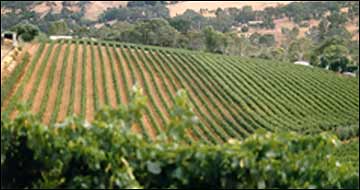
McLaren Vale has both complex, rich soils and mild, temperate climate that produce its full-bodied red wines. The shiraz of D'Arenberg, Chapel Hill, Tatachilla and others are legendary stuff. The region also produces high quality wines from sauvignon blanc and chardonnay grapes, as well as outstanding vintage and tawny ports. This region really does produce something for everyone!
The Wine Bushing Festival is now legendary, with both famous and up-and-coming winemakers crowned the 'Bushing King and Queen' named at the annual winemaker's luncheon. The Continuous Picnic on the October long weekend and the Sea & Vines festivals provide a wonderful opportunity for Adelaideans to taste the glorious wines of the region - all just 45 minutes from the Adelaide CBD.
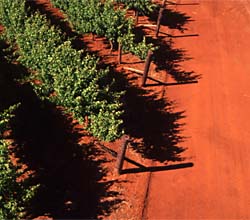
Coonawarra is one of the most renowned region in Australia, famous for intense Cabernet Sauvignon. It is a good four-hour drive south of Adelaide and six hours west of Melbourne. Set on a series of ancient coastal dunes along a limestone ridge, Coonawarra is very similar to Napa Valley, though slightly cooler.
The hidden geological treasure of porous limestone under the rich terra rossa soil creates the ideal cellar by storing water for later use. From these gifts of the earth, the winemakers create their distinctive signatures in wine. Weather, soil and biological influences all impact on grape quality. Coonawarra is blessed with a confluence of soil, climate, underground water and highly skilled viticulturists who enhance what nature has provided.
Coonawarra was the first cool-climate viticultural region to gain national prominence. With no maritime influence whatsoever, the winters are cold, wet and windy, and throughout much of the growing season, the night-time temperatures are likewise low. Frost used to be a major problem, but viticultural adaptation has significantly reduced the danger. The annual rainfall is 647 mm, 282 mm of it falling between October and April - continuing the winter-spring pattern across southeast Australia - necessitates the use of supplementary water from December onwards. In almost all vintages Coonawarra receives intermittent bursts of very hot weather in February-March. The other climatic problems in a basically favourable climate are wind and rain during flowering (frequently upsetting merlot and sometimes cabernet sauvignon) and mid- to late vintage rains, impacting particularly on riesling and shiraz.
Coonawarra's pre-eminent position as Australia's greatest red wine region today stands in stark contrast to Bill Redman's famous dictum: 'From 1890 to 1945 you can write failure across the face of Coonawarra.' For much of that time most of the wine was distilled into brandy, while in the 1930s the South Australian government implemented a mini Vine Pull Scheme, offering all ex-servicemen in the area a bounty of four pounds and ten pence an acre (0.4 hectare) for removing their vines and converting the land to dairying.
Indeed, there is every reason to argue that 1951 should be substituted for 1945, for in the intervening period what is now Wynns Coonawarra Estate was nearly sold to the Department of Lands and Forests. Had that occurred, the only working winery would have been the then tiny Rouge Homme of the Redman family. It was in 1951 that David Wynn made his fateful decision to buy the now famous stone winery and cellars which had been built with such hope and enterprise by John Riddoch exactly 60 years earlier. Until this time the only table wine made in Coonawarra was Redman's Shiraz, which had been sold in bulk to Woodley Wines since 1920. Woodley bottled some of the wine, and sold the rest in bulk to other South Australian wineries. From 1952 Redman started selling to those companies direct, while continuing to supply Woodley with its requirements for bottling (and which gave rise to the famous Treasure Chest series).
Thomas Hardy, Reynella and Leo Buring and Yalumba were among the first purchasers of Redman's wine; in 1953 Ronald Haselgrove of Mildara joined the queue, and - unable to purchase as much as he needed - commissioned Bill Redman to find a suitable vineyard block and develop a vineyard. This was done in 1955, and Penfolds followed suit in 1957. The quest for land was on in earnest, and has still not run its course.
More than that, the unrelenting pressure is now causing problems which even Ronald Haselgrove did not foresee when in 1955 he observed that 'within 15 years every major wine company will be clamouring for Coonawarra vineyard land'. For the whole thrust of viticulture in Australia serves to deny the French view of terroir and of the importance of soil. Yet in Coonawarra there exists a classic example to support the French view.
Coonawarra boasts the most celebrated vineyard soil in Australia, commonly known as terra rosa, a distinctive, albeit thin, band of at times vivid red soil 100 cm to 500 cm deep overlying a bed of soft limestone. In truth there are two technically different soils which are treated as one and the same; a subplastic medium clay and shallow friable loams. On the western side of the terra rosa strip are black cracking clays falling in the Ug group which overlie limestone, but which are fertile and prone to waterlogging. Experience has shown it is extremely difficult to obtain full ripeness on these soils, and many of the plantings are now devoted to sparkling wine production. On the eastern side of the strip are duplex sandy soils over a clay base.
Dr Sam Benwell once said about the position of the Coonawarra: 'It lies between Melbourne and Adelaide, but never quite on the way between the two cities, no matter which way one goes.' It is completely flat, and one can drive through its 15 kilometre length without seeing anything much other than some vines. It is bitingly cold in winter, and can be fiercely hot in summer. The township of Coonawarra is a general store, a phone box, a small but pleasant restaurant and one or two insignificant buildings (all on a side street). The wineries are functional but little more; only Wynns Coonawarra Estate vies - albeit handsomely - with what is commonplace in, for example, the Barossa Valley. But it is the Mecca to which pilgrims must travel'.
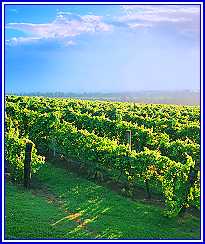
The Lower Hunter Valley, only a short three-hour drive north of Sydney, is arguably one of Australia's best-known wine region. The region enjoys a warm to hot sub-tropical climate not normally suited to producing quality table wine-cooling afternoon sea breezes are the region's savior. Originally making its name for long-living Chardonnay, Semillon and Shiraz, the Hunter Valley also produces a substantial amount of the trendier Chardonnay and Sauvignon Blanc varieties. Many boutique wineries, trendy restaurants, bed and breakfasts, and art and craft shops have sprung up over the last ten years, catering for the many tourists and Sydney wine lovers who venture north to this picturesque area.
The majority of the vineyards are situated on the extreme southern side of what is a broad and relatively flat valley, nestling on the foothills of the Brokenback Range. With few exceptions (notably Mount View) the hills are gentle, gradients modest, and aspect not of great significance. The soils are as variable as the climate, some (the friable red soils and greyer alluvial sandy loams) well suited to viticulture, some (heavy, acidic clays) conspicuously not. Overall, they restrict vine vigour and reduce yields - and in so doing, provide some of the magic quality of the region's best wines.
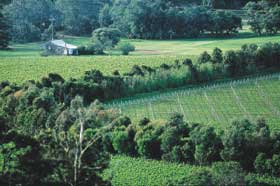
After a much publicised birth in the early 1970s, prompted in part by research by Professor Harold Olmo but more importantly by that of Dr John Gladstones in 1965, the Margaret River seemed to briefly lose its momentum in the latter part of the 1980s before emphatically regaining it in the 1990s. Today it is one of the most vibrant - and popular - wine regions in Australia, with an exceptional range of restaurants, places to stay and things to do and see. Initially regarded as a producer of powerful yet elegant Cabernet Sauvignon, it has since also forged a great reputation for its white wines (notably Chardonnay and Semillon Sauvignon Blanc), but in truth is capable of producing all the classic varietal wines.
The Margaret River coastal wine region, three hours south of Perth, is blessed with a temperate climate, high rainfall and good soils. Vines were first planted here in the late 1960s by Dr Tom Cully of Vasse Felix, Dr Bill Pannell of Moss Wood and Dr Kevin Cullen of Cullen's, all of whom have gone on to produce some of the best wine in the region, and Australia. There are about 40 wineries in the Margaret River region now, focusing on Cabernet Sauvignon and Chardonnay, as well as Semillon and Sauvignon Blanc.
The landscape constantly varies, given character by the abundance of small creeks and gentle valleys, as well as by the profusion of native trees, shrubs and flowers. In physical terms a degree of protection from sea wind is the most important factor. The principal soil type is that of the ridge which runs from Cape Naturaliste to Cape Leeuwin; it is predominantly gravelly or gritty sandy loam formed directly from the underlying granite and gneissic rock. The soil are highly permeable when moist, but quickly shed moisture from sloping sites, and overall water capacities are low, placing additional emphasis on the need for irrigation.
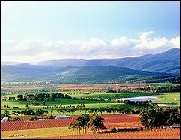
The Yarra Valley, a cool-climate, low-yielding wine region, is an hour east of Melbourne in the rolling foothills of the Great Dividing Range. The region's cold winters and fertile soils help make Chardonnay, Pinot Noir, Cabernet Sauvignon and sparkling wines at home here. The region's winemaking history dates to 1840, but the large plantings now producing great wines began in 1968 at the Yarra Yering, Yeringberg and Fergussons wineries. The French company Moet & Chandon, seeing the district's potential for sparkling wines, established the Domaine Chandon winery here in 1985. As more wine lovers discover this region on Melbourne's doorstep, the number of excellent restaurants and luxury boutique hotels and lodges available here continues to grow. However, beware of the tourist buses and the crowds, as wineries have decided to cash in and charge the wine taster's $2 for a taste of their wines. How I long for no commercial wines and just the local people growing their small plot of vines and making the wines special and unique. So try the smaller wineries where there are no buses parked out the front, these are the ones that will surprise you.
The topography is as varied as that of any wine region in Australia, ranging from river flats or terraces through to some of the steepest slopes to be found in Australia, equalled only by those of the Adelaide Hills. On the steeper slopes, aspect is of great importance, with north facing slopes strongly preferred. There are two basic soil types: the 'traditional' areas on the northern side of the valley which are grey to grey-brown in colour on the surface and range from loamy sand to clay loam in consistency. They have red-brown clay subsoils, frequently impregnated with rock. Most are relatively acidic and low in fertility, but are well drained. The other major soil type is the immensely deep and fertile red volcanic soil to be found at Seville, Hoddles Creek and elsewhere on the southern (Warburton) side of the valley.
All information from above came from the following links, if you need further information on wine click on them to discover more: Premiumwine, Aus Cellar Door, Wine Tours and Wine Pros.
