|
CROCHET
LESSONS BEGINNING
I will be doing a column on Crochet. I will take you step by step and hopefully
in easier terms so you can learn to make something by the end.
This is an overview of upcoming progress to an end that will allow you to make
this:
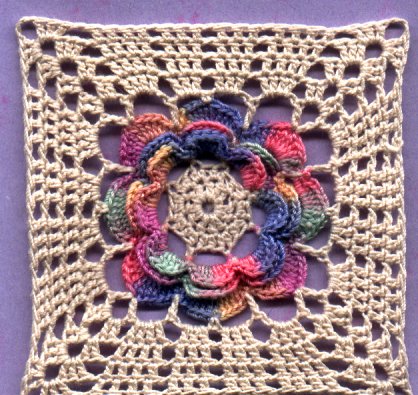
*Note: This may look complicated but it is only 5 basic stitches: single,
double, chain, half double and slip stitch. so don't panic..lol..I will help you
step by step.
I used this design using 4ply yarn to make an afghan for my parents 50th
anniversary and now using thread 10weight to make a bedspread. Same pattern
different weights thus producing a different and beautiful look.
We will learn terminology and how to do each one.
We will then proceed to the next step in actually using those stitches in the
project shown above. Nothing complicated yet! You will end up with something
very special made by you! Eventually going into more intricate designs. Motifs
are very popular in that you can put them together for anything you choose such
as: place mats, table cloths, linens, dishcloths, dishtowels, bedspreads, table
toppers, coasters, runners and the list goes on. The advantage of making your
own is of course you can see the success of your accomplishments and everyone
that sees it just adds more to the pride in making it yourself.
The motif above will be our ongoing project until it is done. Again, this motif
uses just 5 terms: SC (single crochet), DC (double crochet) SL (slip stitch), HD
(half double) and CH (chain) and just look how beautiful it turns out. So see,
you don't have to be a rocket scientist to make something gorgeous!!!!.
Here are some hints on finding the right needle for yarn/thread:
Crochet hooks, which are made of steel, aluminum, or wood, come in many sizes,
each suited to specific-size thread or yarn. The thicker the yarn, the bigger
the hook you will need. It is helpful to have an assortment of sizes so you can
adjust your gauge easily as you begin to follow pattern directions.
The smallest hooks, used primarily with fine, lace-weight threads, are steel.
The sizes are numbered from 00 through 14. The larger the number, the smaller
the hook; and the lower the number, the larger the hook.
Aluminum hooks are larger than steel hooks and are sized by letters. C is the
smallest, K is the largest. aluminum hooks are used more frequently than steel
or wooden ones because they are suitable for working with most yarns.
Wooden hooks--used with thick yarns--come in sizes Q, R, and S. If the yarn
snags on the hook as you work, sandpaper the tip.
Next issue will be Matching Hooks to Yarns and Threads and Maintaining the
Tension and Gauge
Next issue will be the basics of getting started. I look forward to sharing all
this with you.
Suggestions and Questions are welcome, just email me: [email protected]
Thanks and good luck to you all; so go out and get the yarn/thread and needle (I
use #7 for thread) (for yarn usually H, F, or J) and lets get started.
Submitted by
Marge Calaway
|