Tuchuk
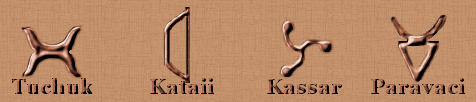
Slaves of the Tuchuk are not branded with the cursive K or Kef normally seen in the cities, they are branded with the sign of the four bosk Horns arranged to resemble an H.
This brand is said to be about an inch high and is performed by an Iron Master. The Iron Master incidently, also affixes the females of the Wagons with their nose rings.
The standard of the Tuchuk is also the sign of the four bosk horns.
Kataii
The brand of the Kataii is a bow facing to the left.
The standard of the Kataii is a yellow bow bound across a black lance.
Kassar
The brand of the Kassars is a representation of the bola. It has three circles joined at the centre by lines.
The standard of the Kassar is a scarlet bola hanging from a lance.
Paravaci
The brand of the Paravaci is a representation of the head of a bosk, a semi circle atop an inverted isosceles triangle.
The standard of the Paravaci is also the representation of the bosk head and horns, made from golden wire that has been strung and beaded with jewels.
"I supposed that on the morrow Kamchak would call for the Tuchuk Iron Master, to brand what he called his little barbarian."
"On the way we passed a girl, a girl from Cos taken hundreds of pasangs away in a raid on a caravan bound for Ar. She had been bound across a wagon wheel lying on the ground, her body over its hub. Her clothing had been removed. Fresh and clean on her burned thigh was the brand of the four bosk horns. She was weeping. The Iron Master affixed the Turian collar. He bent to his tools, taking up a tiny, open ring, a heated metal awl, a pair of pliers. I turned away. I heard her scream."
REF: Nomads of Gor pages 62, 106, 173
The Wagon People do not have castes like much the rest of Gor. The men of the Wagons are expected to be Warriors although there is no 'red caste' among them. They are all expected to be accomplished at tending the bosk, hunting and riding, these are seen as their primary duties.
There are among the Wagon Peoples many clans that specialize in different areas such as leather workers, healers, singers (also known as skalds), year keepers, salt hunters, scarers, torturers, iron masters and so on.
First and foremost though, these men are Warriors and herders.
It is noted that the Wagon People are the only culture on Gor to have a clan of professional torturers, highly trained in the art of detaining life. Many of these men have earned great fortunes in their specialty, being hired by the likes of Initiates and Ubars for their works in persuasion and detection. Those of the clan of torturers wear hoods, it is said they only remove the hood when a person is sentenced to death, in this act it is only a condemned man who may see their face.
Bosk
The bosk are the Wagon Peoples lifeblood, with them the Wagon People could not live. They are huge ox-like animals, their wide heads bearing two long curved horns, somtimes said to be as long as two spears in length, which terminate into fearful points, an intimidating sight when you add their intent yet tiny red eyes to the picture. Bosk are also said to have a wicked temper to match that of a sleen.
The bosk is revered, the Mother of the Wagon Peoples. One who would kill a bosk foolishly is often met with a painful death such as strangulation in thongs and sometimes suffocated in the Bosks hide of which he killed. The killing of a bosk cow carrying unborn young leads to the offender being staked out alive before the path of the herd, to be trampled to death as the People make their way past.
The Wagon People use not only the flesh and milk of the bosk to survive. Almost every part of the bosk is used in some form or another, its hide to furnish the wagons, the skins are used for clothing, its leather covers thier shields. The bosk horns are split and used for many things, some of those being horns for drinking, spoons, weapon tips and various other tools. Hooves are used for glues, the sinew used for thread and its oils are used during wintering to cover the peoples bodies against the cold. Travelling the treeless plains finds the People lacking the use of wood, so even the dried dung of the bosk has its use as fuel.
REF: Nomads of Gor pages 4- 5
Wagering and Games
The Wagon People love to gamble and will do so on just about anything. They have been known to wager whole herds of bosk and countless slaves on such simple things as whether a tospit has an odd or even amount of seeds, which way a bird may fly when startled, they even have spitting contests. It is considered a great honour for a woman to be at stake during such gambling.
Love War
Each spring the ancient Games of Love War is held between the Wagon Peoples and Turia. During the Games of Love War many merchants and judges, some from as far away as Ar are granted safe passage for the duration of the festivities, there is also an unofficial truce between the four tribes themselves and between the tribes and Turia.
The Games of Love War pits the Turian warriors against those of the Wagons, the prize being the free women of the opposing side. It takes place not far from Turia on the Plains of a Thousand Stakes.
Each stake is seperated by around thirty feet with two lines of stakes opposing each other, equally numbered on each side and seperated by fifty feet or so. The stakes themselves are said to be six and a half feet high and seven or eight inches in diameter. They are decorated brightly and bear retaining rings which are bolted near the tops of the stakes, the key hangs here also awaiting the victor to unshackle and carry off his prize. Each stake is numbered with First Stake being the most beautiful of her people. It is between each pair of stakes in a circle of raked sand approximately twenty four feet in diameter that the contests take place. If you are reading this and it doesnt reside on the seven quivas site it has been stolen without permission and those who copy and paste dont often read what they steal in full because they are lazy and incompetent.
Only the best of warriors can compete with only the most beautiful women being used as prizes. About two hundred warriors from each tribe of the Peoples attend with around the same amount from Turia. The warriors from each side may view the women before the contest begins, with the Turian women, who wear their robes of concealment often having their veils unpinned so the People may view clearly the woman they choose to fight for.
Each year the sides alternate the opportunity to choose which weapon will be used in battle.
A warrior may withdraw from the contest after the weapon has been chosen but before his name is entered onto the official scrolls.
Each woman has a pre-selected champion from her own side to fight on her behalf. It is to be noted that if two warriors from the same side wish to contest for the same woman, the one with the greater number of scars or rank wins the honour. A warrior is also entitled to know who champions a woman before deciding to contest for her.
After each fight the winner takes possession of his prize, leading her away in chains.
The woman who was championed by the victor is returned to her People with all honour intact.
The overall winner of the Games of Love War is the side which wins more of their opponents women with this result varying from year to year.
Spear Gambling
In this wager the tem wood lance is thrust into the earth as the warriors circle on their kaiila, the lance being highly flexible will naturally quiver, the padding of the circling kaiila increasing the sway until it tips and finally falls. The warrior the lance points to is the winner. This is a far more serious wager than most and is commonly used when a stranger enters the lands of the Wagon People. The winner is entitled to make the kill.
Running for the Lance
This game is all about speed. It begins with the slave in the circle of a bosk whip, her goal is to run to a lance which is driven into the earth about 400 yards away all the while evading capture. She is given a headstart of 15 heartbeats of a standing kaiila which is considered enough time to reach at least half way to the lance.
A warrior mounted on a kaiila chases, his goal being to bring the slave down with his bola, tie her and return her to the starting circle in the quickest time.
If the slave manages to break free, slip her bonds or even loosen them the warrior is disqualified. The winner is the warrior with the fastest time.
Some slaves are highly trained in evading the bola, it is known that any slave who fails to do her best may be sent to one of the torturers and this tends to assure the girl will try her best.
This game is akin to the more informal 'Running to the City', in which the Tuchuk takes his Turian slave girl within the sight of the cities walls and has her run to them, if she reaches the walls before being re-captured she is free. The slave never reaches the gates. Unlike in the running for the lance these slaves are only given a few seconds headstart before being brought down in amusement by their captors.
Lance and Tospit
This game has two variations.
In the first a tospit is balanced on a wooden stake or wand, the goal is for a rider to pierce the tospit cleanly with his lance as he thunders past on his kaiila, a lighter hit where the fruit is only penetrated by the lance tip is worth three points, a heavier hit where the lance goes cleanly through is worth two. If the tospit is missed, tumbles to the ground or is split it is worth no points.
The second and more dangerous variation of this game replaces the wooden stake with a slave girl holding the tospit in her mouth. She can either be standing facing the lance or to the side. No points for missing here either though a lot more mess.
REF: Nomads of Gor 20 22 60 - 82
112 113 115 116 117 149 150
Zedojehn 2002
| General Rules | Slave Rules | Site Map |
| Wagon People | Cyberisms | Drinks | Foods | Quote Menu | Slave Pages |
| Musings Menu | Links | About | Index |