Puebla/Cholula
See Inset Map of Downtown Puebla
History of Cholula and Puebla
PRECLASSICAL PERIOD
People settled at Cholula around a pond located under the present pyramid in the late centuries BC. Cholula is therefore one of the oldest continuously- occupied cities in the western hemisphere perhaps the oldest. The original settlers were part of the Olmec cultural sphere of influence: technology pottery and cult rituals.
CLASSICAL PERIOD
The city and the pyramid grew during the time of the Teotihuacán empire. Much of the pyramid shows the talud-tablero style of construction that prevailed then and which was very common at Teotihuacán. However, plumed serpents and other emblems of Teotihuacán are missing so it is likely that Cholula was politically independent. In any case, Cholula shrank in size when the Teotihuacán empire collapsed under the pressure of northern invaders around 600, no doubt being subject to the same forces. The pyramid was abandoned.
POSTCLASSICAL PERIOD
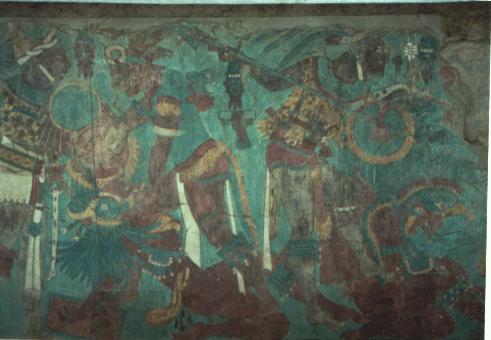
Wall Mural at Cacaxtla
After that Cholula was taken over by Putún Maya, also known as Olmeca-Xicalanca because of their association with a place called Xicalanco which still exists near Ciudad del Carmen. These invaders also built Cacaxtla; the famous murals there show a close affinity with Mayan art of that period. Things picked up in the 10th century. The famous Toltec King Topiltzin, also known by his title Quetzalcóatl, stopped at Cholula while he was fleeing from a military revolt at Tula. Legend says he was looking for water and found it at a spring under the present San Juan Aquiahuac Church. With or without the legend, he had a good reason to go to Cholula; he had been High Priest/Ruler at Xochicalco before assuming the role of Toltec King and as such must have known the Putún-Mayan rulers personally. They, in turn, would have been glad to augment their army with Topiltzin's followers. After twenty years Topiltzin moved to the Putún Maya capital at Chichén Itzá, where he became the dominant ruler of the Yucatan Peninsula. In 1292 Nahuatl-speaking tribes including remnants of the Toltec nation invaded Cholula and took it over. In 1359 it was conquered by the nearby town of Huexotzingo. When the Aztecs became powerful in the 15th century Cholula chose to ally with them, rather than be attacked, and joined on some Aztec expeditions. This exacerbated its rivalry with Tlaxcala, twenty miles to the north, which chose to resist the Aztecs.
THE CONQUEST
In 1519 Hernando Cortés came to Cholula with a large army of Tlaxcalans who camped outside town while Cortés and his soldiers put up in a palace located on the west side of Blvd Miguel Alemán between 5th and 7th Streets. He wanted the Cholulans to help him attack Tenochtitlán. They sent a messenger to Montezuma asking what he would think if they killed the Spaniards. Montezuma didn't have a problem with that so they drew up a plan to surround the palace and attack. However, Cortés's girlfriend and translator, Malintzin, learned of the attack from a friend she had made, a Cholulan official's wife. She reported the plan to Cortés, who called the Cholulan officials into the palace for a meeting. They took their bodyguards with them and once they were inside the Spaniards locked the gates and started killing the bodyguards. Cholulans outside heard what was going on and started their attack, hoping to save the officials. The Tlaxcalans heard the commotion and ran into the town glad of a chance to kill Cholulans. Caught between Spaniards in the palace and Tlaxcalans outside, thousands of Cholulans died, until the officials surrendered and agreed to help Cortés attack Tenochtitlán.
POST-CONQUEST PERIOD
After the conquest the Spaniards tore down Cholula's many temples and replaced them with churches. They built Puebla rather than try to modernize Cholula and Cholula turned into a small town with a lot of churches. Puebla inherited Cholula's religious conservatism. In a way, Mexico's history has been a struggle over the amount of control the Church would have over the Mexican people. In the War of Independence the Church sided with the royalists and the closest the rebels got to Puebla was nearby Atlixco, which successfully stood Morelos off. During the American invasion of 1846-47 the Church openly sided with the Americans and encouraged the people to rebel against the government; in that war Poblanos were predominantly pro-American. A few years later in 1858 the Church started a war to overthrow the government; Puebla was a pro-Church stronghold during what now is called the War of the Reform. The Church and Puebla welcomed the French Imperialists in 1862. The Mexican Army's greatest victory was in stopping the French outside Puebla on May 5 of that year. But the French returned a year later; the pro-French Poblanos were starved and bombarded for two months until the Mexican garrison surrendered. The Revolution of 1910 began in Puebla when 21 Madero supporters were killed in a shoot-out at the house of Aquiles Serdán in 1910; the revulsion many Mexicans felt was an important factor in the downfall of Porfirio Díaz. In July of 1911, some revolutionary soldiers supporting Emiliano Zapata occupied the bull ring. On the 12th they arrested some politicians on suspicion of plotting to murder Madero. Federal troops stormed the bull ring; 50 people died, including women and children. Rebels occupied the city for a few days in December 1914 and January 1915 and were driven out by Government troops with some loss of life on both sides.
MORE ON THE CINCO DE MAYO BATTLE
May 5: 5432 Mexicans under Ignacio Zaragoza block 6000 French under Count Charles Ferdinand Latrille de Lorencez at Puebla. First attack: four French battalions attack Forts Loreto and Guadalupe from the northeast; Mexican infantry supported by artillery in the forts drives them back. Second attack: five French battalions attack Guadalupe; same result. Third attack: two French battalions sweep around to the east of Guadalupe; Porfirio Díaz leads a counter-attack and stops the French advance. The French lose 476 dead 345 wounded; the Mexicans lose 83 dead 132 wounded 12 missing.
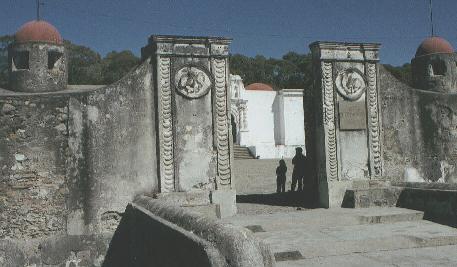
Fuerte Loreto
MORE ON THE AQUILES SERDAN SHOOTOUT
Nov 19: Soldiers and police shoot up the house of Aquiles Serdán a shoe manufacturer who organized workers in support of Madero. Serdán kills Chief of Police Miguel Cabrera but Serdán his brother Máximo and 19 other supporters die and his sister Carmen is wounded. By Dec 20 most of the country is seeing rebellion.
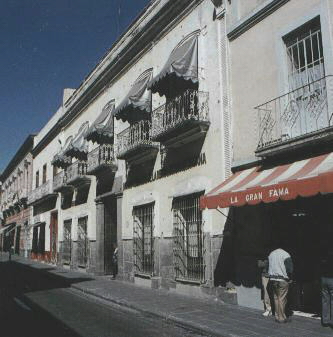
Aquiles Serdán House
A FREE Mexican history reference is available online!
REFERENCES
A. Site Museum Cholula
B. Mexico: From the Olmecs to the Aztecs 4th Edition by Michael D. Coe. New York: Thames and Hudson 1994.
C. History of the Conquest of Mexico by Henry B. Parkes. New York: Bantam Books 1964 (originally 1843).
D. Museo de la No-Intervención Puebla
E. Museo Casa de Aquiles Serdán Puebla
F. "Mexico Has Been Turned into a Hell" by William O. Jenkins. The Mexico Reader by Gilbert M. Joseph and Timothy J. Henderson. Durham: Duke University Press 2002.
G. Womack, John Jr. Zapata and the Mexican Revolution. New York: Vintage Books, 1968.