
| MAIN PAGE | MY PROFILE | MY STATS | MY NEWS | MY GAMES | MY HONORS |

INTERVIEW: SAKESAN PITURATANA
 ver the past decade, as Thailand have dominated football in Southeast Asia, the list of names that have guided the nation to the top of the region's game is one that makes illustrious reading for any fan within the region.
Players such as Piyapong Pue-on, Natipong Sritong-in and Kiatisuk Senarnuang are spoken about in hushed tones, their names said with a reverence bordering on the religious among the football-mad Thais. It is players such as the aforementioned trio, as well as the likes of Surachai Jattarapatarapong and Dusit Chalermsan, who have guided Thailand through what has been the nation's most successful footballing decade. In addition to their massive haul at regional level -they have won the SEA Games gold medal four times in a row, and the inaugural Tiger Cup in Singapore in 1996 -the Thais have played in the finals of the last two Asian Cups and reached the semi-finals of the Asian Games in 1990 and 1998. Much of this success can be credited to the country's prolific line of goalscorers. Now, there's a new name that looks set to be added to that list. Enter 20-year-old striker Sakesan Pituratana, a shaven-headed bulldog of a striker whose tenacious spirit and eye for goal have marked him out as a more than capable replacement for the greats of Thai football. With Piyapong now finally retired and Natipong prematurely joining him when he became disillusioned with the game several years ago, Sakesan is the new star in town. Hailing from Mae Hong Son in the famed Golden Triangle region in Thailand's north, the Sintana striker took the Thai league by storm in his first season in 1998, finishing as top scorer and being named the league's Most Valuable Player.
From there the progression was rapid. After playing at all youth levels for Thailand, Sakesan was soon being touted for a position in the full national team. it was only a matter of time before the call came and when it did he was ready, fulfilling his dream of not only playing for his country but also playing alongside his striking heroes. "I had one chance to play with Piyapong but there was such a big gap between us," says the Sripatum University student. "I also played twice with Natipong - he was a great striker, especially in the sixyard box and in the air. They taught me a lot. "I copied a lot of things from them. Piyapong is great at shooting with both his left and right foot, while Natipong can score a lot of goals from close range and from heading. Piyapong can bring his experience to the Olympic team and teach the players a lot. "I also learned a lot from 'Zico' (Kiatisuk Senarnuang's nickname). He taught me about the importance of good control. He can control the ball so well and his dribbling is great." As Sakesan points out, Piyapong has now moved into coaching and, after several years working with the Airforce club in Bangkok, the former international striker is now hoping to guide Thailand to the Olympics in Sydney next year. Thailand last qualified for the Olympic Games in 1968 (in Mexico City), when Japan went on to win the silver medal. Ironically enough, Japan, along with Kazakhstan, are one of the nations standing in Thailand's way in the final round of the Olympic qualifiers. Says Sakesan of his opponents: "All I know is what I've read from the newspapers. I think that some of the players on the teams will be from the under-16 and under-19 sides that I've faced in the past so I'll know a few of the Japanese, though I know nothing about the Kazakhs.
"To me the SEA (South East Asian) Games is more important in some ways to us than qualifying for the Olympic Games. The people back home know we can win the SEA Games and expect us to win it, but in the Olympics, if we lose they will understand because of the standard. "I'm sure the Olympic team will start to improve when we all come together and I'm sure eventually we can become one of the top nations in Asia. If we can't dominate South East Asia then we lose everything and we're not going to improve." The Thais have been far-and-away South East Asia's top footballing nation and in recent years they have started to make their mark at age-group level. In 1997 they finished as runners-up in the Asian Youth Under-16 Championship, and two years later went one step further by lifting the title in Qatar after a penalty shootout victory over the hosts. As the national association continues to make great strides in developing the country's youth system, Sakesan looks like becoming the first product of that set-up to make a significant impact on the international stage. And the gradual progression through the ranks has benefited his development, says the youngster. "When I played in the youth team we only played in a few tournaments a year, but when I made the move up to the first team I started to playing a lot more, especially outside of the league. There are some differences but I can survive because I'm moving up step by step - from the under-16s, to the under-19s, then to the Olympic team and the full national team. So there's been a gradual progression. "Last year no-one knew me and as a result it was a lot easier to score (in the league). But now they know me and it's become a lot more difficult. But it just means I have to work harder to score."
Despite becoming famous within his homeland for his striking capabilities, Sakesan didn't actually start his football career playing up front. "The first time he played for my team he played as a defensive midfielder," says former Sintana coach Dr Vichai Pituvong, who guided Sakesan through his first two years in Thailand's professional league. "It was a good position for him but in Sintana we decided to improve his game. We trained him to play as an attacking midfielder and sometimes we would put him up front and even as a sweeper! The first time he played as a striker he scored twice!" After making such an impact for Thailand, the questions are already being asked about how Sakesan compares to the nation's former striking sensations. Kiatisuk reckons that, in time, Sakesan will become "a very dangerous striker". But while the forward is keen to follow in the footsteps of players such as Natipong and Piyapong, he's also out to prove that he is his own man. "Natipong and Piyapong were great players and I'll try to do my best to be like them," he says. "I'm still only 20 and I can still improve and learn to score more goals in every tournament I play. I can't compare myself to those players. "I'm trying to improve myself as far as skill and tactics are concerned and I'm sure I will learn a lot from the coaches that I will be working with. I've already learned a lot from Piyapong - but I'm not Piyapong or Natipong. I will try to learn more things to improve myself and I'll try and score more goals."
|

 |
|

|
|

|
 SPECIAL THANKS TO: Footballasia.com
| INTERVIEW | PHOTO ALBUM | FAN'S CORNER | FORUM | LINKS | CONTACT ME |
Copyright 2002, All rights reserved.

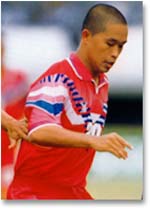 Thailand's Sakesan is the new star in town
 The Sintana striker took the Thai league by storm in his first season in 1998, finishing as top scorer and the league's Most Valuable Player.
 Sakesan's gradual progression through Thailand's various youth set-ups has given him a solid platform on which to build his career.
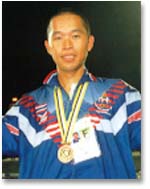 SAKESAN PITURATANA