 |
| Self Injury affects a wide variety of people, including some well-respected and successful celebrities. Listed below are a few that have gone public with their SI and have shared their stories. |
| Angelina Jolie Angelina Jolie, a young actress who has starred in Girl, Interrupted and Tomb Raider, was born in 1975 to famous parents, both actors. She grew up in Los Angeles and studied at the Lee Strasberg Theatre Institute. She appeared in five student films for her filmmaker brother, James Haven Voight, as well as in music videos for the Rolling Stones, Meat Loaf, the Lemonheads, and Lenny Kravitz. Angelina had a short modeling career with Finesse Modeling Agency, in which she appeared in numerous fashion layouts. In 1996, at the age of twenty, she got married to Jonny Lee Miller, a British actor, while wearing a white shirt with her fiance's name written on it in her blood. The two got divorced two years later. In May 2000 she got married to Billy Bob Thornton. In June 2001 Rolling Stone she said that during her very early teens she started "thinking about not wanting to be around. It was when the reality of life set in, the reality of surviving." Also, Angelina used to hurt herself during her early teens but stopped around the age of sixteen. She explained in a 2000 Maxim article, "You're young, you're crazy, you're in bed and you've got knives. So shit happens." But in 1999 Access Hollywood interview she explained it more in-depth, "I was..trying to feel something....I was looking at different things..thinking romantically about...about blood. I really hurt myself," and also said, "I was just....a kid. I was like 13, And, I was saying that it is not something that is cool. It's not cool. And I understand that it is a cry for help..." In a 2000 Jane interview she said, "This person asked me about cutting myself when they saw a scar. I'm very open, but because of that, people think that they know everything about me, and, actually, they don't know anything. I say things that other people might go through. That's what artists should do - throw things out there and not be perfect and not have answers for anything and see if people understand. But this person made the cutting sound interesting, like it was something I do now. (For the record, she did, but doesn't now, and doesn't endorse it.) And then I met somebody who said they'd seen movies of mine and then showed me where they had cut themselves. I had to explain, first off, not to do that. But it made me really fucking angry at the people who represent me in a way that would get that person to do that and show me. I don't understand why people would want to use something so damaging. It's like, let's make me look 'cool' and worry a lot of people in my family." Angelina has the Japanese symbol for "death" tattooed on her shoulder, and the Latin words, 'Quod me nutrit me destruit,' on her stomach, meaning "What nourishes me also destroys me." Angelina Jolie no longer hurts herself as a way of coping but she freely admits to using knives during sex play. Article and interviews indicate that she is a much happier and more content individual than she was earlier in her life. |
 |
 |
| Christina Ricci Christina Ricci, an actress since childhood, was born in Santa Monica, California to a lawyer-psychiatrist father and real estate agent mother in 1980. Her parents divorced when she was thirteen. She was discovered at the age of seven and a year later made her screen debut in Mermaids (1990), in which she played Cher's daughter. She showed herself to be a talented, adult actress in the movie, The Ice Storm, in which she played a sexually precocious fourteen-year-old. Christina, a compulsive talker and smoker, is known for her outspokenness on a large number of controversial topics. In a US magazine interview Christina explained a small, smile-shaped scar on her hand. "I was trying to impress Gaby (Hoffmann, her best friend). So I heated up a lighter and pressed it on my hand." She revealed other burn scars on her arms and said, "I wanted to see if I can handle pain. It's sort of an experiment to see if I can handle pain." In a SPIN magazine interview she revealed that she sometimes would put out cigarettes out on her arms. When asked if it hurts she replied, "No. You get this endorphin rush. You can actually faint from pain. It takes a second, a little sting, and then it's like you really don't feel anything. It's calming actually." In a 1998 Rolling Stone interview she explained where each scar came from. When she was angry about "not looking very good" Christina heated up a lighter and held it to her hand to impress some boys. Scratches on her forearms came from fingernails and soda tops. She explained, "It's like having a drink. But it's quicker. You know how your brain shuts down from pain? The pain would be so bad, it would force my body to slow down, and I wouldn't be as anxious. It made me calm." Christina also developed anorexia when she was fourteen but has since recovered. In a 1999 Mademoiselle interview she said, "In a way, I was trying to get rid of my breasts. Everyone my age wanted them, so it was like, whoo-ooo. Then I started hating them. And for all of my movies, I was supposed to be younger, so I'd have to strap them down." When looking back on her self-injury the same interview Christina said, "when I was younger, I did self-mutilate. I'd be upset, so I'd do it, and it would calm me down. It's a horrible way to feel better. But there are two parts of your brain - one that really wants to destroy the other. And sometimes the idea of self-destruction is very romantic. I got over that." |
 |
|
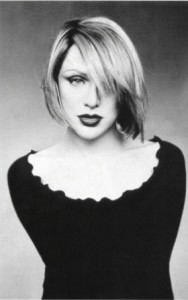
| Courtney Love Courtney Love, outspoken and often times controversial singer and actress, was born in San Francisco in 1965. Her parents, who have been living a hippie lifestyle, bitterly divorced when Courtney was only five. As a child she was diagnosed as being autistic and went to therapy for several years. She went wild during her teenage years and was expelled from school at the age of fourteen for drinking alcohol, had many conflicts with teachers and had several minor shoplifting offenses. At the age of sixteen she dropped out of high school. Courtney formed her band, Hole, in 1989 with her friend, Eric Erlandsen. She married Kurt Kobain, the lead singer for Nirvana, in early 1992. Kurt killed himself in 1994. There was some controversy because there are rumors that Courtney killed him, she has denied it. Courtney went through a period of self-injury; she would cut herself on stage. While talking about Kurt's overdoses in a 1995 SPIN interview she said, "Some people OD. I've never ODed, ever. I've gotten really fucking blasto, but instead of ODing, I chatter and start talking too much, screaming and running around naked and getting hysterical, cutting my arms, you know, crazy shit. Breaking windows. But I never have fallen on the floor blue." She said in a 2000 SPIN interview, "I have many (self-destructive bones), and I've broken a bunch. I think self-destructiveness is given a really bad rap. I think that self-destructiveness can also mean self-reflection, can mean poetic sensibility, it can mean empathy, it can mean a hedonism and a libertarianism and a lack of judgement." |
 |
|
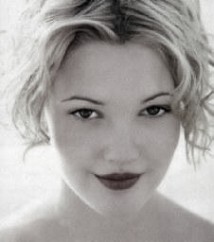
| Drew Barrymore Drew Barrymore was born in Los Angeles in 1975, her parents part of the famous Barrymore family. Great grandfather Maurice Barrymore, grandfather John and father John Drew, were actors who spent all their money on alcohol and women. Drew says, "They were all out of their minds. I love that they lived hard and passionately. Maybe the chaos and craziness goes with all that passion, you know? It makes perfect sense about how I am." Drew was three years when she first met her father; he threw her against a wall in an alcoholic rage. Drew talks about her father, saying, "I really love him. I hated him while I was growing up. He was an abusive asshole. But now that I've grown up, I do love him. For a crazy person, he's the most intelligent, fascinating man I've ever met, but he is crazy. Oh my God, he's insane!" Drew was eleven months old when she starred in her first commercial, one for puppy food. At age seven, she became a hit because of her role in E.T. Her life began to go downhill soon after. Drew first got drunk at age nine, smoked marijuana at age ten, and snorted cocaine at age twelve. She tried to commit suicide at age thirteen by slashing her wrists with a butcher knife. After that all-time low, she entered rehab, not for the first time, but this stay was successful. To celebrate her triumph over drugs, Drew emancipated herself from her parents' control at age fifteen. A year later, she published her autobiography, "Little Girl Lost." Drew began starring in sexually-loaded films and modeled for Guess? jeans. Slowly, she began showing herself to be a great actress and has become a famous star. Drew Barrymore explains how she looks at herself, saying, "I know I'm not ugly, but I don't think I'm a pretty girl. I'm very critical of myself, definitely. There's one thing about my body that I truly, truly hate. I hate my arms! I have really fat arms! They're like sacks! I always really wanted those long, lanky, thin, model-like arms, but I don't have them. There's nothing I can do about it." She admits that she occasionally has periods of depression. "I used to get into wallowing depressions that would last for months. So, like, fucking Camille-esque, you know? Now they're very sporadic." |
 |
|
| Elizabeth Wurtzel Elizabeth Wurtzel, author of "Prozac Nation" and "Bitch," was born on July 31, 1967, in the middle of the Summer of Love. Her parents divorced before she turned two, and her father would sleep through all her visits. Her mother was over-protective and usually unemployed. She describes herself as being a "golden girl" until she turned eleven, a time when she first broke down. "When I was ten or eleven, I really cracked up, started hiding in the locker room at school, crying for hours, or walking around the corridors saying, 'Everything is plastic, we're all gonna die anyway, so why does anything matter?' I'd read this phrase in a picture of some graffiti in a magazine article about punk rock, which I decided was definitely a great invention. When I stopped talking, stopped eating, stopped going to school, and started spending my time cutting my legs up with razor blades while listening to dumb rock music like Foreigner on a little Panasonic tape recorder, my parents agreed I needed psychiatric help. To make a very long and complicated story short, my mom found a therapist for me, my dad didn't like him and kept trying to sneak me off to others, I never got terribly effective treatment, my father refused to file an insurance claim for the psychiatrist I was seeing, and the whole scenario concluded with me as messed up as ever, but with all the adults involved suing one another. My mom sued my dad for unpaid alimony and child support, my psychiatrist sued my dad for unpaid bills, and after years of lawyers everywhere, my father finally fled to Florida when I was fourteen years old and did not turn up in my life again until my freshman year at Harvard." Elizabeth was clinically depressed. During her college years she had a series of breakdowns and drug abuse. Finally, she attempted to kill herself in her psychiatrist's bathroom and ended up in a psychiatric hospital. She began taking Prozac, one of the first individuals to take Prozac. She told how it helped her, "Something just kind of changed in me...I became all right, safe in my own skin...One morning I woke up, and I really did want to live...The black wave, for the most part, is gone. On a good day, I don't even think about it any more." Elizabeth wrote a memoir of her struggles with depression, "Prozac Nation," and a book that describes the history of manipulative female behavior, "Bitch: In Praise of Difficult Women." She has written articles and for various newspapers and magazines. In 2000 she revealed that she had become addicted to Ritalin and cocaine during the years after "Prozac Nation," but had checked herself into a clinic where she became clean. In a Daily Telegraph article she said that she is no longer depressed but still has some anxieties. Elizabeth Wurtzel described her cutting in much better words than I would be able to do: "I guess the cutting began when I started to spend my lunch period hiding in the girls' locker room, scared to death of everybody around me. I would bring my functional black and silver Panasonic, meant for voice recording and not music, and I would listen intently to the scratchy sounds of the tapes I'd accumulated, mostly popular hard rock like Foreigner, which, trashy as it was, sounded like liberation to me. I'd sit there with my tape recorder, eating cottage cheese and pineapples from a stout thermos I brought from home (I was, by this time, also certain that I was fat), and it was a peaceful relief from having to deal with other people, whether they were teachers or friends. Every so often, I would sit in the locker room on the floor, leaning against the concrete wall while my tape recorder sat on the bench, and I would fantasize about going back to the person I had always been. The reverse transformation couldn't be that much of a leap. I could just try talking to people again. I could get the astonished look off my face, as if my eyes had just been exposed to a terrible glare. I could laugh a bit. I would imagine myself doing the things I once did, like playing tennis. Every so often I would make a decision, first thing in the morning as I headed out the door for the school bus, that I was going to be bright-eyed and bushy-tailed that day; I would be friendly, I would smile, I would raise my hand in math class from time to time. I remember those days, because I could see how my friends got this look of relief on their faces. I would walk toward them, standing in a huddle in the blue-carpeted hall outside of the classroom, and they would half expect me to say something like, 'Everything's plastic, we're all gonna die' and instead I would just say, 'Good Morning,' And suddenly, their bodies would relax, their shoulders would drop comfortably, and sometimes they would even say, 'Oh wow, you're the old Lizzy again,' kind of like a parent who has finally accepted that his oldest son has become a Shiite Muslim and is moving to Iran when, suddenly, the kid returns home and announces that he wants to go to law school after all. My friends, and my mother for that matter, would be relieved to find that I was more the me they wanted me to be. The trouble was, I thought this alternative persona I had adopted was just that: a put-on, a way of getting attention, a way of being different. And maybe when I first started walking around talking about plastic and death, maybe then it was an experiment. But after a while, the alternative me really just was me. Those days that I tried to be the little girl I was supposed to be drained me. I went home at night and cried for hours because so many people in my life expecting me to be a certain way was too much pressure, as if I'd been held against a wall and interrogated for hours, asked questions I couldn't quite answer any longer. I remember being in a panic one day at school when I realized that I could not even fake being the old Lizzy anymore. I had, indeed, metamorphosed into this nihilistic, unhappy girl. Just like Gregor Samsa waking up to find he'd become a six foot long roach, only in my case, I had invented the monster and now it was overtaking me. This was what I'd come to. This was what I'd be for the rest of my life. Things were bad now and would get worse later. They would. I had not heard the word depression yet, and would not for some time after that, but I felt something very wrong going on. I felt that I was wrong - my hair was wrong, my face was wrong, my personality was wrong - my God, my choice of flavors at the Haagan Dazs shop after school was wrong! How could I walk around with such pasty white skin, such dark, doleful eyes, such straight anemic hair, such round hips and such a small clinched waist? How could I let anybody see me this way? How could I expose other people to my person, to this bane to the world? I was one big mistake. And so, sitting in the locker room, petrified that I was doomed to spend my life hiding from people this way, I took my keys out of my knapsack. On the chain was a sharp nail clipper, which had a nail file attached to it. I rolled down my knee socks (we were required to wear skirts to school) and looked at my bare white legs. I hadn't really started shaving yet, only from time to time because my mother considered me too young, and I looked at the delicate peach fuzz, still soft and untainted. A perfect, clean canvas. So I took the nail file, found its sharp edge, and ran it across my lower leg, watching a red line of blood appear across my skin. I was surprised at how straight the line was and at how easy it was for me to hurt myself in this way. It was almost fun. I was always the sort to pick scabs and peel sunburned skin in sheets off my shoulders, always pestering my body. This was just the next step. And how much more satisfying it was to muck up my own body than relying on mosquitoes and walks in the country among thorny bushes to do it for me. I made a few more scratches, alternating between legs, this time moving the file more quickly, less cautiously. I did not, you see, want to kill myself. Not at that time, anyway. But I wanted to know that if need be, if the desperation got so terribly bad, I could inflict harm on my body. And I could. Knowing this gave me a sense of peace and power, so I started cutting up my legs all the time. Hiding the scars from my mother became a sport of its own. I collected razor blades, I bought a Swiss Army knife, I became fascinated with different kinds of sharp edges and the different cutting sensations they produced. I tried out different shapes - squares, triangles, pentagons, even an awkwardly carved heart, with a stab wound at its center, wanting to see if it hurt the way a real broken heart could hurt. I was amazed and pleased to find that it didn't." |
 |
|
| Fiona Apple Fiona Apple, famous singer//songwriter, was raped outside of her mother's apartment at the age of twelve. For years after her rape she would check her closets to make sure no one was hiding in the house and would be nervous around older men. And she still continues to have bad, violent dreams. During her teens and the months she spent making her album, Tidal, she suffered with an eating disorder. Frustrated at the misunderstanding by the media of her eating disorder she attempted to explain it in a 1998 Rolling Stone interview, "I definitely had an eating disorder. What was really frustrating for me was that everyone though I was anorexic, and I wasn't. I was really depressed and self-loathing. For me, it wasn't about being thin, it was about getting rid of the bait attached to my body. A lot of it came from the self-loathing that came from being raped at the point of developing my voluptuousness. I just thought that if you had a body and if you had anything on you that would be grabbed, it would be grabbed. So I did purposely get rid of it." As a result of her eating disorder Fiona became extremely thin. But the media wrote off her thinness as an attempt to "fit in." After her "Criminal" video from her album, Tidal, came out she began gaining weight on purpose. She wanted to show the world that she doesn't care about being thin. In 1998 she said, "I mean, my plan is to gain enough weight that I can really be considered voluptuous, and do my 'First Taste' video. And I am preparing myself for what is going to happen. Because soon they will be saying that I'm fat. And it will hurt me." When Fiona read her first bad review for Tidal she began scratching her left wrist with the fingernails of her right hand. She scratched all the way up her arm, there are still some dark patches on her wrists, where she dug the deepest. Fiona said, "I have a little bit of a problem with that. It's a common thing." When asked if it made her feel better she simply replied, "It just makes you feel." Fiona also sometimes bites her lips as hard as she can, sometimes until they bleed. "And it'll be bleeding, and I can't stop, because it almost feels so good when I bite my lip." Trying to explain her actions she said, "It was never, like, 'I am going to hurt myself and put myself in the hospital.' ...It is that I am going to give myself the pain that I need to feel to put the punctuation on this shit that's going inside." Fiona would get frustrated and sad when she feel that people think she's "crazy." She says, "The most annoying thing for me to hear about myself is that I'm trying to make people have a pity party for me. Everything that I've gone through has been dramatized by the people who've written about it, not by me. I'm just saying, 'This happened to me, this happened to a lot of people.' Why should I hide shit? Why does that give people a bad opinion of me? It's a reality. A lot of people do it. Courtney Love pulled me aside at a party and showed me her marks." Fiona Apple has become a happier and more confident individual since she talked so frankly about her past self-injury and eating disorder to Rolling Stone. Articles in several magazines and newspapers, including The Washington Post and USA Today, mention different new aspects of Fiona, such as her new take on life, a healthy weight gain and a new-found confidence in herself and her music. In a USA Today interview she said still gets upset when she reads a particularly bad article about herself or review of her music but does not mention any further self-injurious behavior as a result. |
 |
|
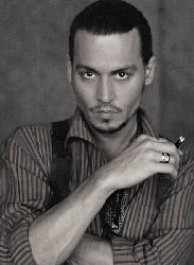
| Johnny Depp Johnny Depp, a young actor well known for his past "bad boy" behavior, was born in Owensboro, Kentucky in 1963. In a 1999 Avantgarde interview Johnny said, "As a teenager I was so insecure. I was the type of guy that never fitted in because he never dared to choose. I was convinced I had absolutely no talent at all. For nothing. And that thought took away all my ambition too." Even today he still has feelings of insecurity about himself. In 1999 he said, "My self-image it still isn't that alright. No matter how famous I am, no matter how many people go to see my movies, I still have the idea that I'm that pale no-hoper that I used to be. A pale no-hoper that happens to be a little lucky now. Tomorrow it'll be all over, then I'll have to go back to selling pens again." During his teens he had been drinking, smoking and doing drugs. There were episodes of petty theft and vandalism. He dropped out of high school at the age of sixteen so that he could concentrate on being a musician. He continued to have problems with drugs and drinking into his twenties. Johnny has a series of seven or eight scars on his left forearm where he has cut himself with a knife on different occasions to commemorate various moments or rights of passage in his life. In a Talk magazine interview he said, "It was really just whatever (times when he hurt himself)--good times, bad times, it didn't matter. There was no ceremony. It wasn't like 'Okay, this just happened, I have to go hack a piece of my flesh off.'" In a 1993 Details magazine interview Johnny explained his self-injury, "My body is a journal in a way. It's like what sailors used to do, where every tattoo meant something, a specific time in your life when you make a mark on yourself, whether you do it yourself with a knife or with a professional tattoo artist." Johnny has several tattoos, such as the one that says 'Wino Forever' (used to be 'Winona Forever" when he was dating the famous actress, Winona Ryder). Johnny Depp is now thirty-seven, lives in France with his steady girlfriend (whom he considers his wife), Vanessa Paradis, and his young daughter. He has quit doing drugs and no longer drinks heavily. In a 2001 Movie Star Magazine interview he talked about how he is currently the happiest he has ever been, "My upbringing made me as I am now. But I can become merry and happy at once. There were many years I was feeling at a loss about my life or how I grew up. I couldn't understand what is right or what is precious. At that time, I was so miserable and self-defeating. I was feeling angry with various things. My anger came up to the surface then. I don't say such tendency has disappeared. Even now there are anger and the dark side in myself. But it's the first time I've been so close to the light." |
 |
|
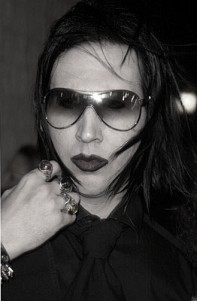
| Marilyn Manson Marilyn Manson was born in Canton, Ohio to Episcopalian parents, a smothering mother and a volatile father suffering from Post-Traumatic Stress Disorder. As a child he was terrified of the apocalypse and the Antichrist, fears introduced by a grade-school teacher. Manson described himself as an adolescent "worm" with no self-esteem, surrounded by a dysfunctional family and hypocritical, emotionally abusive peers at school and church. As a teenager, Manson stole, and later experimented with black magic, drugs and rock music. Later, after he had formed his band, he would perform bizzare on-stage antics, abused drugs, self-injured, and did other self-destructive things. Manson first cut himself when he was in the ninth grade during a class, he dug into his forearms with a penknife. Later in life he would cut himself on stage, scar his skin, and got numerous tattoos of demonic figures on his body. He had about 450 scars at the publishing of his book, "Long Hard Road out of Hell." Some of his fans have, unfortunately, decided to imitate him. In particular, two girls would follow Manson and would carve the words "Marilyn" and "Manson" on each other's chests and would show up at the concert in the front row with blood from their wounds dripping down their tank tops. In a 1997 Guitar School interview he stated that he had been hospitalized for depression and scarification (self-injury) but didn't comment further on that. In a 1998 Rolling Stone interview he answered some questions regarding his self-injury, both onstage and offstage. About self-injury he said, "I think that's all a form of wanting to let go, of wanting to get out," and, "It's not something easily described or understood." About the differences between his onstage self-injury and offstage self-injury he said, "I think onstage it was more me trying to show people my pain, and offstage it was just feeling it, period." In a 1998 Jane interview he said, "I would put myself through a lot of physical pain with drugs or masochistic behavior. And that was something that transformed me, really. I find myself being a different person. Yet no therapy was involved. I've tried a couple of times, but I find that self-examination works better for me than trying to explain it to someone else." |
 |
|
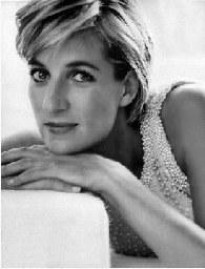
| Princess Diana While it was well known that the late Princess Diana suffered from an eating disorder for many years, far fewer people knew or understood that she waged another secret war on her body. In an extraordinary 1995 television interview on the BBC, the Princess admitted to intentionally cutting her arms and legs. "You have so much pain inside yourself that you try and hurt yourself on the outside because you want help," she explained. While Diana's struggle with bulimia received extensive media attention, her self-injury prompted almost no further coverage -- perhaps because of the on-going denial that such a problem exists as a social and psychological phenomenon. In his controversial biography "Diana: Her True Story," journalist Andrew Morton reports that Diana at various times threw herself into a glass cabinet at Kensington Palace, slashed at her wrists with a razor blade, and cut herself with the serrated edge of a lemon slicer. On one occasion, during a heated argument with Prince Charles, she picked up a penknife lying on his dressing table and cut her chest and thighs. "Although she was bleeding her husband scorned her," Morton writes. "As ever, he thought she was faking her problems." During a fight on an airplane, when Charles insisted she accompany him on holiday to Scotland, she locked herself in the airplane bathroom, cut her arms deeply, then began smearing the blood over the cabin walls and seats. Charles, according to Morton, believed that her cutting was nothing more than melodramatic attention-seeking. When she once threw herself down the stairs, he simply ignored her and went out riding. Even Diana seemed to have only limited understanding of her behavior, referring to the incidents as half-hearted suicide attempts. It may seem hard to believe that someone as beautiful and beloved by millions around the world as Princess Diana could have been a cutter. But if one strips away the trappings of royalty, fame and wealth, the seeds of Diana's distress closely match the family histories of more typical cutters. When Diana was six, her mother left home for another man, and her parents bitter divorce was her first introduction to the ravages of tabloid scandal. She told Morton of listening to her little brother crying in the night and calling out for their mother, while Diana lay frozen in her bed, terrified of the dark. Their childhood was an constant shuttle between two households, her parents trying to fill their children's needs with material things "rather than the actual tactile stuff, which is what we both craved but neither of us got," Diana said. She recalled her mother's endless tears at each separation and the wrenching choices she sometimes had to make between warring parents. By fourteen, she described herself as hopeless, a poor student. Ballet, she recalled, was the only thing that released the "tremendous tension in my head." The night before her wedding, having already discovered that her husband-to-be was in love with another woman, she began purging. Soon she moved to more direct forms of self-injury. The realization that the pain and betrayal of her childhood was repeating itself in her marriage to the Prince, was more than she could bear. She also felt no control over her life. Spied on by household servants, her schedule dictated, and her every word and movement monitored by the Royal Family and a voracious press, she even feared that Buckingham Palace would lock her away in a mental hospital and take away her children. In an aptly chosen metaphor, Diana's own former private secretary, Patrick Jephson, described her life with Charles as like watching "a pool of blood spreading from under a locked door." |
 |
|
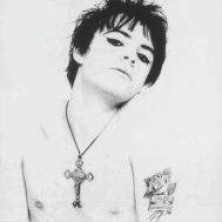
| Richey Edwards Richey James Edwards, a musician who was the celebrity most up front with his self-injurious behavior, was born on December 22, 1967. He grew up under his grandmother's care in Blackwood until he was thirteen because his parents could not afford to take care of him. He joined the band, "The Manic Street Preachers," after they had funded their first single, "Suicide Alley." While in the band Richey suffered from deepening alcoholism and anorexia, he also went through long bouts of depression and insomnia, and self-injury. He had suffered from self-injury since he was a teenager. On May 15, 1991 Richey carved "4 Real" on his forearm with a razor blade. The wound required seventeen stitches, and was done while Richey was involved in a discussion with an NME Live Reviews Editor at the Time. The next day he called and apologized and explained his behavior, "I tried talking to Steve for an hour to explain ourselves (The Manic Street Preachers)...I didn't abuse him or insult him. I just cut myself. To show that we are no gimmick, that we are pissed off. That we are for real." By the end of 1993 he had started stubbing cigarettes out on his arm and was drinking heavily. Also, at an April 1994 concert in Bangkok, Thailand, he appeared with his chest slashed open by knives a fan had sent him. In July of 1994, after having been missing for forty-eight hours and drinking and self-injuring during this time, Richey entered a rehabilitation clinic and stayed ten weeks. On February 1, 1995 leaves the Embassy Hotel he was staying at, stopped at his Cardiff apartment, and disappeared, leaving behind his passport and credit cards. He was reported missing and his abandoned car was found on the Severn Bridge, a place notorious for suicides. Police presumed he was dead by the time summer came around. People still wonder if Richey is still alive and occasionally there are "sightings" of him. |
 |
|
| Shirley Manson Shirley Manson, the sexy, red-haired singer of Garbage, was an angry child. She was teased, tormented, and even beaten-up by her classmates because of her looks. Classmates called her names such as "posh," "bloodhound," and "frog-eyed" because of her red hair and green eyes. As she grew older she became unhappy and violent, and planned to drop out of high school when she turned sixteen. A certain teacher began ridiculing her until, "Until, I think, everyone in that school thought I was less than human. I felt ugly, weak, overwhelmed - I couldn't imagine being capable of doing anything. I certainly never thought I could be in a band. This was a dream it didn't even occur to me to dream about." (1998, Select Magazine) Shirley took up smoking, boys and drinking, she began using drugs on a regular basis during her late teens. In 1995, Shirley and her band released the self-titled, Garbage, their debut album, which became an instant hit. The lyrics of her songs are well known for revealing her true emotions and feelings. Shirley Manson has a low self-esteem and hates the way she looks. In a 1998 Select interview she said, "I feel disgusting. I could take a knife to my throat for the way I look. Can someone just put a bin or a bag or a fucking bomb on my head?" As a teenager her feelings of weakness and of being overwhelmed were manifested in cutting, she would snip the safety guards off Bic razors and would cut up her arms. When she was a teenager she used to carry a sharp object in the laces of her boots and would cut herself with it whenever she felt stressed, anxious or depressed; she hid the scars by wearing long pants and boots. She explained in a The Herald article the experience of self-injuring, "I wouldn't say that cutting was pleasurable, but there is a sense of euphoria that follows cutting yourself. The quick pinch of pain and the sight of blood snaps you back to the surface and you start to appreciate being alive." Shirley Manson no longer self-injures but still feels the urge from time to time. In 1998 she almost relapsed during her European Tour, in which she felt homesick and tired of hearing the males in her group talk about women. She told The Herald about her near relapse, "I ran to my dressing room in a flood of tears. I hated myself all over again for not being thin enough or having a perfect body. It hurt so much that suddenly cutting started to make sense again." She took a penknife and was about to cut herself when a fellow band member walked in. She has gone public with her past experiences because she feels the need to help others. She said, "I'm speaking out because I feel this problem is getting worse for some kids. I'm not an expert on this, but you have to talk to someone. I've seen kids with cigarette burns on their arms or gashes on their legs. It kills me, but hopefully my coming forward can help a little." Lyrics from the song, Medication: "Somebody get me out of here, I'm tearing at myself. Nobody gives a damn about me, or anybody else..." |
 |
|
| Back to Home Overwhelmed? Rest at Smile! My Happy Place |
 |