Geography
| Background | Transportation | Culture | People | Geography |
 |
Geologically the island consists of a number of provinces - in the far west around Galway and Donegal is a medium to high grade metamorphic and igneous complex of Caledonide (Scottish Highland) affinity. Across southeast Ulster and extending southwest to Longford and south to Navan is a province of Ordovician and Silurian rocks with more affinities with the Southern Uplands province of Scotland. Further south, there is an area along the Wexford coast of granite intrusives into more Ordovician and Silurian rocks with a more Welsh affinity.
In the southwest, around Bantry Bay and the mountains of Macgillicuddy's Reeks , is an area of substantially deformed but only lightly metamorphosed Devonian-aged rocks.
This partial ring of "hard rock" geology is covered by a blanket of Carboniferous limestone over the centre of the country, giving rise to the comparatively fertile and famously "lush" landscape of the country. The west coast district of The Burren around Lisdoonvarna has well developed karst features. Elsewhere, significant stratiform lead-zinc mineralisation is found in the limestones (around Silvermines and Tynagh ).
Location: Western Europe, occupying five-sixths of the island of Ireland in the North Atlantic Ocean, west of Great Britain.
Area Comparative: slightly larger than West Virginia
Climate: temperate maritime; modified by North Atlantic Current; mild winters, cool summers; consistently humid; overcast about half the time.
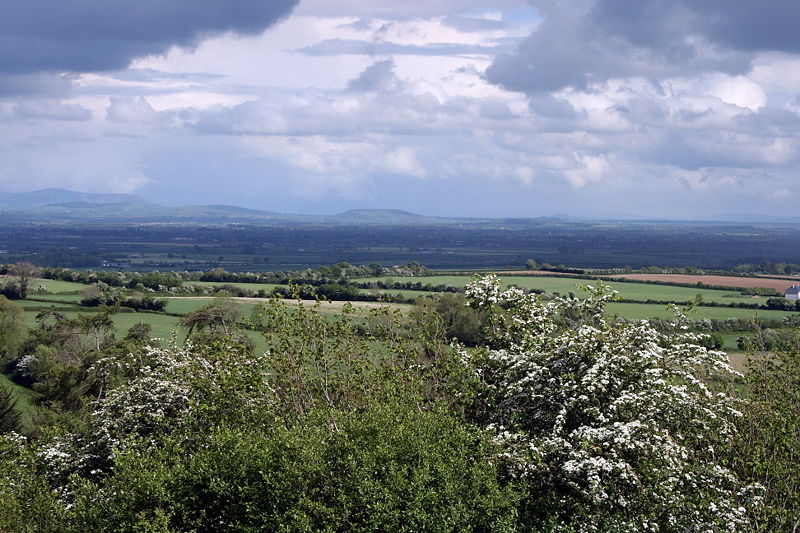
Terrain: mostly level to rolling interior plain surrounded by rugged hills and low mountains; sea cliffs on west coast.
Natural Resources: natural gas, peat, copper, lead, zinc, silver, barite, gypsum, limestone, dolomite.
Geography - Note: strategic location on major air and sea routes between North America and northern Europe; over 40% of the population resides within 100 km of Dublin.