Question: Sometimes Option A shows me an "options screen" before the suggested configuration. Can you explain why this "options screen" is displayed ?
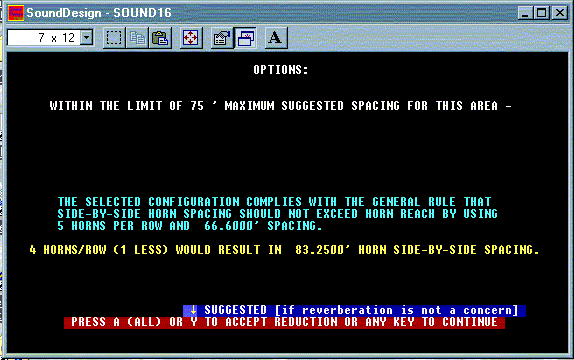
Answer: An example of the screen that you are referring to is shown below. This screen resulted from entering a length of 222 feet, a width of 333 feet, a mounting height of 18 feet and an ambient noise level of 88 dBspl.
The default suggested horn spacing for this noise level is 75 feet for 15 watt horns. The program divided the 333 foot width by 75 feet in order to determine the number of horns required per row. The calculation resulted in 4.44 horns per row.
Rounding up results in 5 horns per row. The spacing of these five horns would not exceed 75 feet (they would actually be only 66.6 feet apart).
Rounding down results in 4 horns per row but the spacing would exceed 75 feet. The program only offers this option when a certain criteria has been met. Pressing "Y" will force the program to use 4 horns per row. It's your choice. If the area is reverberant (echoes) or above 90 dBspl then I would shy away from any reductions.
Answer: This program was originally written in an DOS based program called QuickBasic which does not inherently support the use of a mouse.
Question: Option C tells me that I need to use 18 AWG wire for my power pair. I would like to use 24 AWG instead. Any suggestions ?
Answer: You can always use 22 or 24 AWG cat 3 wire with self amplified speaker runs. This is accomplished through the use of remote power supplies and by twisting extra pairs together to increase the effective AWG. Refer to pages 19 and 21 of the manual for examples of using remote power supplies and page 35 for information on twisted pair calculations.