 |
| Junkers JU-87 "Stuka" |
|
|
 |
|
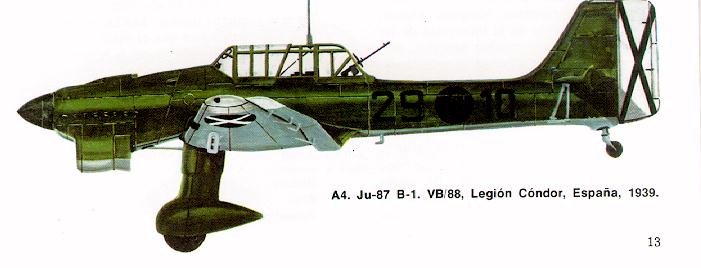
| In late 1936 three Ju 87A-1s were sent to Spain for operational evaluation. They were followed in 1938 by three Ju 87B-1s. More would arrive later. The A-models had not been very successful in combat, mainly because of technical shortcomings, but the Ju 87B proved to be effective. They were used to attack bridges, command posts, artillery positions, and ships in harbour. The war in Spain was more important for the Ju 87 than the other way around, for it was in Spain that the Germans developed their air-ground cooperation doctrine. |
|
|
| ~ Back to Nationalist Attack Aircraft ~ ~ Back to Nationalist Aircraft ~ ~Back to Nationalist Forces ~ ~ Back to Main Page ~ |
| Type: Ju 87A-1 Engine: 640hp Junkers Jumo 210D Wing Span: 13.00m Length: 10.80m Height: 3.90m Wing Area: 30.00m2 Empty Weight: 2273kg Maximum weight: 3324kg Maximum Speed: 320km/h Dive Speed: 550km/h Ceiling: 9430m Climb: 3000m in 8.8min Range: 995km Fixed Armament: 1*mg7.9mm MG17 Rear Armament: 1*mg7.9mm MG15 Bomb Load: 500kg |
| Type: Ju 87B-1 Engine: 1200hp Junkers Jumo 211A Wing Span: 13.20m Length: 11.00m Height: 3.77m Wing Area: 31.90m2 Empty Weight: 2760kg Maximum weight: 4400kg Maximum Speed: 350km/h Dive Speed: 600km/h Ceiling: 8100m Climb: 3000m in 8.8min Range: 800km Fixed Armament: 2*mg7.9mm MG17 Rear Armament: 1*mg7.9mmMG15 Bomb Load: 1000kg |
 |
|
 |
|
|
| In Germany the development of dive bombers was set up in October 1933, as part of the secret rearmament programme. (Which in its origins dated back to 1921, long before Hitler came to power.) The first dive bombing unit was equipped with the Heinkel He 50, a sturdy biplane that had originated from a Japanese requirement for such an aircraft. Later the Henschel Hs 123, also a biplane, replaced the He 50. The Hs 123 was, like many early aircraft of the Luftwaffe, seen as an interim type, but it would actually give excellent service during most of World War II. In 1934 the Luftwaffe tested a modified Junkers K 47, an all-metal, low-wing monoplane with twin tail fins. The K 47 was originally designed as a two-seat fighter, and the diving tests were purely experimental. There was also an exchange of ideas with the Swedish airforce, which was also interested in dive bombing - and would, after the end of W.W.II, produce one of the most advanced dive bombers ever flown, the Saab 18. Then in 1936 the Luftwaffe selected a new dive bomber to replace the Hs 123. The contenders were the Arado Ar 81, the Blohm & Voss Ha 137, the Heinkel He 118 and the Junkers Ju 87. The Ju 87V1, which made its first flight on 17 September 1935, was again a monoplane with an inverted gull wing, but it was by far the ugliest of all. The wing had no taper on the leading edge of the anhedralled center section; on the dihedralled outboard section the leading edge tapered gently backwards. The trailing edge tapered more sharply. In line with earlier Junkers practice -- also seen on the Ju 52, Ju 86 and the K 47 -- the entire trailing edge of the wing was fitted with slotted flaps; the ailerons too were slotted. This gave the Ju 87 fine low-speed handling, but of course also generated a lot of drag. The undercarriage was fixed and covered with ugly 'trousers'. The blunt-edged nose had a deep radiator, with entrance louvers, for its Rolls-Royce Kestrel engine. This was replaced in later prototypes and the Ju 87A series by the Jumo 210 engine, and a smaller, rectangular radiator bath. The fuselage itself had fairly gracious lines. It tapered upwards from the nose to the cockpit, so that the pilot had a good forward view. The view all around was excellent, thanks to a roomy greenhouse canopy for the two crew members. The slender tail structure is alleged to have been quite vulnerable to enemy fire, because the control lines were grouped close together. Initially the rectangular, strut-braced tailplane had two small, rectangular endplate fins, but after the crash of the Ju 87V1, that was attributed to weakness of the tail, this was replaced by a large single tail fin. The dive brakes consisted of a pair of long, rectangular strips attached to stubs under the wing leading edges. They were rotated perpendicular to the airstream to reduce the speed of the aircraft. Initially the brakes were not fitted to the first prototype, and after they were fitted the tail of the Ju 87V1 broke up during a dive test. But the third prototype (Ju 87V3) demonstrated its ability to dive at 90 degrees, and to resist a force of 6G during the pull-out. It was primarily this ability that made it win the competition. Development History There were three major versions of the Ju 87: The A-series, the B-series (including the R and C) and the D-series (including the G and H). Every step in this series involved an engine change, a redesign of the engine installation, a refinement of the cockpit canopy, and a modification of the undercarriage. They can be easily recognised. Ju 87A The production Ju 87A featured the revised tail with a single fin, but the heavy `trousers' on the fixed undercarriage of the prototype were retained, making it easy to distinguish this version from later models of the Ju 87. The radiator intake was (relatively) small and rectangular, and is another easy recognition feature. If that is not enough, the cockpit of the A-model featured two small angled out antenna masts, that were later replaced by a single, vertical one. The canopy had hinged panels instead of the sliding sections featured by later models. The Ju 87A-0 pre-production model entered service in the spring of 1937. The engine was the Jumo 210, which was to be retained in different versions by the production A-series: the Jumo 210Ca for the A-1, and the Jumo 210Da for the A-2. Production of the A-series ended after 262 aircraft, at the end of 1938. The Junkers Ju 87A had two fixed, forward-firing MG 17 guns, installed in the wing outboard of the undercarriage attachment points. There was a flexible MG 15 in the rear cockpit. The Ju 87A could carry a 250kg bomb, or a 500kg bomb if the rear gunner was left home. The bomb was carried on a swing-down rack, a tubular structure of which the front end was attached under the engine. On release, the bomb was swung forward and downward, so that it was free of the propeller disc. (The swinging bomb crutch seems to have been an American invention. The USN considered it important enough that they refused, in 1939, to allow export of such bomb racks to France! The logic behind that decision is difficult to explain.) There were also two small racks for SC50 bombs under each outboard wing panel. The Ju 87A did not see combat, with the exception of three aircraft which were sent to Spain during the civil war, but it was important in the development of the automatic bombing system of the Ju 87. This consisted of an Askania autopilot, which was used together with a Revi gunsight. The bomb release gear, elevator controls, and dive brakes were linked to this system. Before attacking the pilot would set the bomb release height. The deployment of the dive brakes automatically adjusted the elevator trim tab, and put the aircraft into a dive. When the bomb release height was reached and the bombs were dropped the autopilot adjusted the elevator trim tab again, so that the aircraft became tail heavy and pulled itself out of the dive. The use of the elevator was forbidden, except in case of emergency. The pilot thus needed not to be concerned too much with the pull-out. This was just as well, because the pull-out put a an acceleration of 6G on aircraft and pilot. Under such conditions one could not expect the pilot to perform complicated control sequences. Normal procedures called for a bombr release at an altitude of about 900m, which brought the Stuka down to about 400m before it started to regain altitude. Ju 87B The Ju 87B was to be the standard model during the early years of World War II. It was powered by the much more powerful Jumo 211 engine. This engine had fuel injection, an important feature for an aircraft which had to be subjected to heavy G-forces and acrobatic manoeuvres. A new engine cowling was designed, with a new air intake on top of the cowling, and a deep half-circular radiator under it. The radiator was larger for the B-2 model than for the B-1, because the B-2 had an even more powerful engine, and it can only be described as a deliberate insult to the aerodynamicists. The trousered undercarriage of the A-model was replaced by a `spatted' one, with closer-fitting leg covers and better streamlined wheel spats. The change was more than cosmetic, for the undercarriage was also redesigned and considerably strengthened. The mainwheels were also moved slighlty backwards. If the Ju 87 had to operate from poor airfields, such as found at the Eastern front, the spats were often removed because they tended to get clogged with mud. It was not even uncommon for Ju 87s to have their undercarriage ripped off when operating from such airfields. On the undercarriage legs a fitting was installed for a siren, a so called `Jericho Trumpet', to enhance the effect on morale of the Ju 87's attacks. This was driven by a small propeller on the left undercarriage leg. When the siren was not installed the mount was faired over, leaving a protrusion on the undercarriage. The sirens were mostly discarded during the Battle of Britain, because they reduced the performance of the already slow and vulnerable Ju 87. The greenhouse canopy of the Ju 87B was also different of that of the Ju 87A, with sliding sections for the pilot and the gunner, which replaced the earlier hinged entry panels. The twin radio masts of the JU 87A were replaced by a single, tall, vertical mast. |