 |
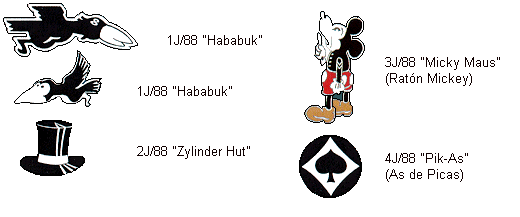
| Sondersstab S/88, (General Staff) It regrouped the airplanes of the General Staff, liaison airplanes and transport. Aircraft: (Fieseler Fi-156A, Messerschmitt Bf-108, Klemm KI 32a XIV, Junkers W 34) Jagdgruppe 88 (J/88) (fighter group) Fighter group, whose beginnings predate the formation of the C�ndor Legion. 5 squadrons Aircraft: (Heinkel 51, Messerschmitt 109 (models A-B-C-D-E) Squadrons: * 1.J/88 * 2.J/88 * 3.J/88 * 4.J/88 * 5.J/88 VJ/88, (experimental fighter group) Aircraft: (Heinkel He-50G, Heinshel Hs 123, JU unkers JU-87 A-0, Messershmitt Bf-109, Heinkel He-112) Kampfgruppe 88 (K/88), (bomber group) 4 squadrons Aircraft: (Junkers 52/3 ms, HeinkeI 111, Junkers 87A & B, Dornier 17, Junkers 86D- 1) Squadrons: * 1.K/88 * 2.K/88 * 3.K/88 * 4.K/88 VB/88, (experimental bomber group) Aircraft: (Dornier 17, Junkers Ju-86 D-1, Heinkel He-111) Aufkl�rungsgruppe 88 (A/88), (recon group) Aircraft: (Dornier 17, HeinkeI 126a, FleinkeI 59a, HeinkeI 46c-1, HeinkeI 70) Aufkl�rung gruppe AS/88 (maritime recon squadron) Aircraft: (Plow Ar-95, Heinkel He-60, Heinkel He-59) Background of the Condor Legion In the morning of the 27th of July,1936 after Hitler's favorable decision to ship material to Spain and after an arduous negotiation between German and Spanish Nationalists, G�ering and Blomber along with other delegates, examined the details of the aid asked for and decided to send volunteers to Spain. On the 30th of July,1936, Von Scheele selected the first 87 expeditionary volunteer instructors from both fighter and bomber squadrons. Generals Wilberg and Milch gave instructions for their immediate transfer to Spain as well as information relative to the mission which they were going to carry out. This way the German aid to the Nationalist Side in the Spanish Civil War began. The expeditionary force arrived at the Port of Cadiz with the material sent from Germany. On the 15th of August they began to operate HE-51s. From the first moments, the activity of the HE-51 very noticable on the fronts. Initially they saw combat on the North front, but after that front stabilized, the HE-51s transferred to bases at �vila and Salamanca on the 28th of October. Throughout this period of time, the first months of German intervention, the German "instructors" maintained the prohibition of actually flying in Republican zones, that is the reason for the reduced numbers in action during Alemanes. Podemos defines these first months of the German aid as " the first phase ". By the end of October, however, the initial elements of the Condor Legion were in Spain. After the conversations between Franc and Admiral Alem�n Wilhelm Canaris in Salamanca, the Condor Legion is officially formed on the 30th of October. This body was formed by volunteers of the Luftwaffe, within the German Air Force, and is assigned a unit designation 88. It was created by virtue of the intention of Germany to maintain in Spain an approximate one hundred airplanes while the war lasted. Fighter group 88 had the designation J/88 and was comprised of four squadrons of 12 airplanes each. Initially the C�ndor Legion had 6500 men. Initially the air branch was outfitted with 32 Heinkel HE-51s of which four squadrons were formed under the command of Von Merhard. These squadrons denominated themselves according to their symbols: Marabou (Marab�), Zylinder Hut (Hat of Glass), Mickey Mouse (Mickei Mouse), Wilder J�ver (wild Cazador). The aerial units remained equipped in their totality with exclusively German personnel up to 1938 when, gradually Spanish National pilots began to be incorporated. The C�ndor Legion also had auxiliary troops, of which there were sections of signal and communications detachments, units of surface-to-air detection, units of ambulances, and detachments of motorists. In March of 1937 the Messershmitt Bf 109 arrives in Spain. This plane proves to be quite exceptional during the war. On the 26th of April,1937 Guernica was bombed. This is one of the most controversial actions of the Spanish civil War. There is still some doubt over who executed the order, but everything seems to indicate that Von Richthofen may have. The C�ndor Legion participated actively with the rest of the Nationalist Air Force on all the fronts of the War and claimed credit for 296 Republican airplanes, 235 by its pilots in air combat. The most outstanding pilot was M�lders with 14 victories, followed by Schellman, Harder, Bodden, Ebbighausen, Tietzen and Ihlefeld. On May of 1939, after the conclusion of the War, the Condor Legion participated in the Madrid parade of the Victory, in which those of the C�ndor Legion marched past their 350 aircraft. On the 28th of May in the port of Vigo, 6,000 Germans led by Baron Richthoffen, embarked on their return journey to Germany, and on the 31st of the same month were received with tremendous enthusiasm in the port of Hamburg by G�ering. A few days later in Berlin, Adolph Hitler praised the 14,000 veterans of Spain (rotated during the war) and offers the tribute to the fallen ones of the unit. (This is a rough translation of H. San Benito's website: http://members.es.tripod.de/henrisb/GRHELP.htm) |
| 01 |
|
| The Condor Legion |
 |
|
| 02 |
| 02 |
 |
|
|
|