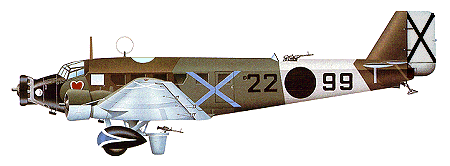
Low wing fixed undercarriage monoplane with corrugated metal skin, a direct descendant of the Junkers F-13 and successor to the Junkers G-24 three-engined commercial aircraft. The prototype derivative of the single-engined JU-52 and powered by three BMW-132 A-3 radial engines developing 550 Hp. was evaluated in April 1931 and found to possess clearly superior qualities to its predecessor.
In 1934 it entered commercial service with "Lufthansa", and was bought by various South American countries. The then clandestine "Luftwaffe", unwilling to wait for the new projects, (He-111,Do-15, and Ju-86), and despite the aircraft's low top speed, had a provisional bomber version built, the Ju-52/3mge, later improved as the Ju-52/3mg3e, powered by BMW 132 A-3 750 HP radial engines.
Initially it was armed with two MG-15, 7.92 mm moveable machine guns, one in a dorsal installation and the other in a retractable ventral housing. It had a five-man crew: first pilot. second pilot, navigator/bomb aimer, radio operator and gunner (subsequently flight engineer).
When the Civil War broke out the Nationalist side acquired 20 aircraft, which joined one of Lufthansa which had been requisitioned in the Canary Islands. Its first action consisted of the transporting of some 10,000 legionaires and regular troops during the Straits airlift. At least nine of the twenty were armed up immediately on arrival, forming three Spanish flights commanded by captains D�az-Trechuelo, Carrillo and Gil Mendiz�bal. They formed B Squadron, whose OC was major Jos� Rodriguez y D�az de Lecea. Later six of them joined the German squadrons of "Pedros" and "Pablos", commanded by Von Moreau y Henke.
In November 1936 the Condor Legion was formed, and its K/88 bomber group took on three squadrons of Ju-52, each with ten aircraft. With the Ju52s which the Germans handed over to the Spanish, and the addition of a few more, Nos 5 and 6 squadrons were formed, joining the already existing No 4 Sqn. The six Spanish squadrons were established in three groups, bearing the brunt of the bombing missions in the Tajo valley and in the assault on Madrid. After the battle of the Jarama, one group was disbanded. One day group was maintained (2G22) among other secondary ones, and a night group was established (1G22). Both saw action at Brunete, Santander and Belchite.
At the end of 1937 they were incorporated into No1 Wing, which saw combat at Teruel, Arag�n, El Maestrazgo, Extremadura, el Ebro and Catalonia.
They were decorated with the Collective Military Medal in June 1938.
In all, the Spanish Air Force had on inventory during the Civil War 60 Ju-52 with serial numbers 22-47 to 22-106. CASA built 170 serialled 22-110 to 22-279, which entered service between 1944 and 1953.
By the end of the conflict the Ju-52s had logged some 13,000 hours on operations, dropping 6,000 tonnes of bombs. |