 |
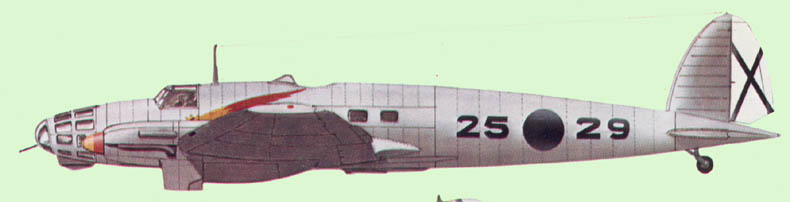
| Heinkel He-111 Pedro |
|
|
 |
| 0 |
|
| Designed by brothers Siegried and Walter G�nter for both civil and military applications. It was rolled out in the colours of Lufthansa on 10th January1936 and entered service on that company's routes. The first military pre-production models of the He-111 A, with BMW V1 750 H.P. engines, were rejected by the Luftwaffe for being too low powered and sold to China. The new He-111 B version, powered by the new 950 H.P. Daimler Benz DB600 was accepted, and entered service at the end of 1936. This aircraft was of all-metal construction with a cantilever wing and monocoque fuselage. Flaps, undercarriage and brakes were hydraulically actuated. It had excellent flying qualities, being stable yet exceptionally manoeuvrable for its size. It first saw combat in Spain. In February 1937 the first four He-111 B-1 arrived. They carried out their first combat mission on the 20th of that month, bombing within a few days the airfields at Barajas and Alcal� de Henares. Later they supported the Italians at Guadalajara, subsequently deploying to the north where, at Gij�n, they sank the Republican destroyer "Ciscar". They also flew missions over Brunete, Teruel, the Ebro and Catalonia. One stormy day one of these He-111 landed by mistake in Republican territory. After being evaluated and flown by professor Konstantin Rozanoff, it was shipped to the USSR. In all 95 Pedros arrived in Spain, 50 of the B-1 and B-2 series, and 40 E-1 and E-3, the latter powered by Junkers Jumo engines. The aircraft were initially flown by Germans, but from April 1938 Spanish crews began joining the Condor Legion, and in August the first Spanish group was formed: 10-G-25, under the command of de Luis Rambaud. DETAILS - He-111B-2 He-111-E Power plant 1.760 HP 2.200 HP Wingspan 22,5m 22,5 m Length 17,6 m. 17,6 m Height 5,7 m 5,7 m Wing area 87,6 m.2 87,6 m.2 Empty weight 5.830 kg. 6.100 kg Maximum weight 9.400 kg 10.600 kg. Cruising speed 345 km/h 345 km/h. Maximum speed 370 km/h 390 km/h. Rate of climb 270 m./min. 270 m/min. Ceiling 7.000 m. 7.350 m. Range without bombload 3.500 km 3.500 km. Range with 1500 kg. bombload 900 km 900 km. In the Spanish Civil War the He-111 showed itself to be the best bomber the Germans had. Twenty one aircraft were shot down and a further sixteen lost through various causes. After the war the remaining 58 formed the 8th Bomber Squadron based at Zaragoza and Logro�o under the command of Lacalle and Ureta. Later dispersed to various airfields, the He-111s of the Spanish Air Force continued flying until the end of the 1950s. In the postwar period six He-111 J were purchased from the Germans. This was a later development of the same aircraft for use in met recce flights. |
|
|