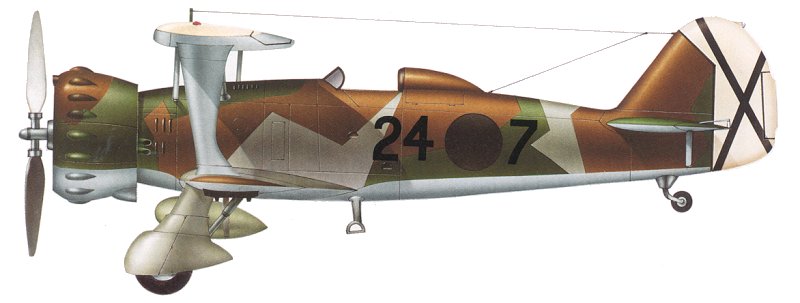
Designed to an official requirement for a dive-bomber, issued in 1933, the Henschel Hs 123 single-bay biplane was of all-metal construction, with fabric covering used only for the rear portions of the wings and the control surfaces. Powered by a 650 hp (485 kW) BMW 132A-3 radial engine, the prototype flew in 1938 and quickly established its superiority over the rival Fieseler Fi 98. The third prototype was the first to be armed, carrying two fixed forward-firing 7.92 mm (0.31 in) MG 17 machine-guns in the fuselage top decking. The first three aircraft were flown to Rechlin for testing in August 1935, in the course of which activity two of them were destroyed when their wings came off in dives. A fourth prototype tested successfully the structural changes introduced to overcome this problem and initial production orders were placed for the Hs 123A-1, which retained the blistered cowling of the second and third prototypes, rather than the NACA cowling of the first. Power was provided by the BMW 132De radial engine and, in addition to the two fixed MG 17 machine-guns, a mounting for a 551 lbs (250 kg) bomb or an external fuel tank was included beneath the fuselage, and four 110 lbs (50 kg) bombs could be carried on underwing racks.
The Hs 123A first entered service with 1./StG 162 in the autumn of 1936, although its career as a front-line dive-bomber was short-lived because the Junkers Ju 87A Stuka began to replace it in 1937. Five Hs 123As were supplied to the Legion Condor in Spain in December 1936
Powerplant: One 880 hp (656 kW) BMW 132Dc 9-cylinder radial piston engine rated at take-off and 870 hp (649 kW) at 8,200 ft (2500 m).
Performance: Maximum speed 211 mph (340 km/h) at 3,935 ft (1200 m) and 207 mph (333 km/h) at sea level; cruising speed 196 mph (315 km/h) at 6560 ft (2000 m); ceiling 29,525 ft (9000 m); initial climb rate 2,950 ft (900 m) per minute.
Range: Range 531 miles (855 km) on internal fuel but this could be extended with the use of single auxiliary fuel tank.
Weight: Empty equipped 3,318 lbs (1505 kg) with a normal take-off weight of 4,888 lbs (2217 kg).
Dimensions: Span, upper 34 ft 51/2 in (10.50 m) and lower 26 ft 3 in (8.00 m); length 27 ft 4 in (8.33 m); height 10 ft 6 in (3.20 m); wing area 267.49 sq ft (24.85 sq m).
Armament: Two fixed forward firing 7.92 mm (0.31 in) MG 17 machine guns in the upper fuselage decking, plus underwing racks for four 110 lbs (50 kg) bombs, two containers with 92 4.4 lbs (2 kg) anti-personnel bombs or two 20 mm MG ff cannon pods. In practise, the centerline bomb position usually carried an external fuel tank but could carry a single 551 lbs (250 kg) bomb instead.
|