| Heinkel He-112 |
| Condor Legion ~ Technical Drawings |
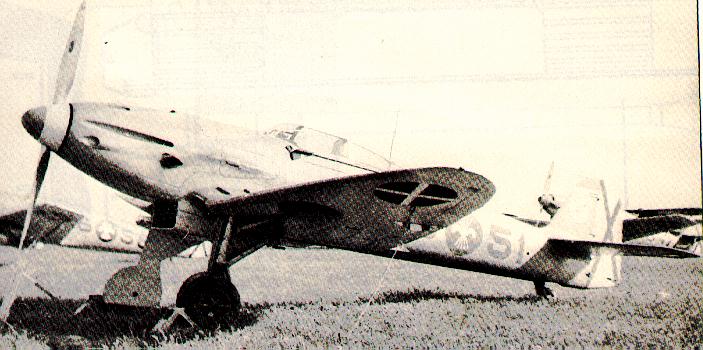
| Origins Early in 1934 a contract tender was offered to the German aircraft industry to build the new fighter to arm the re-forming Luftwaffe. Although the aim of the contract was to produce a design that would leapfrog other air forces, the requirements were nonetheless surprisingly modest. Four planes were submitted to the contest and two were quickly eliminated. Of the remaining two, the Heinkel He 112 was the clear favorite to win the contest. But today the Heinkel 112 is perhaps the poorest known German production fighter of World War II. That's an interesting statement when you consider that it was still flying for almost a decade after it was first designed. It's obscurity is likely best understood by considering the fame of the plane it lost the competition to, the Messerschmitt Bf 109. The story of the He 112's obscurity is an interesting one. Basic specifications Company: Ernst Heinkel Flugzeugwerke GmbH Designer: Walter and Seigfried G�nter Year: 1935 Type: Day fighter Crew: 1, pilot Description: Low wing monoplane fighter with conventional layout. All of the surfaces are well rounded as opposed to straight edged and ended. Fuselage: The fuselage is elliptical in cross section, cigar shaped front to back, and has no ridgeback. The front is pierced in many places with openings for the engine and weapons. A lip on the upper engine decking gives the plane a slight resemblance to the Il-2. Wings: The wing is a large elliptical planform with a small amount of reverse gull-wing bend. Flaps span the inner part of the wing out from the bend, with fabric covered ailerons meeting them about two thirds of the way out from the wing root and running to the tip. Other details: The canopy is an early example of the bubble type, but in three pieces rather than two. Tail-dragger landing gear were used, with all three gear retracting (although the tailwheel was "half out" when retracted. The wing droop resulted in short gear legs, so they could be retracted outwards, and the cover left a small amount of the wheel uncovered when retracted. Background When the re-forming Luftwaffe started to look for new planes in the early 1930's, initially training and utility aircraft, Heinkel was one of the most experienced firms in the country. Contracts were received for numbers of two seat planes, and the He 45, 46 and 50 were born. The company also continued to work on fighter designs, which culminated first with the He 49, and later with the improved He 51. This placed the Heinkel firm in good standing with the Reichsluftsfahrtministerium (Reich Air Ministry, or RLM). The He 51 was a workmanlike but otherwise uninspired biplane, which first flew in May 1933 when the Luftwaffe was still a secret. Deliveries started in July of the next year, the 51 was intended to replace the earlier Arado 65 and 68's but they ended up flying side-by-side. The He 51 was outdated the day it entered service, and after an initial run of 75 production fighters, the design was switched into the B-2 reconnaissance floatplane for another 80, and then finally the C-1 light ground attack plane for a further 79. On August 6th, 1936 six of the planes were sent to Spain to fight in the civil war. Deliveries continued until there were three squadrons of 12 planes each, and the Legi�n C�ndor (Condor Legion) was formed from these squadrons in November. Deliveries continued as the hostilities increased, and the plane met and beat a number of older biplane designs. This time of superiority was short lived. The arrival of the superior Polikarpov I-15 started it's downfall, and when the new I-16 monoplane arrived it was clearly hopeless. The He 51 was withdrawn from fighter duty and relegated to the ground attack role, and then eventually to training. After the war the 46 surviving planes would be joined by another 15 new builds, and serve in the utility role in Spain until 1952! The experiences in Spain would prove once and for all that the days of the biplane fighter were over. Although the later model Fiat biplanes were superior to the He 51 and continued to soldier on in Nationalist service, the I-16 monoplanes were basically untouchable because of their speed. If the conditions were right they could use their heavy armament in a quick pass and then leave, if things weren't so favorable they simply flew away. The lesson learned by all of the participants was that speed was far more important in combat than maneuverability. Although no clear date is given, in Stormy Life it is Udet himself that delivers the news to Heinkel that the 109 had entered series production in 1936. He is quoted as saying "Pawn your crate off on the Turks or the Japs or the Rumanians. They'll lap it up." Perhaps he was not so far wrong. With a number of air forces looking to upgrade from biplanes and various designs from the early 1930's, the possibility for foreign sales was promising. In order to show off the design,the V9 spent much of the later half of 1937 being flown by pilots from all over the world. It was also sent around Europe for tours and air shows. The effort was a success and orders quickly started coming in. The first was from the Imperial Japanese Navy. After seeing the V9 in flight they quickly placed an order for thirty 112B's with an option for 100 more. The first four were shipped in December of 1937, another eight in the spring, and promises for the rest to arrive in May. Before delivery the Luftwaffe unexpectedly took over twelve of the planes to bolster its forces during the Sudetenland Crisis. The planes were then returned to Heinkel in November, but the Japanese refused to accept them this late and Heinkel was left holding the aircraft. Luckily Spain was so impressed with the 112's performance during evaluation in the civil war, that the Aviaci�n Nacional (Spanish Air Force) purchased the twelve planes in early 1938, and later increased the order by another six (some sources say five). Of the first twelve, two were shipped in November, another six in January, and the rest in April. He 112 in Legi�n C�ndor Service When it was clear the 112 was losing the contest, Heinkel offered to re-equip V6 with 20mm cannon armament as an experimental aircraft. The Technisches Amt was very interested; at the time many tanks were equipped with 20mm guns as their primary armament, the same armament on a plane could prove to be a powerful weapon. In September a 20mm MG C/30L cannon was mounted to the plane, with the breech to the rear of the engine and the barrel lying between the cylinder banks and exiting in the propellor spinner. This is the first experimental mounting of what would later be called the motorkanone, a feature that would become a standard on most German fighters. She was then broken down and shipped to Spain on the 9th of December. After being re-assembled she was assigned to Versuchsjagdgruppe 88, a group within the Legi�n C�ndor devoted to testing new planes. There she was nicknamed the Kanonenvogel, and joined three V series Bf 109's which were also in testing. The Kanonenvogel was adopted by Oberleutnant G�nter Radusch who started flying the plane on the 9th of December at Tablada. From then on it joined the Ju 87A's and Hs 123's already in service and was used as a ground attack plane. On the 6th of February the plane was moved to Villa de Prado near Mardid, and then in March she was re-assigned to Jagdgruppe 88 at Almorox near Toledo. While sitting at Almorox due to a mechanical problem in his He 45C, Oberleutnant Wilhelm Balthasar heard that a Republican armored train was approaching and talked himself into the cockpit of the V6 by insisting he was a Heinkel test pilot. After teaching himself to fly the plane and managing to get into the air, he found the train parked at the station in Sese�a and attacked it. On his third pass one of the 20mm shells punctured the ammunition car and the entire train exploded. Then on the way back to Almorox he came across an armored car and set it on fire. His exploit in the V6 made him famous, and Balthasar found himself in command of the newly formed combat group with the V6 and three He 45C recon planes. Over the next few months the V6 was flown by a number of pilots, and on the 6th of July Unteroffizier Max Schulze knocked out an additional number of armored cars. On the 19th of July Schulze was once again flying the V6 when the engine seized during landing. Schultze walked away from the resulting pancake landing, but the plane broke her back and was a writeoff. V8 and V9 were then sent to Spain in the spring of 1938. The V8 was the earlier A series model with the larger DB600Aa engine, but it was only in Spain until July when it crashed. V9 was the B series platform and armed with the twin 20mm cannons. Like the V6 it was then used primarily as a ground attack plane, but it was also flown by a number of experienced Spanish pilots before being returned to Heinkel and becoming the show plane. |
 |
|
|
|
|
|
 |