| Dornier Do-17 |
 |
|
|
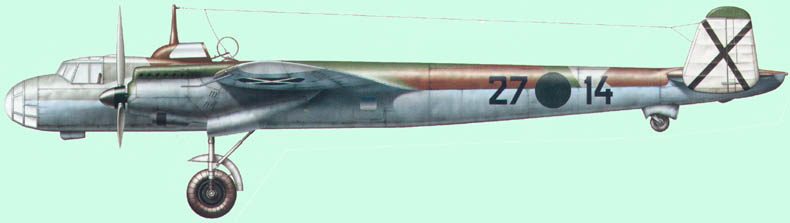
| The Do 17 was one of the first modern types of aeroplane to go into production for the Luftwaffe in 1935. Over it's lifespan it was fitted with three different types of motors. The prototype Do 17 flew with 660 h.p. B.M.W. VI un-supercharged liquid cooled upright Vee motors in the Summer of 1936. It had a top speed of 400 km.h. (249 mph.) at sea level. Later the 880 h.p, B.M.W. cylinder supercharged air-cooled radials were installed. They raised the top speed to 445 km.h. (276 m.p.h.) at 3,000 m. (9,840 ft.). Next the Do 17 was built with 1,050 h.p. Daimler Benz DB.600G motors. With them the top speed went up to 470 km.h. (292 m.p.h.) at 14,800 ft. The original long tapered nose gained the Do 17 the name of the "Flying Pencil." The whole machine is flush riveted. There was no dihedral on the wings, but the whole of the taper in thickness is on the under surface, The fuselage was a metal monocoque with stressed skin covering. The full cantilever tail plane was set at a small dihedral angle. Trimming tabs were used on all the movable control surfaces. The elevators were mass balanced with external balances, which pass through slots in the tail plane. The twin rudders had aerodynamic as well as mass balances. The fixed surfaces had metal covering, the movable surfaces fabric. The undercarriage was retracted hydraulically. The wheels, mounted between two oleo legs and equipped with mudguards and brakes, were raised backwards in to the motor nacelles and enclosed by hinged doors, so that only the tyre was left protruding. The tail wheel retracted vertically in to the fuselage. The Do 17 carried a crew of three, all in front of the wing. The pilot sat on the port side of the fuselage, so that there is room for the bomb-aimer to pass to his prone position below. A navigation compartment with hinged chart table occupies the space between the back of the pilot and the front spar of the wing. Forward armament consisted of two fixed machine guns in the front cowling, operated by the pilot. The bombs were stowed horizontally in the centre section of the fuselage between the spars. Up to 1,000 kg. (2,205 lb.) could be carried internally. It was robust enough to endure terrible amounts of gunfire, especially small calibre gunfire. It's strength did not depend upon bracing wires and wooden spars: it had armour protection, with some of the vital mechanical parts duplicated. Even more valuable were the self sealing fuel tanks. The Do-17 is the least known of the trio of German twin-engined bombers (He-111, Ju-88 and Do-17). It was originally designed as a passenger aircraft and it made its first flight in 1934. The following year a model was developed as a bomber and reconnaissance plane. It entered service with the Luftwaffe in 1937. Foreign observers at a military aircraft competition in 1937 were impressed with the aircraft's speed ( 400km/h) as it could out-pace some contemporary fighters. It was in active service in the European theatre and in the Battle of Britain. The D17s were largely withdrawn from front-line service in 1942 being replaced by Ju-88 which had a better performance Like the He-111, the aircraft saw service in the Spanish Civil War and fared equally as well against the Republican's fighters. The major production version was the Do-17Z which appeared in 1939, capable of carrying up to eight machine guns and an increased crew of five. The Dornier Do 17 had a maximum speed of 255 mph (410 km) and had a range of 721 miles (1,160 km). It was 51 ft 10 in (15.79 m) long with a wingspan of 59 ft 1 in (18.00 m). The aircraft was armed with 6 machine-guns and could carry 2,200 lb (1,000 kg) of bombs. |
|
|
| ~ Back to Nationalist Bombers ~ ~ Back to Nationalist Aircraft ~ ~ Back to Nationalist Forces ~ ~ Back to Main Page ~ |
 |