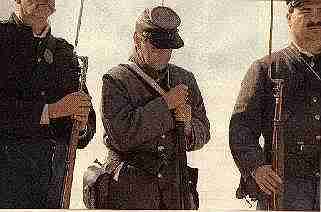
| Re-Enactors of the 6th
Infantry, Company I, NC State Troops. From left, David Dorman, Woody Ragan and Tim Morton. |
 |
From the camp scrapbook
| Re-Enactors of the 6th
Infantry, Company I, NC State Troops. From left, David Dorman, Woody Ragan and Tim Morton. |
|
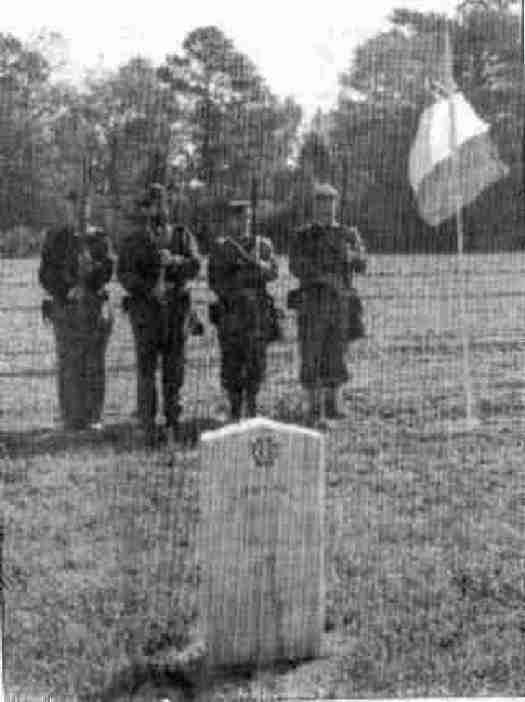
| A marble headstone was
unveiled in honor of an unknown Confederate soldier who was buried in an unmarked grave in
Angier, NC. Members of the Colonel Leonidas Lafayette Polk camp, of the Sons of Confederate Veterans, and re-enactors of the 6th NC State Troops, paid tribute to the soldier. |
 |
The following is the full text of the speech given by Thomas Christian O'Steen, Adjutant, NC Division, Sons of Confederate Veterans.
Some 130 years ago a war, like no other this country has ever seen, erupted, tearing a nation in two and bringing internal destruction to its people, property, and human dignity. But how could such a destructive event in our history continue to mesmerize so many people? Consider the loss of life, the destruction of public and private property, and the changes that this conflict has had on the political, social, and economic conditions in this nation today. So, if war is suppose to settle, once and for all, political and economic disputes, then I wonder just what happened here. Although this great tragedy did put closure on several issues including the validity of Southern Independence, rejection of Jeffersonian ideals, the power of the federal government, and the slavery issue, this conflict remains the subject of passionate debate over its' causes and economic and political results. Called by so many names, "Civil War", "War Between the States", "The War of Northern Aggression", from a Southern perspective this truly was a "War for Southern Independence"
I feel that to understand history is to understand the life and times of the people. So, as best we can, let's remove ourselves from today's views on politics, economy, and race and endeavor to understand the views of the 19th century man with a 19th century education and a 19th century way of life. Can you imagine a daily existence without electricity, running water, indoor plumbing, a telephone??? How about transportation by horse and carriage??? Can you imagine for a moment that you are going to raise the majority of the food that your family will eat for the next year, and make your families' clothing? Hard to do, isn't it??? But these were the conditions of mid 19th century America.
I have been a student of genealogical research for over seven years and have been and continue to be totally intrigued by the wealth of information that is available on my family. The NC State Archives is packed full of documents, census records, land transactions, court records, wills and estate papers all about my family and it has been an exciting adventure to discover and meet each of my ancestors. An absolute wealth of information exists on these people, their lives, and life of the times.
As a neophyte genealogy researcher, my research mentor pointed me in the direction of a book entitled Albion's Seed, by David Fisher. I was told that this book was the researchers' guide to understanding how the colonies were settled, by whom they were settled, and provided key information to settler origin and migration patterns in colonial America. To read this book is to begin to understand major differences that assured sometime down the road, this nation just may end up in major political disagreements. The various cultural distinctions Fisher outlines in Albion's Seed focuses on social behavior, dress, dietary preferences, and religious preferences of colonial settlers.
Early immigration patterns to the Southern colonies came primarily from Northern England, Scotland, Northern Ireland, and the Saxon regions of Southern England. The New England colonies were settled primarily by immigrants from the traditional English and Puritan cultures. Middle America colonies received the bulk of their settlers from the North Midlands of England and Quaker cultures. With their settlements, immigrants brought with them their own customs and ideals. John Adams of Massachusetts, while attending the Continental Congress, wrote that Northern and Southern colonies were starkly dissimilar, and so different that a political union could not be held together without the utmost caution being exercised on both sides. So, very early on, this nation was faced with strained relationships.
With the Declaration of Independence as the basis of our country, our nation entered into a confederation in 1781 with ratification of the Articles of Confederation; and 13 colonies formed the perpetual union of The United States of America. Following in 1787 a process of secession from the Articles of Confederation was begun by the individual states and the US Constitution was ratified and put into place in 1789. Confronted with continuing political disagreements and the culmination of the struggle between forces of a strong centralized federal government and the forces of a limited central government, Southerners in 1860 were compelled to exercise the position that, by virtue of the Declaration of Independence and the Constitutional ratification process. individual states were constitutionally sovereign. In the language of the Declaration of Independence, our country's founders wrote:
"...Governments are instituted among men, deriving their power from the consent of the governed. That whenever any form of Government becomes destructive of these ends, it is the right of the People to alter or abolish it, and to institute new Government... But when a long train of abuses and usurpation's, pursuing invariably the same Object, evinces a design to reduce them under absolute Despotism, it is their right, it is their duty, to throw off such Government, and to provide new guards for their future security."
Thus, under these very ideals and Constitutional promises, the Confederate States of America was born in 1861.
The ensuing four years and the following period of Reconstruction are surely considered by us all as the darkest period in American history. A new nation of Southern states, conceived in the promises of Jefferson, Adams, and Madison and confirmed by the sacrifices of Washington's Continental Army was thrown, against her will, into war ... a war instigated by an aggressor whose reasonability had been clouded by the desires of its own empire.
Why we fought??? ... Well, to me its evident that our Southern ancestors, our family, our very own blood kin, were fighting first to protect their families and their personal property from an invading aggressor set on nothing less than the total destruction and subjugation of an independent nation. And, secondly our ancestors were fighting for their right to declare independence for themselves, their family, and their country and to exercise their Constitutional right to govern and regulate their own affairs.
But, why are the events of 130 years ago important to us today? This is best summed up in the commission by Gen. Stephen D. Lee as he read his charge to the founding assembly of the Sons of Confederate Veterans in 1896:
"To you, Sons of Confederate Veterans, we submit the vindication of the Cause for which we fought; to your strength will be given the defense of the Confederate soldier's good name, the guardianship of his history, the emulation of his virtues, the perpetuation of those principles he loved and which made him glorious and which you also cherish. Remember it is your duty to see that the true history of the South is presented to future generations."
So today, we as Sons of Confederate Veterans and United Daughters of the Confederacy shall continue to promote the good name of the Confederate soldier and his virtuous principles. We, as Sons of Confederate Veterans, shall continue to oppose those who would take our Confederate symbols for their own self-serving purposes which mock, defile, and disgrace these beloved, blood-soaked emblems of honor. And we continue our stand to protect these same honorable symbols which special interest groups, in their own misunderstanding of the symbols' true meaning, vow to destroy. We, as Sons of Confederate Veterans, will continue our proud, nonracial, nonpolitical community and civic efforts to provide educational programs and events which enlighten and inform the general public, and which portray the true history of the South.
We have assembled here today to honor this unknown Confederate soldier. Little is known of his life or service to his lost cause other than on his return home from Appomattox his wounds overtook him on his journey. This soldier was taken in by Dr. Bill Williams of Angier and died at some later date in his care, and is buried here. By our gathering here, we honor this soldiers' sacrifices and the ultimate sacrifice of his very life. But in a greater sense, today we honor all of our Confederate dead across all the battlefields and cemeteries of our great nation.
So it is in proud remembrance of my ancestors, Pvt. David Parsons of Montgomery County who served in the defense of northern VA, Pvt. John L. Webb of Montgomery County who was captured the third day at Gettysburg and imprisoned at Point Lookout, MD, Lt. Solomon Burris of Stanly County, with service in the NC Militia and protection of the homefront, Pvt. Levi Lowder of Stanly County who died in defense of Fredricksburg, VA, Pvt. John Hatley of Stanly County who was captured at Cold Harbor, suffered the inhumanities of Elmira Prison and died in the NY winter of '64 ... and in proud remembrance of your Confederate ancestors who also gave their ultimate measure, we pay our humble respects to this unknown soldier.
Yes, it's things like duty, honor, courage, dedication, integrity, responsibility, heritage, and blood kin family sacrifice that we choose to remember.
In closing I would like to read the following... "I Am the South".
I was born on April 12, 1861, in the Harbor of Charleston, South Carolina and the Constitution of the Confederate States of America is my Birth Certificate. The blood lines of the South run through my veins, for I offer freedom that each State should regulate her own affairs, according to its best interest. I am many things and many people
I Am The South. I am millions of living souls, and ghosts of thousands who died for me. I am the Farmer-made soldier who did not turn his back during Pickett's Charge. I am the Rebel Yell that was heard across many of my rolling fields, protecting our homeland. I am Robert E. Lee and Thomas J. Stonewall Jackson: I stood at Fort Sumter and fired the shot heard through our young nation. I am Longstreet, Hood and Patrick R. Cleburne. I am General's Johnson, Beaugard and President Jefferson Davis. I remember how we fought in Gettysburg, Cold Harbor, Vicksburg, and Atlanta. When duty called I answered and stayed until it was over. I left my heroic dead in Chickamauga, in the fields of Shiloh, on the bloody hills of Mannassas and the mountains of Kennesaw.
I Am The South. I am the Mississippi River, and the cotton fields of Alabama and the piney woods of the Carolinas. I am the coal fields of Virginia and Kentucky, the Florida coast and the Louisiana bayou. I am Richmond, the Capitol of the Confederacy. I am the forest, field, mountain, and rivers. I am the quiet villages and the cities that never sleep. I am the Heritage that's been forgotten, the dying memory of a way of life that is being still. You see me in the twilight and hear me in Dixie, as the past continues to fade away each year.
Yes, I Am The South, and these are the things I represent . I was conceived by force, and God willing, I'll spend the rest of my days remembering my birth. May I always possess the integrity and the courage, and the strength to keep my Heritage alive, to remain a Loyal Southemer and stand tall and proud to the rest of the world. Do not forget: who we are; what we are and where we came from.... This is my goal, my hope, my prayer."
Written by a true Southerner, Louise Weeks of Hampton, Georgia, age 95 years two weeks before her death.
Thank you all for coming today to celebrate our heritage, to celebrate the remembrance of this unknown Confederate soldier and to honor our own heroic ancestors who gave everything unselfishly for the Lost Cause.