The Loch Ness monster, known as Nessie, is an alleged plesiosaur-like creature living in Loch Ness, a long, deep lake near Inverness, Scotland. Many sightings of the "monster" have been recorded, going back at least as far as St. Columba, the Irish monk who converted most of Scotland to Christianity in the 6th century. Columba apparently converted Nessie, too; for it is said that until he went out on the waters and soothed the beast, she had been a murderess.
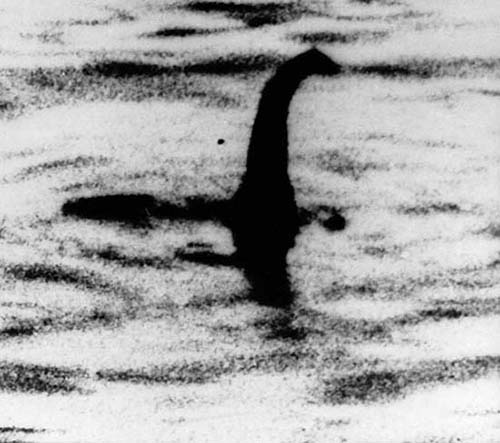
The modern legend of Nessie begins in 1934 with Dr. Robert Kenneth Wilson, a London physician, who allegedly photographed a plesiosaur-like beast with a long neck emerging out of the murky waters. That photo created quite a fuss.
There have been other photographs of Nessie, as well. The tabloids will pay good money for a photo of Nessie, and some enterprising souls have camped out for years in hopes of capturing the elusive beast on film. One good photo and they can retire for life!
Even though most scientists believe the likelihood of a monster is small, they keep an open mind as scientists should and wait for concrete proof in the form of skeletal evidence or the actual capture of such a creature.
Since the Loch Ness monster story has been around for more than 1500 years, if there is a monster it is not likely that it is the same monster seen by St. Columba. In short, there must be more than one monster. One report claimed that a minimum population of ten creatures would be needed to sustain the population. |