| Child Labour: From Industrialization to the Present |
| Child labor in the Industrialization: Samuel Slater was the father of American industrial revolution but also yet the father of child labors. He had a system of child labor in Rhode Island �s first textile mill- the Slater mill. In the mills, life was difficult and unhealthy for adults and children alike. They started work before sunrise and after sunset. The air in the mills weren�t clean and fresh, it was filled with flying lint particles that would cause breathing problems. In the winter the mills were cold, and in the summer it was hot and humid. And always dirty and noisy and also uncomfortable. What child laborers miss out in their life? The children miss out plenty. They had no time to play or learn, they only learned form their experience (which isn�t a teacher that would teach you all there is to know) they only know the most basic reading, and writing along with a bit of arithmetic. They missed out life. They weren�t children, nor were they adults, they were just workers that were beyond workers maybe slaves would be a word to describe them. Risks in the mill: Children get the same punishments as adults, but didn�t earn as much money as adults and children would certainly get sleepy if they wake up before sunrise everyday and stop working after sunset everyday, they might lose a finger or an arm or a scalp just as easily as walking. what about child labour in industrialization differ from child labour in present? child labour back then wasn't against the law, it was everywhere so not many people found it illegal. |
 |
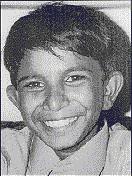
| Igbal Masih: Igbal Masih is a child who was sold into slavery at age 4 by his parents for less than $16. Until he was 10 he remained shackled to a carpet weaving loom most of the time, tying tiny knots all the time he was there. "We had to get up at 4 and work 12 hours," Iqbal told the conference, barely tall enough at the time to peer over the podium. "We were chained to the looms, but after work, we were usually released and could go home to sleep." |
 |
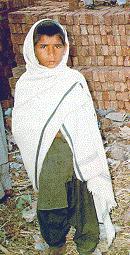
| Ashique: Ashique works in a brick kiln in Pakistan. He has been working there for six years with his father and three brothers. "I work everyday except Sunday. My father, 3 brothers and myself are paid together a sum of (P) Rs.30 (US$1.4) per 1,000 bricks. We can make approximately 2,500 - 3,000 bricks in a day. But during the monsoon we cannot produce the same amount. Our wage is cut by 50% for loan repayments. We do not understand the loan interest which seems to be always increasing. Now the loan has gone up to RS.5000 (US$237). I work very hard from 2a.m. to 6-7p.m. in the evening and get only one 1/2-hour break from 8 to 8:30 a.m. for a meal. There are 30 - 35 families working in the brick kiln." He went to school for three months but was put back to work by the owner. |
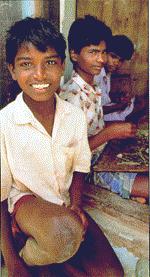 |
| Pattinather: Pattinather spent six years working up to 16 hours days at a cigarette factory. He started working at age 6. He began to work for a little more than $1.30 per week from 6am to 10 pm, six days a week. "If you don't earn, you don't eat," says Alagesh. He tried to escape; he tried it eight times until they bounded him with a two-foot long chain that bounded his feet even when he slept. A world vision staff saw the Pattinathar in chains. John Vincent had photographs made of Pattinathar in his chains and threatened to send the pictures to the press unless the foreman freed him. And the shackles came off. |
| what about chilid labour today differ from child labour in industrialization? today child labour is only found in poor countries and is now illegal in the US. And many people are trying to stop child labour from being in the world. |
| For more infomation on child labour but not related to child labour form industrialization to present. -----> |

|