| 'Gora Qabristan': Peshawar's Historic Cemetery |
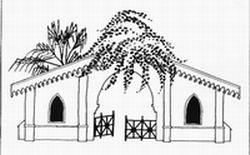
| Peshawar Cemetery lych-gate - A sketch by Diana Farrington (used with permission) |
 |
| For comments or any further Information. Contact: Dr Ali Jan Sarhad Conservation Network � (SCN) Peshawar, Pakistan. |
| Sarhad Conservation Network � (SCN) 2004 |
 |
| "The romance of the North West Frontier of undivided British India is legendary. Peshawar was the forward base of the British for a little under one hundred years and by taking an hour or two to walk round the cemetery, it is possible to absorb the whole history of the border area without the need to plough through history books, or struggle with complicated military analyses. Here, engraved on stone and marble, the story unfolds in a poignant and vivid manner - the soldiers who died in action in the confrontations with Afghanistan and the Tribal people, their wives and children who followed them to the heat and discomfort of what was then, and to a certain extent still is a classic "frontier town", civil administrators businessmen, medical staff, clergy - all are represented and are part of the jigsaw which makes up the Peshawar Cemetery." (Susan Maria Farrington, BACSA 1988) |
| The first recorded English burial in India took place in Bengal in 1631. In the following centuries the number of graves in the subcontinent peaked at two million. However, today, most of these cemeteries are in various stages of decay while others have entirely disappeared. The Christian cemetery in Peshawar or the �Gora Qabristan� is one such surviving cemetery of the Victorian Era. The Christian cemetery in Peshawar or the 'Gora Qabristan' is one of the few surviving cemeteries in the Frontier region from the Victorian Era. There were many others that have now disappeared altogether. Out of the four large cemeteries at Peshawar originally, only two survive today. Reverend James Worthington Jukes in his reminiscences "Missionary work 1873-1890" recorded the following cemeteries that existed in the 19th century: 1. Old City Cemetery (perhaps Wazir bagh. The cemetery no longer exists) 2. Saddar Cemetery (at the back of CMH. The cemetery no longer exists) 3. Old Jamrud Road Cemetery (now inside PAF base ever since aerodrome�s extension) 4. Tehkal Cemetery (present 'Gora Qabristan', located on the busy Jamrud Road) About the old city the Reverend noted in 1876 that there was a cemetery in the North East of Kohati gate of the walled city: "�in which many English officers and soldiers were buried at a time when Peshawar was first occupied, before the present cantonments were laid out." The Tehkal cemetery (Gora Qabristan) lies at the entrance to Khyber Pass. It is sheltered by tall peepal, sheesham and palm trees that are as old as the cemetery itself. As one enters through the elegant lych-gate one notices fine marble crosses in various English and Celtic styles. A bit further, grey slate and clay coloured square headstones and obelisks abound far and wide. They chronicle Peshawar�s history and bear the epitaphs of battles fought and British lives lost in the region. In the distance one can see the Khyber Hills, snow-capped in winters. It is mainly for it�s historical importance that the cemetery has now become a kind of tourist destination, and finds a mention in most travel books and regional guides. Whilst wandering amongst the graves, one often comes across interesting epitaphs: "In the loving memory of Sub Conductor CEW Waters, IASC. Died Peshawar 28 Oct 1933 as a result of burns received in gallantly fighting a fire. Aged 30 Years." The British had this urge to carve a bit of England here. Unable to find foxes, they engaged in sporting eccentricities such as jackal hunting - �Frontier� style. One headstone evokes memories of the famed �PVH�: "Lieutenant Colonel Walter Irvine IMS. Chief Medical Officer NWFP who lost his life in the Nagoman River when leading the Peshawar Vale Hunt of which he was Master. 26th January 1919. Ever faithful to duty, ever loyal in friendship." Among many notable personalities, one distinctive grave belongs to Isador Loewenthal. It bears a Pushto inscription on the side. He was an oriental scholar and an Evangelist missionary who led a remarkable life. Under the auspices of the Presbyterian Board of Foreign Missions he translated the New Testament in Pushto and embarked upon compiling a Pushto dictionary before he was killed accidentally on 27 April 1864 aged 37, by his chokidar who mistook him for an intruder. The British army launched hundreds of campaigns and Frontier expeditions from 1840s onwards until about partition time. Many military regiments are represented here. Companies and regiments whose names still evoke the pomp of monarchy: 10th Royal Fusiliers, 42nd Royal Highlanders; Royal Horse Artillery; King's Dragoon Guards. The names also indicate the extent of the spread of the Raj: Bengal Artillery; Queen's Own Madras Sappers; 11th Sikh Regiment and so on. Although, these magnificent monuments aptly portray the pomp and show of the empire, yet a deeper study of the inscriptions also reveals harrowing tales of the hardships faced by the English in this harsh and hostile land, where according to Noel Coward, only "mad dogs and Englishmen go out in the midday sun". Life was not easy on the Frontier. Perhaps no other place in the subcontinent offers such a striking snapshot of the mortals in their dying moments as this: "stabbed to death"; "shot by tribesmen"; "assassinated by Ghazi"; �fell from horse�, "killed in Afghan war"; "shot by accident"; "drowned". The non-violent causes of death were often: 'heat exhaustion', 'influenza', 'enteric fever', 'dysentery', �malaria� and so on. Adding poignancy to the setting are a number of graves belonging to women and children - families of those who left their pastoral homelands and are buried here: "In loving memory of our darling baby boy Lindsay Owen. Son of Sergeant and Mrs Hyson. E Divisional Signals. Died 1 Dec 1922. Aged 5 months. We loved him well. God loved him best.� ��In the loving memory of Susan, the dearly beloved wife of Frank Brooks, chemist of Peshawar, who died 12 Dec 1928.� Sadly, with the passage of time the cemetery has declined due to both natural and man-made causes. Media columnist, Susan Taylor Martin, gives an apt description. She writes: �Today, the cemetery looks forlorn and abandoned. Weeds scraggle up through parched, bare earth. Dead leaves skitter over broken hunks of marble. Many of the tombstones are so caked with dirt it is impossible to read the inscriptions. Others are so old that time and weather have worn off any clue as to who lies below.� The lovely bougainvillea creeping over the main entrance has been chopped. Water seeps through the roof of the stylish lych-gate during rain showers. Moreover, trespassers can easily scale the boundary walls at the back and hundreds of priceless decorative monuments have been stolen or vandalised. Many peepal trees are afflicted by, what appears to be, a form of plant disease and are dying. Since the cemetery is still in use by the local Christians for burials, encroachment of new graves over older ones is a major problem. The cemetery was desecrated by locals on more than one occasion. In 1979 a rowdy mob, reacting to a false rumour of a Christian takeover of the holy sites in Mecca by a group ransacked it and damaged several crosses. Similar scenes were witnessed in the aftermath of the recent American attacks on Afghanistan. A perturbed gentleman wrote a protest letter in a national daily: �This is with reference to the desecration and vandalism of the Christian cemetery at Peshawar on Eid day. It did not ever occur to me that even the dead have their share of the vile hatred which is overtaking the country. As a Christian native of Peshawar, where I have family members buried, I strongly condemn in no uncertain terms what was done.� (Dawn 2002) In order to preserve cemeteries in the subcontinent, a UK based charity, British Association for Cemeteries in South Asia (BACSA) was established in 1978. Owing to the combined efforts of Shelter Now International and BACSA, the Peshawar cemetery was partly restored. A dire need was also felt to record all the existing headstone inscriptions before they perished. It was a seemingly daunting task and Susan Farrington of BACSA deserves the credit for undertaking this good deed. She set out on an ambitious project in 1980s to record and photograph nearly 1200 inscriptions in Peshawar alone. Although her exhaustive survey has included 260 other cemeteries and churches all over Pakistan but she confesses that the Peshawar cemetery occupies a special place in her heart. During the course of her research she discovered that some of her own ancestors had served in Peshawar. �Peshawar Cemetery & Monumental Inscriptions II� published by BACSA in 1988 (reprinted in 1989 and 2001) are the outcome of her painstaking research. As the best-known resource on the subject, the books carry detailed inscriptions and plans of the cemeteries and other useful information. Cherry Godin, a scion of �A. Godin & Sons Piano/ Record Store� fame - which is the last surviving vestige of the Raj days in Saddar - is also in-charge of the Peshawar Cemetery Board. Godin has been highlighting the plight of the cemeteries and has drawn the attention of concerned quarters towards their preservation on many occasions, but on the contrary, they keep deteriorating further. The funds available for the upkeep are modest so if you ever visit the cemetery do not forget to tip the caretaker, Fakir Hussain. In Britain and other parts of the world, there is a growing interest in researching one�s family roots and genealogy, especially amongst the younger generation. There are many Internet websites that offer advice on the subject. I operate one such web-forum where numerous queries are received from descendants of those individuals who had once served in Peshawar and are looking for the graves of their ancestors. There are other volunteers and professionals on the forum that assist with the searches. There are many success stories. However, at times such requests may not yield any results and that is always a disappointment. Nonetheless, searching for a query name is a fascinating task. One discovers a great deal about the remarkable lives people led in those days and one learns about their own history in the process. Recently, Janice Walker, a school teacher from Somerset UK, contacted the forum to help locate the grave of her great grand uncle Reginald Green of the 2nd Battalion Somerset Light Infantry, died Peshawar 27 October 1918. Aged 19. The hunt was on; we noticed a section of the graveyard with several burials within the space of few weeks between Oct-Nov in 1918 � all from Influenza. A bit of research revealed that indeed a flu pandemic in 1918 had killed an estimated 20 million worldwide in a matter of weeks. 12.5 million died in India alone. A swine flu virus that transferred its virulence to a human virus had caused the 1918 pandemic. In addition, some elders from the period informed us that as the disease spread during those months, almost the entire local populace had fled the town. Peshawar's streets became deserted and shops were closed. The graves of over forty soldiers, clumped together aged between 18 and 30, who fell victim to the lethal Influenza flu in 1918 are a vivid reminder of that event. Unfortunately, in Janice Walker�s case despite all attempts to locate her ancestor�s gravestone the search could not materialise. However, there was some consolation as we were able to confirm the cause of his death due to Influenza with the help of registry records. We even had a black and white photograph of the grave (courtesy of BACSA) that showed the exact location. Indeed, it was quite disturbing to learn that many headstones and graves that were recorded by Susan Farrington in the mid 1980s had now disappeared. Years back, tombstones from the old city cemetery were salvaged and had been set into the boundary wall of Gora Qabristan. They all dated from the earliest days of the British presence in Peshawar, so in their way were quite historic. The earliest stone was from 1849. Sadly, when the recent expansion work on Jamrud Road began it took a large chunk of the burial ground and the wall was raised to rubble. It also endangered the 150 years old peepal trees lining the sidewall, but better sense prevailed in the end and they were spared. Peshawar has a rich history that is gradually fading brick by brick. The significance of the Victorian cemeteries is of immense importance from a historical point of view. They are irreplaceable landscapes and have been neglected for decades. They must be included in the threatened monuments and the heritage lists. Moreover, they ought to be on the list of items for the recently started 'Save Peshawar Movement'. Besides local initiatives by citizens, the British and Pakistan Governments and their agencies need to play a more pro-active role in their upkeep. The involvement of national and international NGOs in their conservation is also necessary to seek a broader base of support. Recently, a group of school children in Karachi cleaned up the 19th century Wallace Bridge on McLeod Road. Surely, we can launch similar campaigns in Peshawar to salvage our surviving heritage sites and historic landmarks before they are erased from our collective consciousness. |
| Dr Ali Jan (The writer is a member of Sarhad Conservation Network) |
 |
| Dr Ali Jan |
| For Peshawar cemetery/ burial records and headstone images click here |