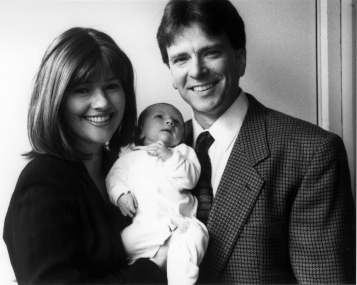
Background. I spent most of the 1990's in the physics department of the University of California, Davis, and received my PhD in 2001. I am now working at Intel near Portland, Oregon, in Quality and Reliability. My current project involves writing software simulations of the IC fabrication process that are mathematically quite similar to my quantum field theory simulations below. My wife Karen and I have been married since June 1993. We have two children, Ben (age 3) and Andy (age 1). Please feel free to e-mail me at [email protected].
QM2 I am participating in a Yahoo group discussion about alternative formulations of quantum mechanics. My first "paper" for this forum is on the decoherence effect and contains lots of animations like the QFT animation below. I also participate in the Undernet Physics group.
Atoms In Motion. My gas, liquid, and solid simulation program is being sold by Physics Academic Software. (Here it is in the online catalog.) Bobby Lau has adopted the Mac version. The web page for Atoms In Motion was landau.ucdavis.edu/atoms. This page is no longer active and needs to be relocated.
Ferroelectric Research. My dissertation, "The Effects of Crystal Size on the Lattice Dynamics of SrTiO3 and BaTiO3", is available here: Scott's dissertation. This is a zip file that contains a postscript file, so you will need WinZip to extract it and a postscript viewer to view it. My advisor Larry Coleman and I plan to submit this to Physical Review B. (Larry, when are we going to submit this??) Here is a preprint of the paper: preprint. This is a non-compressed postscript file called srtio.ps.
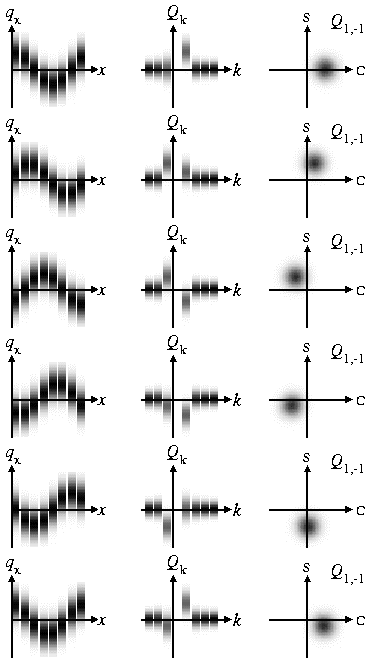
Quantum Field Theory. I am working with Tom Gutierrez on various visualization strategies for teaching quantum field theory at the undergrad level. The first result of this is a paper that appeared in the March 2002 issue of the American Journal of Physics (the theme issue on quantum mechanics). You can download a copy (my formatting, not AJP's) here: qft paper. This is a .ZIP file containing a .PS file, so you will need WinZip and a postscript viewer to view it. You can also download the actual C++ source code that generated all the pictures in the paper. Beware, though, unlike the user-friendly Atoms in Motion above, this software is quite user-hostile. It has no user interface; you must edit the source code and recompile it. See the readme file for more detailed information. The image below is an animated version of the most important graph in the AJP paper, a propagating coherent state of the phonon field.