Diagram
Mixture
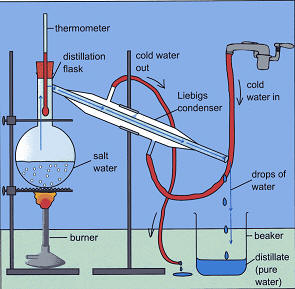
- can also be used to separate a mixture of miscible liquids that have different boiling points
- similar to Evaporation/Boiling, but with this apparatus, you collect the vapor and cool it back into a liquid
To see the information in the empty cells, either print this page or click your mouse in the cell and drag to highlight the words to make them appear.
Physical Properties
| luster | a measure of how well light reflects off an object (shininess) | malleability | ability to hammer a material into sheets | |
| flexibility | ability of a material to bend | ductility | ability to pull a material into wires | |
| elasticity | ability of a material to bend and return to its original shape | texture | relative smoothness of an object | |
| density | a measure of how tightly packed
molecules are in an object; amount of mass that fits into a certain
volume; d = m / V |
transparent | an object that light can pass through completely (clear) | |
| magnetism | when electrons align in specific domains; occurs strongly with iron (Fe), cobalt (Co), nickel (Ni); the force of attraction or repulsion of magnetic materials | translucent | an object that light can pass through partially (cloudy) | |
| phase or state | solid, liquid, gas, or plasma | opaque | an object that light cannot pass through |
Chemical Properties
| flammability | ability of a material to burn |
| reactivity | ability of a material to react under certain conditions |
| solubility | ability of a material to dissolves in certain solvents (such as water) |
Mixtures
| Term | Definition | Example |
| element | a material made up of just one type of atom | oxygen gas (O2), iron (Fe), cobalt (Co) |
| compound | a material made up of two or more types of atoms | water (H2O), carbon monoxide (CO) |
| substance | a general term used to refer to any element or compound | water, oxygen, cobalt, carbon monoxide... |
| mixture | any combination of two or more substances | |
| homogeneous mixture | a mixture that is the same throughout; every part of the solution is the same; each time you scoop out part of the mixture you always get the exact same stuff | think of tomato soup or a box of Cheerios |
| heterogeneous mixture | a mixture that is different throughout; when you scoop out some of the mixture, you get different things | think of beef stew or a box of Lucky Charms |
| miscible | any two liquids that can mix together | water and food coloring |
| immiscible | any two liquids that cannot mix together | water and oil |
| solute | a material that dissolves in a solvent | sugar, chocolate powder |
| solvent | a material that dissolves the solute | iced tea, milk |
| solution | the combination of solute and solvent (true solutions are homogeneous) | sweetened iced tea, chocolate milk |
| soluble | when a material can dissolve in a solvent such as water | sugar, salt |
| insoluble | when a material cannot dissolve in a solvent such as water | sand, pebbles |
| colloid | a heterogeneous mixture; cloudy; particles stay mixed; does not need to be shaken | milk |
| suspension | a heterogeneous mixture; cloudy; particles slowly settle to the bottom; needs to be shaken | orange juice, Italian salad dressing |
Separating Mixtures
|
Diagram |
Term - Definition | Example Mixture |
Materials Separated Out | Materials Remaining |
|
|
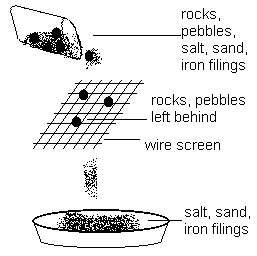
Sieving - technique used to separate solid particles of different size, typically using a wire screen | rocks, pebbles, salt, sand, iron filings | rocks, pebbles | salt, sand, iron filings |
|
|
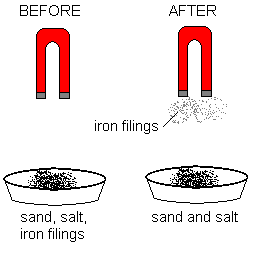
Magnetism - use of magnetic forces to remove magnetic objects | salt, sand, iron filings | iron filings | salt, sand |
|
|
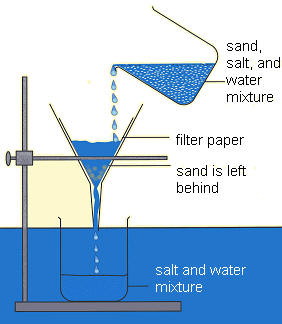
Filtration - technique used to separate an insoluble material from a liquid | salt, sand, in water | sand | salt in water |
|
|
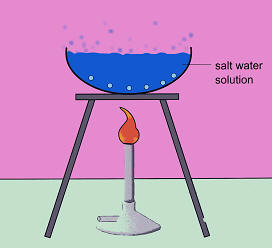
Evaporation/Boiling - technique used to separate a soluble solid from the liquid in order to obtain the solid | salt in water | water | salt |
|
|
Distillation - technique used to separate a
soluble solid from a liquid in order to obtain the liquid - can also be used to separate a mixture of miscible liquids that have different boiling points - similar to Evaporation/Boiling, but with this apparatus, you collect the vapor and cool it back into a liquid |
salt in water | salt | water |
| ethanol and water | water | ethanol |
Solubility Curve (7E Only)
| A solubility curve shows how much of a particular solute that will
dissolve in a solvent at various temperatures. Generally, a solubility graph includes information from several solutes, such as shown in the image to the right. Reading the curve is easy. It reads like any other graph. You can look up the amount of solute based on the temperature, or you can look up the temperature based on the amount of solute. The most challenging part of reading the solubility graph is that several solutes appear. Look at that graph to the right. How many grams of KNO3 can dissolve in 100 grams of H2O at 60 oC? Look carefully and you should see that is reads 90 grams. |
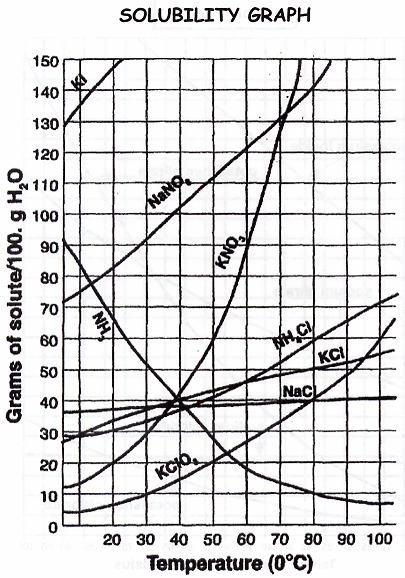 |
| Amount of Solvent | This solubility curve is based on 100 g of H2O as the solvent. If you have a different amount of solvent, you need to adjust the amount of solute. If you wanted to know how much KNO3 can dissolve in 200g H2O at 60oC, then you look up the information for 100 g of H2O then double it (because you have twice as much water/solvent). So: 90g x 2 = 180 grams |
| Unsaturated | A solution is unsaturated if is there is not enough solute to fill the solvent. Any amount of solute that falls below the solubility line, then the solution is unsaturated. Therefore, at 60oC, dissolving 50 grams of KNO3 in 100 grams of H2O would be an unsaturated solution. |
| Saturated | A solution is saturated if the solvent cannot dissolve any more solute. If the amount of solute falls on or above the solubility line, then the solution is saturated. Therefore, at 60oC, dissolving 120 grams of KNO3 in 100 grams of H2O would be a saturated solution. |
| Supersaturated | You cannot tell if a solution is supersaturated from its solubility curve. |
Practice Problems (highlight empty cells to see the answers)
| 1. | How many grams of KClO4 can dissolve in 100 grams H2O at 40 oC? | 15 grams |
| 2. | How many grams of NH3 can dissolve in 100 grams H2O at 80 oC? | 10 grams |
| 3. | At what temperature can 60 grams of NH4Cl can fully dissolve in 100 grams H2O? | 80 oC |
| 4. | At what temperature do NH4Cl and KCl have the same solubility in 100 grams H2O? | 60 oC |
| 5. | How many grams of KClO4 can dissolve in 200 grams H2O at 30 oC? | 20 grams |
| 6. | How many grams of NaCl can dissolve in 100 grams H2O at 80 oC to make an unsaturated solution? (There are several possible answers.) | (Any number less than 40 grams) |
| 7. | At what temperature can 140 grams of KNO3 be dissolved in 200 grams H2O? | 55oC (because 200 g H2O) |
| 8. | What type of solution is created when 150 grams of KI is dissolved in 100 grams H2O at 20 oC? | saturated |
| 9. | What type of solution is created when 90 grams of NaNO2 is dissolved in 100 grams H2O at 40 oC? | unsaturated |
| 10. | Which compound shows the least change in solubility as temperature increases? | NaCl |