Density
|
density |
a measure of how tightly packed particles are in an object |
|
|
mass |
a measure of the amount of matter in an object |
|
|
volume |
a measure of the amount of space an object takes up |
n
Density is a measure of how tightly packed molecules are

n
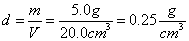
Mass divided by volume
n
Mass # always goes into the calculator first even if it’s
smaller
n
EX: If mass is 5.0 g and volume is 20.0 cm3 then d = 0.25
g/cm3
3 Important Density Facts
1. Density does not change
if you cut an object into pieces
n
EX:
If you have a block with a density of 0.25 g/cm3 and you cut the
block in half, its density will still be 0.25 g/cm3

Same material, so it’s the same density!
2. Density can help predict
whether an object will float in a liquid.
n
If the
object has a lower density then it will float
n
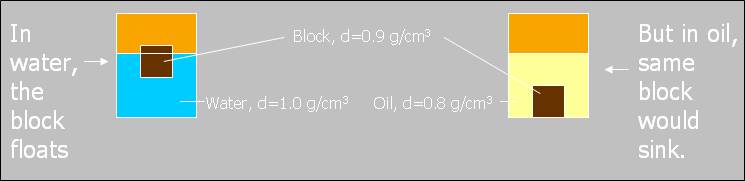
EX: A block that has a density of 0.9 g/cm3
will float in water (d = 1.0 g/cm3)
but will not float in oil (d = 0.8 g/cm3).
3. Density values can predict where an object can float
in water.
n
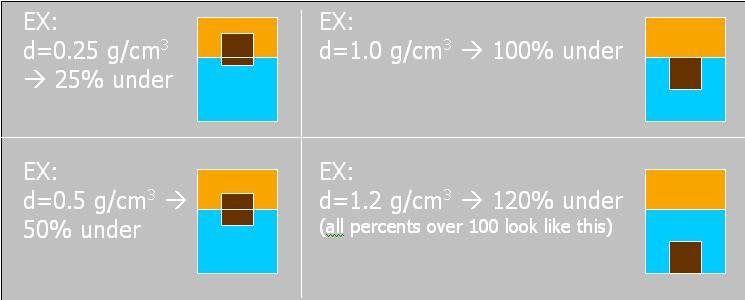
Just view the density as the % underwater
n
Mentally multiply density by 100.
n
Anything over 100% then it is at the
bottom
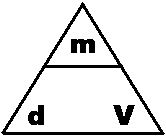
Density Triangle – For Calculations
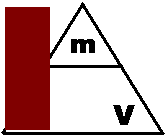
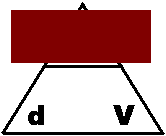
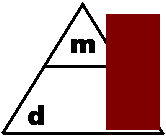
To use the density triangle, cover up the variable you need to find. See how the other two variables are arranged. That will give you the formula. If the two variables are side by side, multiple. If one variables sits atop another, divide. See the examples below.
|
To Find Density |
To Find Mass |
To Find Volume |
|
Cover "d" |
Cover "m" |
Cover "V" |
|
|
|
|
|
d = m / V |
m = d x V |
V = m / d |