Ever wished that you could wish (more) upon a star?
If you have, then you could have had your wish come true on November 14-21, 2001, especially on the 18th and 19th.
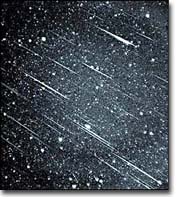 |
| Photo of a 1966 Leonids storm |
"This weekend is what we call the peak period when more meteors strike the atmosphere than any other nights," said Fr. Victor Badillo of the Philippine Astronomical Society. "In fact, the Leonid Meteor Shower lasts from Nov. 14 to 21 when the Earth passes through a region of dusty trails shed by the comet Tempel-Tuttle."
The comet passes near the sun every 33 years, causing it to cast off dust streams of tiny particles. When the Earth passes these particles, it is the time when we have those Leonid showers.
It becomes visible when particles, no larger than apple seeds, enter the atmosphere at 65 kilometers per second and burst up due to the air friction. The meteors appear to originate from the constellation Leo, hence its name.
In addition, astronomers from the Australian National University predicted that the shower rates could reach 10,000 to 35,000 per hour.
|