| News - Headlines - See also News in brief, or browse/search the Archive - Write to SCR about significant news (send us a mail)
Touching what is out there
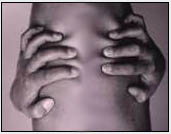
The conscious sensation of touch is felt at the location of the tactile
stimulus: we feel the key or the pen that we pick up at our fingertips
rather than in the brain where the sensory signals end up. If we use a tool to
explore our surroundings, such as a walking-stick, something even more curious
happens. We feel the sensation of touch taking place out there at the tip of the
stick. How is that possible; after all, there certainly are no sensory receptors
located at the tip of the stick!
See story
Motion induced blindness 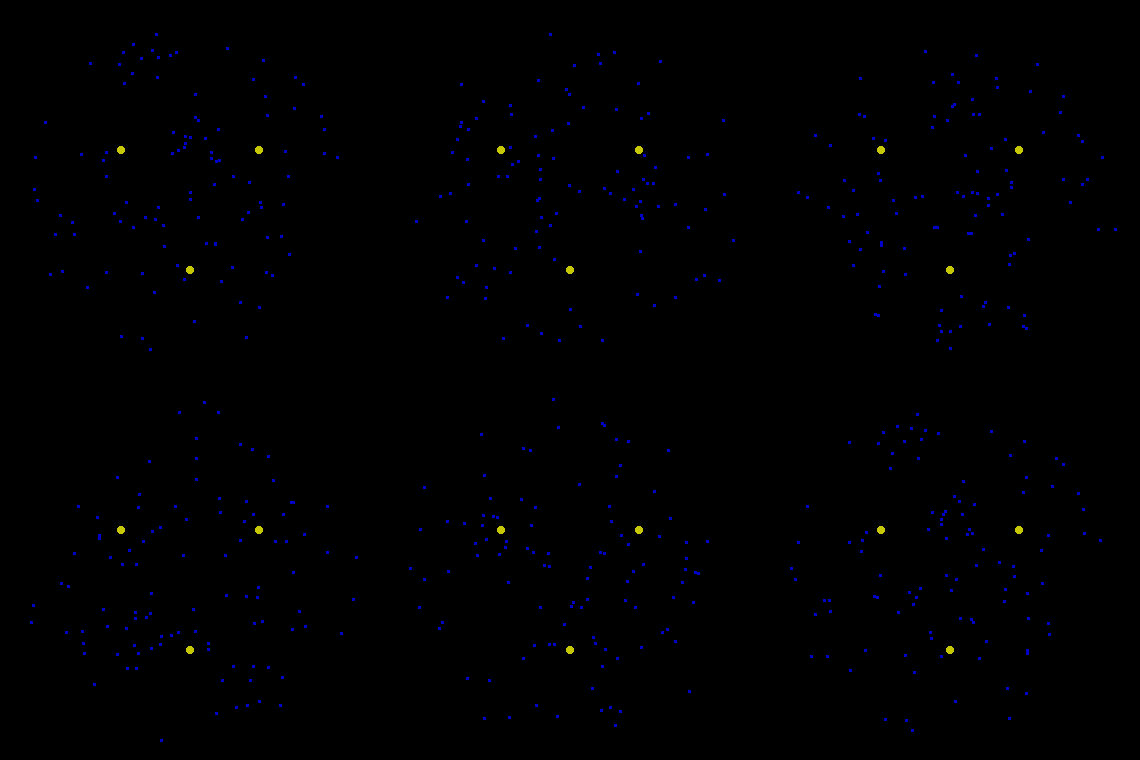 In a paper in Nature, Dr. Yoram Bonneh, of the Smith-Kettlewell Eye Research Institute in San Francisco, and his colleagues have studied a remarkable new visual illusion, consisting of a swirling pattern of blue dots superimposed on three stationary yellow dots (click on the image to go to the demonstration page). When viewing the figure, and paying attention to the blue dots, the yellow dots sometimes disappear. In a paper in Nature, Dr. Yoram Bonneh, of the Smith-Kettlewell Eye Research Institute in San Francisco, and his colleagues have studied a remarkable new visual illusion, consisting of a swirling pattern of blue dots superimposed on three stationary yellow dots (click on the image to go to the demonstration page). When viewing the figure, and paying attention to the blue dots, the yellow dots sometimes disappear.
See story
Tilt after-effect 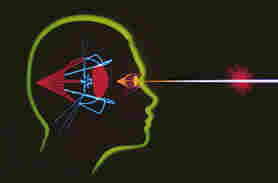 In a recent article in Nature, Dr. Sheng He from the University of Minnesota and Dr. Donald MacLeod of the University of California at San Diego, describes an effect where previously presented stimuli that have not been perceived consciously, still has an effect on what their subjects saw next. In a recent article in Nature, Dr. Sheng He from the University of Minnesota and Dr. Donald MacLeod of the University of California at San Diego, describes an effect where previously presented stimuli that have not been perceived consciously, still has an effect on what their subjects saw next.
See story
Nonconscious goals and "mysterious moods"
 Do we always know why we feel the way we do? According to the accumulation of recent findings, this is not always the case. Dr. Chartrand at the Ohio State University shows evidence that �mystery moods� may be the result of how well people achieve goals they did not know they had. If we succeed at an unconscious goal, we may be in a good mood. If we fail, we may suddenly feel down without knowing why. Do we always know why we feel the way we do? According to the accumulation of recent findings, this is not always the case. Dr. Chartrand at the Ohio State University shows evidence that �mystery moods� may be the result of how well people achieve goals they did not know they had. If we succeed at an unconscious goal, we may be in a good mood. If we fail, we may suddenly feel down without knowing why. See story
A breakthrough in testing unconsciousness 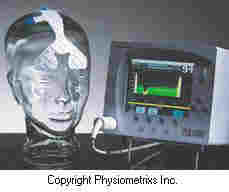 So you think the scientific study of consciousness has no practical applications? So you think the scientific study of consciousness has no practical applications?
Well, consider this: an estimated 40,000 to 200,000 people wake up in the middle of surgery each year in the United States, often in agonizing pain, in spite of modern anesthetic technology.
Anesthesiologists around the world are acutely aware of the problem, but have been frustrated for years by the absence of an accurate "consciousness monitor" to tell surgeons precisely when a patient under the knife is unconscious and protected from feeling pain. But this agonizing problem may now have a solution. E.R. John of NYU Medical Center has worked for many years on
Quantitative EEG measures of consciousness, and recently an anesthesia monitor developed by him was approved by the FDA. It is now being marketed. But the fundamental science underlying the new technology is
also important. See story |