 Touching what is out there
The
conscious sensation of touch is felt at the location of the tactile stimulus:
we feel the key or the pen that we pick up at our fingertips rather
than in the brain where the sensory signals end up. If we use a tool to
explore our surroundings, such as a walking-stick, something even more curious
happens. We feel the sensation of touch taking place out there at the tip of
the stick. How is that possible; after all, there certainly are no sensory
receptors located at the tip of the stick!
Yamamoto
and Kitazawa (2001a,b) have recently reported two studies in Nature
Neuroscience that may elucidate this mystery. When two stimuli were given
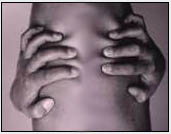
in rapid succession to the fingertips of uncrossed hands, the subjects were
remarkably good at judging which hand was stimulated first. But if the arms
were crossed,
 reversing
the spatial locations of the hands, subjects tended to
misreport
the order unless there was about
one second
between the successive stimuli. This experiment shows that the judgement of
subjective temporal order is based on a reconstruction of the spatial
locations of the stimuli within an internal spatial representation. It also
demonstrates that the binding together of a unified body image takes time,
especially when the default mapping of locations is violated.
reversing
the spatial locations of the hands, subjects tended to
misreport
the order unless there was about
one second
between the successive stimuli. This experiment shows that the judgement of
subjective temporal order is based on a reconstruction of the spatial
locations of the stimuli within an internal spatial representation. It also
demonstrates that the binding together of a unified body image takes time,
especially when the default mapping of locations is violated.
Even more
dramatically, this effect also applies to the subjective spatial location of
touch at the tip of a tool! Yamamoto & Kitazawa (2001b) showed that if stimuli
are elicited at the ends of tools (drumsticks), simply crossing the tools
without crossing the arms resulted in misreporting the spatial locations of
the stimuli at short inter-stimulus intervals: �This strongly suggests that
the somatosensory signals evoked at the hands were referred to the spatial
locations of the tips of the sticks before these cutaneous signals were
ordered in time� (p. 980).
But what
does it mean to say that the sensations are �referred to� the tips of the
sticks? We must resist the projectivist reading of such referral: There
certainly is nothing literally projected out of the brain and referred
to the physical tool out there in external physical space. Already
Gestalt psychologists were quite clear about it � Wolfgang K�hler wrote in
1929: �Under no circumstances has the phenomenal object anything to do with
the place in physical space where the �corresponding� physical object is
located�. Thus, we can be absolutely sure about one thing: the sensations we
feel in our consciousness cannot magically travel to the tip of the external
physical stick out there in physical space. What is going on, then?
An inviting
- but awesome - interpretation is that the sensory experiences we subjectively
feel are
 really
located in a �virtual space� inside the brain, a space where all conscious
sensations and experiences happen. Within this phenomenal space, the sensation
of touch at the tip of a tool is reconstructed as happening at the same distal
spatial position relative to the body image as the visual percept of the tip
of a tool is located.
really
located in a �virtual space� inside the brain, a space where all conscious
sensations and experiences happen. Within this phenomenal space, the sensation
of touch at the tip of a tool is reconstructed as happening at the same distal
spatial position relative to the body image as the visual percept of the tip
of a tool is located.
Since our
subjective sensations cannot literally travel out of the brain, to the tips of
our tools, or even to the tips of our fingers, it appears that the brain must
reconstruct an internal virtual reality of consciousness within which
sensations and percepts can be located in spatial relations to one another. If
that interpretation is accurate, it is much easier to understand how the brain
constructs the hallucinatory experience of a phantom limb, or of an entire
body image in a dream: they must be phenomenal events that take place within
the confines the virtual reality of consciousness.