PecanBread.com - Treating Autism with the Specific Carbohydrate Diet
Join the Elaine's Children Discussion Group
FAQ
Parents' Reports
Why SCD is the Answer for Autism
Why SCD is not the official autism diet
Why use SCD for Autism?
The Science Behind the Diet
Easy Explanation
Standard Explanation
Comic Book Explanation
Research
GI disorders
Austism
Seizures
How to Implement the Diet
products
Ways to Transition Your Child to the SCD
Recipes
Menu
Required Reading
Kitchen Equipment
Cooking tips
Protocol
Goat Milk Yogurt and Autism
Tanya's FAQ
Links
FAQ 2
Kim's FAQ
Chelation and SCD

Easy explanation:
The SCDiet
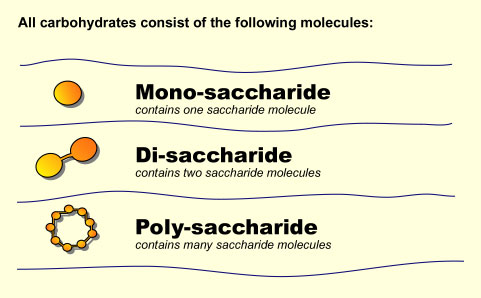
First, I'll tell you something about the different types of food we humans eat. Our meals primarily contain proteins, fats and carbohydrates. Fats and proteins cause no problems. The problem is caused by some carbohydrates. More specifically, the di-saccharides and the poly-saccharides are causing the problems.
Mono-Saccharides
Monosaccharides are built out of one sugar molecule. The holes in the lining of the intestines are exactly the size of these sugar molecules. The body can readily use these saccharides when they pass through the holes and enter the bloodstream. They don't even have to be digested, since they can be absorbed directly by the intestines absorptive cells. Monosaccharides are primarily found in (ripe) fruit and honey (in the form of glucose and fructose).
Disaccharides and polysaccharides
Disaccharides consist of two sugar molecules. Disaccharides are too big to pass the filter in the intestines (only monsaccharides can pass). The body has special enzymes in the first part of the small intestines, the duodenum, where these enzymes are produced. For example, lactose is a disaccharide. The body produces lactase to digest/split the lactose into two monosaccharides. These monosaccharides can then pass the filter. Disaccharides can be found in table sugar, brown sugar and milk (lactose).
Polysaccharides are even bigger molecules. These consist of many sugar molecules. These molecules are even more difficult for the digestive system to handle. First, the pancreas releases a fluid, which contains for an enzyme that can split the polysaccharides (starches) into disaccharides (maltose). Next, the enzymes (maltase), which are produced in the duodenum, must break down the disaccharides (maltose) into monosaccharides, before the body can utilize this kind of carbohydrates. Starches mainly contain polysaccharides.
The problem
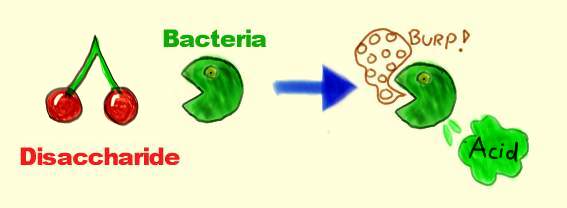
In a healthy person all these processes work perfectly. However, in a small group of people, the duodenum can't produce enough enzymes to digest all the carbohydrates (di- and polysaccharides). This is what happens next: Large amounts of undigested carbohydrates remain in the intestines. This would normally be no problem, because whatever the body doesn't utilize will end up in the toilet. However, the intestines also have natural inhabitants: Bacteria. The bacteria have been waiting for a long time for such a feast ! Lots and lots of disaccharides, their favorite meal !
To thank you for the meal, they start to produce large amounts of gas and they start to produce acids. As a result, the gas pressure in the intestines gets higher and higher. The body wants to relieve itself of the overpressure, and the host (you) starts to burp and have gas. Also, the gas is giving the stomach some false signals. The stomach replies by producing more digestive acids. The result for the host: heartburn and throwing up and nausea.
I almost forgot: The bacteria are also producing acids. The acids start to degenerate the intestines lining, its absorptive cells and its enzyme producing cells.
The vicious cycle
This is the introduction of a severe vicious cycle:
The enzyme producing cells in the intestines (duodenum) are dying because of the acids. So, while eating your next meal, there will be an even larger shortage of enzymes. So, more bacteria can eat more undigested disaccharides and they produce even more acids. The acids destroy even more enzyme producting cells. This is where the cycle restarts and restarts and restarts... Until you one day go the physician and complain about heartburn, burping, having gas, throwing up, etc.
The solution
The solution is very simple: Stop eating complex carbohydrates !
Complex carbohydrates are the disaccharides and the polysaccharides.
The list of foods that can be eaten is still very large. It consists mainly of: Fruits, vegetables, oils, honey and nuts. Wheat and every other granes are forbidden. Table sugar, brown sugar are also forbidden. For a complete list of foods, check www.scdiet.org, a really nice site, made by Mik, from Denmark, who has completely healed himself using the SCDiet. The www.scdiet.org you can find a large number of recipes. It's even possible to bake your own bread by using almondflour !
I find it not too hard to eat by the diet. Some think it's very hard, but after a couple of weeks on the diet, you start to feel so much better. Next, you even start to like the foods, because they are so much more natural than what you used to eat before. Not much later, you won't even bother when your friends are eating a Big Mac menu and you are not. It's very important to not cheat on the diet.. I learned it the hardway.. After being on the diet for seven weeks I ate some cookies and within 5 days I felt completely misserable. It took another seven weeks to regain my condition !
