RELATIVISTIC CAPACITOR PROPULSION
Relativistic Effect Phased Capacitor Propulsion should work in space and a vacuum and it needs no propellant to develop it's driving force. I have high hopes that Relativistic Effect Phased Capacitor Propulsion will be viable some day.
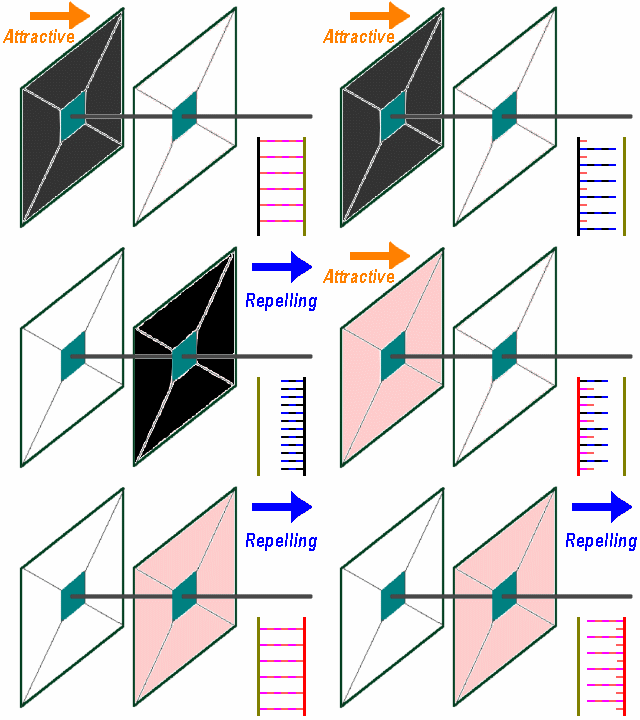
Basically I envision a large two plate capacitor, (we are talking square miles), and they are attached together by a rigid but insuating struture. Yu can look at the plates phasing gif animation below to get a better idea of how it works. The plates share a three state power supply, that is it has positive voltage, neutral, and negative voltage states. Each of the plates is switched at a different time. I think of the electro static field as being strings that connect every charged particle to every other charged particle in the universe, as these particles distribute themselves they make kinks in the strings that propogate down the string. It takes time for the field to propogate. Because the plates are being switched independent of each other, free space is acting as the intermediate storage plate that the capacitor plates are acting against. If you switch the potential of the plates between the three states you should be able to create the condition that as the sytem moves the forward plate is repeled from the trailing plate, and the trailing plate is attracted to the forward plate. Thus you have the forces to accelerate the whole system forward.
So what are we talking about in terms of voltages, switching speeds, and force. Suppose that we had two plates that were each 10 square kilometers in area and seperated by 10 meters. Let's say that the power supply is plus and minus 10,000 Volts or 10 KV. The plates would need to be switched every 10/300000000 seconds which is 3.3 nano seconds. The actual switch from plus or minus 10KV to neutral or zero potential would have to take place in a shorter period of time, the shorter the better. If it switched in a tenth of a nano second that would correspond to a switching rate of 5 Giga Hertz. There is 20KV between the plates when they are attracting. For a 10 square kilometer capacitor with ten meters seperation between the plates the capacitance in free space would be equivalent to 8.854e-6 Farads or 8.8 micro farads. The force of attraction between the plates of this capacitor at 20KV is 97 Newtons which is 21.8 pounds. For the electrostatic propulsion capacitor with each plate half the time at zero or neutral potential the total force for propulsion would be half of the static force. Therefore there should be 48 Newtons or 10.9 pounds of force for propulsion. Not much, but in outer space with a long time to accelerate it could be a very viable system.
Among the many problems that will need to be overcome before any practical model can be made is how to switch each plate to a different potential and so that all parts of the plate get to that potential at very nearly the same time. I foresee a backplane of parallel switching semiconducters on the backside of each of these plates that are switched by computers so that there is no significant potential differences on the face of the plates. Because of the expense and sophistication needed to build one of these things I am looking mostly to NASA to realize it. I would also mention that I do not know that such a system of phasing capacitor plates will really generate any propulsive force, I just think that it might.
[email protected]
Basically I envision a large two plate capacitor, (we are talking square miles), and they are attached together by a rigid but insuating struture. Yu can look at the plates phasing gif animation below to get a better idea of how it works. The plates share a three state power supply, that is it has positive voltage, neutral, and negative voltage states. Each of the plates is switched at a different time. I think of the electro static field as being strings that connect every charged particle to every other charged particle in the universe, as these particles distribute themselves they make kinks in the strings that propogate down the string. It takes time for the field to propogate. Because the plates are being switched independent of each other, free space is acting as the intermediate storage plate that the capacitor plates are acting against. If you switch the potential of the plates between the three states you should be able to create the condition that as the sytem moves the forward plate is repeled from the trailing plate, and the trailing plate is attracted to the forward plate. Thus you have the forces to accelerate the whole system forward.
So what are we talking about in terms of voltages, switching speeds, and force. Suppose that we had two plates that were each 10 square kilometers in area and seperated by 10 meters. Let's say that the power supply is plus and minus 10,000 Volts or 10 KV. The plates would need to be switched every 10/300000000 seconds which is 3.3 nano seconds. The actual switch from plus or minus 10KV to neutral or zero potential would have to take place in a shorter period of time, the shorter the better. If it switched in a tenth of a nano second that would correspond to a switching rate of 5 Giga Hertz. There is 20KV between the plates when they are attracting. For a 10 square kilometer capacitor with ten meters seperation between the plates the capacitance in free space would be equivalent to 8.854e-6 Farads or 8.8 micro farads. The force of attraction between the plates of this capacitor at 20KV is 97 Newtons which is 21.8 pounds. For the electrostatic propulsion capacitor with each plate half the time at zero or neutral potential the total force for propulsion would be half of the static force. Therefore there should be 48 Newtons or 10.9 pounds of force for propulsion. Not much, but in outer space with a long time to accelerate it could be a very viable system.
Among the many problems that will need to be overcome before any practical model can be made is how to switch each plate to a different potential and so that all parts of the plate get to that potential at very nearly the same time. I foresee a backplane of parallel switching semiconducters on the backside of each of these plates that are switched by computers so that there is no significant potential differences on the face of the plates. Because of the expense and sophistication needed to build one of these things I am looking mostly to NASA to realize it. I would also mention that I do not know that such a system of phasing capacitor plates will really generate any propulsive force, I just think that it might.
[email protected]

Centrifugal Coriolis Propulsion