CENTRIFUGAL FORCE BUCKING
CORIOLIS COUPLED PROPULSION SYSTEM
So How Does It Work
This Page No Longer Reflects My Thinking On This System & Needs Revision
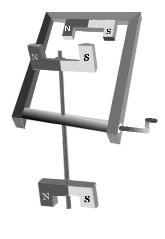
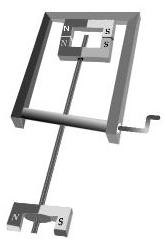
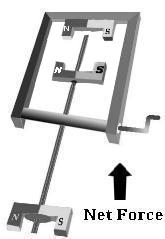
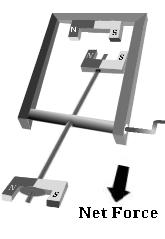
An axel with perpendicular spokes is rotated. On these spokes are some masses that are thrown out by centrifugal force, (don't believe that stuff about it being a fictional force), to the end of the spokes where there is a mechanical stop. These rotating masses are represented by the magnets in the above drawings. There is a fixed magnet at the top of the frame that is oriented to repel the magnets on the rotating shafts. If the force of repulsion is greater than the (Mass*(v^2))/r centrifugal force throwing the magnet out there will be a net force to accelerate the magnets apart. The fixed magnet transfers this force of repulsion to the whole system which causes the system to move forward. The rotating magnet is repelled down the shaft toward the axel but it's movement in that direction is only coupled by coriolis force. That is in order to conserve angular momentum as the weight is pushed down the rotation must speed up. After the magnets pass each other the rotating magnet will be thrown back out to the end of the shaft. As the rotating magnet is being thrown the whole system is being repelled away from it. The integral of the vectored repelling force that the system experiences while the rotating magnet is returning is at a different angle than the integral of the vectored repelling force that the fixed magnet experienced originally. Therefore the original impulse that the whole system experienced will only be partially canceled when the magnet is spun back out to the end. There will also be a torque developed to spin the frame around the axel. However you could have two of these units in parallel and they should rotate their shafts in opposite directions. In that manner the torques will be cancelled out and what you are left with is the leftover impulses of these units which will add together and propel the system forward. It also is possible to steer the system using a set of these units by creating torque imbalance for a while.
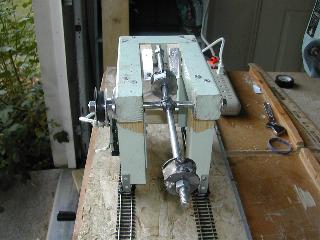
This system uses magnets to develop the repulsive force between the rotating masses and the system as magnets make it easy to visualize what is happening. There is nothing sacred about using magnets and it is probably impractical. What is important is that there is some method to push a mass back down the rotating shaft. This might be done by a fast acting piston or some sort of hammer. The rotation speed should increase during the pushdown cycle of the rotation It is not good to slow down the rotation system. On my proto type model below I used a deflection ramp to push the masses down the shaft, which unfortunately slowed rotation and I can not tell that the system has any propulsion. There may be no net acceleration obtainable by this system. What you have is a system that may work by balancing torques in order to jerk itself from position to position.
I see Centrifugal Force Bucking Coriolis Coupled Propulsion as having applications for manuevering space craft. If you had excess electric power available from say a solar source. You could use this system to manuever your space craft around a space station and not have to throw off any mass doing it. If you have any other questions you can email me at:
[email protected]

Relativistic Capacitor Propulsion
This system uses magnets to develop the repulsive force between the rotating masses and the system as magnets make it easy to visualize what is happening. There is nothing sacred about using magnets and it is probably impractical. What is important is that there is some method to push a mass back down the rotating shaft. This might be done by a fast acting piston or some sort of hammer. The rotation speed should increase during the pushdown cycle of the rotation It is not good to slow down the rotation system. On my proto type model below I used a deflection ramp to push the masses down the shaft, which unfortunately slowed rotation and I can not tell that the system has any propulsion. There may be no net acceleration obtainable by this system. What you have is a system that may work by balancing torques in order to jerk itself from position to position.
I see Centrifugal Force Bucking Coriolis Coupled Propulsion as having applications for manuevering space craft. If you had excess electric power available from say a solar source. You could use this system to manuever your space craft around a space station and not have to throw off any mass doing it. If you have any other questions you can email me at:
[email protected]
Relativistic Capacitor Propulsion