 |
| Ric Flair |
|
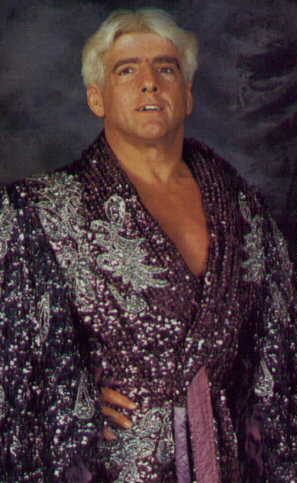
| Real Name: Richard Fliehr Stage Name / Aliases: Nature Boy Date of Birth: 25 February 1949 Home Town: Height: 6'1" Weight: 243lbs. Brief Bio: Ric Flair, born Richard Morgan Fliehr, was birthed on February 25, 1949, in the small hamlet of Edina, Minnesota. The son of an obstetrician/gynecologist and a marketing executive, Ric proved himself an able sportsman, no doubt a foreshadowing of greater things to lie ahead. A basketball player in high school, he also won the Wisconsin state high school championship in amateur wrestling. Soon after completing his time at the University of Minnesota, Ric started his wrestling training under the watchful tutelage of Verne Gagne and Billy Robinson. Promptly joining the American Wrestling Association, his first opponent was the inimitable "Scrap Iron" Gadaski, whom he met on December 10, 1972. The match ending in a draw, Ric realized that his full potential would have to be realized at a different time in a different place. Between May and June of 1974, Ric moved to North Carolina, wrestling in the National Wrestling Alliance around the mid-Atlantic region. Here he quickly established himself as a proficient tag team wrestler; indeed, he was initially introduced as a partner of the great Rip Hawk, winning the Mid-Atlantic Tag Team title with him on July 4, 1974, against Paul Jones and Bob Bruggers in Greensboro, North Carolina. He also showed himself to be a competent singles competitor in defeating Paul Jones for the NWA Television title on June 3, 1975 (He reciprocated the favor to Paul exactly one week later). He also defeated Wahoo McDaniel in Hampton, Virginia, on September 20, for the NWA Mid-Atlantic Heavyweight title. On October 4, 1975, shortly before arrival in Wilmington, North Carolina, his private plane crashed due to a lack of fuel. Times truly looked dire for Ric, as his back was broken in three places. Besides Flair, two other occupants, John Valentine and Bob Bruggers, suffered permanent, life-altering injuries, while another two occupants, Tim Woods and David Crockett, emerged from the aircraft with relatively minor cuts and scratches; the pilot was killed. After the crash, the doctors informed him with the wrenching news that he would most likely never wrestle again and would need at least an entire year to recover fully. Exceedingly even the most liberal estimates, Ric miraculously not only fully recovered in less than a year but also returned to the squared circle less than four months later on February 1st of the following year. In defeating Wahoo McDaniel again, the victory became not only a comeback for the ages but also the beginning of a scintillating rivalry between the two accomplished grapplers. On May 24, 1976, Flair defeated Wahoo McDaniel yet again for the Mid-Atlantic Heavyweight title, this time in Charlotte, North Carolina. During the rest of 1976, Flair alternated between the Heavyweight title, exchanging it a few more times with McDaniel, and the Tag Team title, uniting with Greg Valentine to defeat Gene and Ole Anderson on Christmas Day in Greensboro, North Carolina. The rest of the 1970s bore witness to a burgeoning champion. Beginning in 1977, Flair, still somewhat viewed as a tag team wrestler, captured the NWA World and Mid-Atlantic Tag Team titles (both with Greg Valentine), but also secured the NWA Television title and the United States Heavyweight title. The Television title was obtained via a victory over the jocular Rufus Jones, and Flair snatched the US title from a particularly enigmatic Bobo Brazil in July. 1978 saw Ric obtain the US Heavyweight title again, this time from Mr. Wrestling. He also teamed with Big John Studd to win the Mid-Atlantic Tag Team titles over Paul Jones and Ricky Steamboat. The timeless feud with Steamboat started to reach a boiling point in 1979 with Ric reclaiming the US Heavyweight from him on April 1, 1979 On August 8, 1979, just before the turn of the decade, Flair collaborated with Blackjack Mulligan to defeat Paul Jones and Baron von Raschke in Greensboro, North Carolina, for the NWA World Tag Team Title. Losing it a mere two weeks later, however, Flair was at a crossroad in his career. He soon made the decision to focus mainly on singles competition; four months into 1980, on April 20, Ric Flair defeated "Superfly" Jimmy Snuka to capture the NWA United States Heavyweight Title for the fourth time. Losing it to his former tag team partner, Greg "the Hammer" Valentine three months later in Charlotte, North Carolina, Flair, in his unwittingly steady march towards establishing a lasting wrestling legacy, reclaimed it on November 24, 1980, in Greenville, South Carolina, and fended off all competitors until Rowdy Roddy Piper wrested it from his waist on January 27 the following year in Raleigh, North Carolina 1981 would signal the move of Ric Flair from the level of ordinary mid-card champion to the upper echelons of legends and fables. On September 17, 1981, Ric Flair defeated Dusty Rhodes in Kansas City,Kansas, to win his first world championship belt, the NWA World Heavyweight Title. This singular victory was seminal; indeed, the true measure of his unequivocal dominance in the 1980s is his unprecedented seven NWA/WCW World Heavyweight Championship reigns. The defeat of Rhodes marked the beginning of the highly celebrated Flair/Rhodes feud. It is clear, though, that the feud was one-sided, as Flair completely mastered Rhodes in only losing the world title to him once, that defeat coming on July 26, 1986. The first title reign of Ric Flair lasted almost a now-uncanny two years with defeat coming at the hands of then-Missouri champion Harley Race on June 10, 1983. The reign wasn't without its intrigues, though. On July 4, 1982, Ric Flair, the NWA World Champion, battled Bob Backlund, the WWF World Champion at the Omni in Atlanta, Georgia. With action highly intense and furious, they were eventually both disqualified after twenty minutes. After Race defeated him in June 1983, Flair entered a twenty-man tournament for the Missouri title which Race vacated after winning the world title; Flair subsequently defeated David Von Erich in the finals to capture the championship. Four months after first defeating Flair, Harley Race again encountered Ric Flair at the inaugural Starrcade in Greensboro, North Carolina, on November 24, 1983. A capacity crowd of 15, 447 people, as well as approximately 30,000 fans throughout the mid-Atlantic area via closed-circuit television, witnessed Flair recapture the NWA World title. There were two additional battles for the title in the ensuing months: Harley Race won the title yet again from Flair in Wellington, New Zealand, on March 21, 1984, but two days later was handed his second defeat from Flair in Singapore. After losing and regaining the world title to and from Kerry Von Erich in May 1984 in Irving, Texas, and Yokosuka, Japan, respectively, the NWA found its way back to the New York metropolitan area, stopping at the Meadowlands Arena in New Jersey. There, Ric Flair defeated Ricky Steamboat in the epic main event. After defeating Von Erich in 1984, Flair surpassed his earlier, seemingly impossible feat of maintaining title supremacy for close to two years, this time not losing the belt until July 26, 1986, to Dusty Rhodes. Shortly before facing defeat, however, Flair, Ole Anderson, Arn Anderson, and Tully Blanchard formed the first, unopposed wrestling group, the Four Horsemen. Appropriately named after the biblical harbingers of apocalyptic doom, they proceeded to wreak havoc and mayhem on all opposition and all opponents. The Horsemen were formed by a complex convergence of different factions in the NWA roughly around May 1986. Ole Anderson, originally the tag team partner of Thunderbolt Patterson, abruptly dropped him and decided to join with another Anderson, Arn, to resurrect the Minnesota Wrecking Crew; meanwhile, Flair was engaged in a monumental feud with Magnum TA for the United States Championship. This particular angle revolved especially around the claim that Flair or TA could beat the other wrestler in ten minutes or less. During one match of this feud, TA actually had Flair in a figure-four leglock at the ten-minute mark. The Andersons, at ringside providing color commentary, rushed in to interfere, ham-handedly establishing through a Minnesota connection that Flair was a "cousin." After this clumsy incident, members of the trio routinely appeared at the matches of the other members for support or, usually, interference. Tully Blanchard was approached by the Minnesotan trio after a incredibly intense encounter with Sam Houston, at the time a promising, young wrestler who had feuded briefly with Flair and the Andersons. After interfering in the match, the four proceeded to brutalize Houston until amelioration came in the form of various jobbers. The quartet was finally galvanized into a bona fide group by JJ Dillon, Blanchard's manager. Flair, now with a formidable force trailing him, only continued to assert his grave hand against all who would mount any opposition against him. After defeating Dusty Rhodes decisively in St. Louis a mere two weeks after losing to him in Greensboro, Flair proceeded to retain the title for slightly over a year, uncontested until facing a formidable foe in "Rugged" Ronnie Garvin. On September 25, 1987, in front of a manic crowd in Detroit, Michigan, Garvin virtually stole the hearts of fans and the belt, dethroning the champion in a match marred by controversy. Flair would not stay vanquished for long, however; a disgraced Garvin only held the title for two months before painfully succumbing to pinfall after a particularly savage blow to the head in Chicago, Illinois, on November 26, 1987. This sixth title reign would once again be marked by utter dominance, as this reign was not ended until February 20, 1989. Ricky Steamboat, a familiar and, more importantly, well-matched foe, ended the seemingly eternal sixth reign in Chicago, Illinois; the match was exemplified by drama, the rawest of human emotions, and scientific wrestling par excellence. Steamboat and Flair would again confront each other at the Clash of Champions in New Orleans, Louisiana, on April 2. Flair, proving himself to be a most able tactician, engaged Steamboat in a monumental battle of nearly one hour; the match, a virtual primer on the sport of wrestling, was two out of three falls. The match abruptly ended in Steamboat taking the third and decisive fall, despite the strategic and psychological edge Flair possessed and his fateful, unseen foot on the ropes. These two epic grapplers, resurrecting a feud existent since the late 1970s, engaged in this battle only surpassed by the match that followed it, the match on the fateful day of May 7, 1989, at Wrestle War. As high as the heavens are above the earth, so was the match that occurred on May 7, 1989, in the city of Nashville, Tennessee. To counter accusations of referee corruption and quell mounting suspicions of administrative negligence, National Wrestling Alliance officials ordered yet another rematch between Steamboat and Flair, this time at Wrestle War. A phenomenal bout, it featured spectacular moves and countermoves on the parts of both Flair and Steamboat. Flair's strategy throughout the struggle was to weaken the leg of Steamboat to prepare it for the dreaded figure-four leglock, a maneuver which had humbled countless opponents before. Conversely, Steamboat attempted to cripple the arm of Flair through a series of kneedrops, Irish whips, and armbars in order to end the match with the chicken-wing submission hold. It seemed as if Flair had achieved final vindication when he forced Steamboat into the figure-four hold; however, Steamboat managed to break the hold and stage a slight, if ultimately futile, comeback. The momentary change in the momentum was all for naught, though, when Steamboat picked Flair up for a bodyslam. Midway through the maneuver, Flair grabbed the leg of Steamboat and countered the bodyslam by executing a reverse inside cradle pin. After this grueling exhibition of wrestling purity, Flair regained the world title for the seventh time in the 1980s. This was an ephemeral celebration, however; Terry Funk, appointed as the ringside judge and timekeeper, came into the ring supposedly to congratulate the new champion. Challenging Flair to a title match, Funk abruptly and savagely attacked Flair with vicious punches, foreign objects, and taunting. Funk ended this brutal display by piledriving the new champion through the timekeeper's table. It was clear that Flair, weakened by his just-finished match against Steamboat, was severely and debilitatingly injured. On September 17, 1995, Ric Flair and Arn Anderson, two long-time friends, faced each other in a match that was a highlight of both of their careers. The fued started in July of 1995, when Ric Flair lost a match to Vader, and blamed Arn Anderson for not being there to prevent Vader from winning. The two got into another argument on July 26, when Arn Anderson did not help Ric in his match against Alex Wright. By this time, Ric Flair got so angry that he challenged Arn to a match. Fortunately, Ric Flair and Arn Anderson were able to settle their differences during the next few weeks in time for Arn's match with Alex Wright. At one point during the match, Arn threw Alex Wright outside, who then attacked Ric Flair outside the ring. Ric fought back, and soon, after DDT'ing Alex Wright, Arn Anderson had won the match. Flair and Anderson then had an interview to say that they had reunited, and that everything was fine. However, this fued was far from over. In an interview after a match with Tim Horner, Arn Anderson gave his opinion on what he thought about Ric Flair. Flair did not like was Arn Anderson was saying about him, and would soon get revenge on his former best friend. This led up to what would happen in what was supposed to be a taped thumb match between Arn Anderson and Jim Duggan. While Arn was walking down the aisleway, he was attacked from behind by Ric Flair. This was when a match was signed for Ric Flair to face Arn Anderson at Fall Brawl. When the match took place, many wrestlers in the back who had matches earlier on in the show came out to watch the Flair/Anderson match. Arn Anderson focused on injuring Ric Flair's left arm, a typical strategy of the "Enforcer". Knife-edge chops were delivered by both wrestlers, and Ric Flair was eventually able to put Anderson in the figure four. When Flair was disrespectful enough to spit at Arn Anderson while he was in the hold, it gave him the anger and determination to reverse the hold, inflicted pian on Ric Flair instead. Soon, when both wrestlers had gotten up, Flair was punching Anderson in the corner. This was when Brian Pillman came to the ring. When the referee and Arn Anderson were not looking, Brian Pillman kicked Ric Flair in the head. Although Arn Anderson did not see this, he saw the opportunity to hit the DDT on Ric Flair and then cover him for the pin. Ric Flair and Arn Anderson once again were able to settle their differences after that match, but used what everyone thought was a bitter rivalry to come up with a plan. Ric Flair recruited Sting to join him in the "battle" against Arn Anderson, while Arn recruited Brian Pillman for a Halloween Havoc tag team match against Sting and Flair. The plan that Anderson and Flair came up with would come into play in this tag team match. During the match, Brian Pillman, Arn Anderson, and Ric Flair revealed their plan to the world , and gave Sting a typical horsemen beatdown. After recruiting Chris Benoit, the 4 Horsemen had reunited. Ric Flair won the WCW World Heavyweight title for the 14th time on March 14, 1999, at Uncensored. This match (in which Ric Flair defeated Hollywood Hogan for the World Heavyweight title) had a long story building up it. Hollywood Hogan made his return to WCW, by coming out of retirement on January 4, 1999. Hogan and the nWo made a mockery of the WCW World Heavyweight title belt, by having Kevin Nash lay down so he could be pinned by Hogan. Ric Flair, who had won the presidency of WCW just one week before this match happened by beating Eric Bischoff, decided he would see to it that Hogan should lose the belt as soon as possible. However, Ric Flair, along with son David, had to focus on thier upcoming tag team match at Souled Out, against Barry Windham and Curt Hennig. This was not just a Horsemen vs. nWo tag team match, it was a match against two wrestlers who had both joined the 4 Horsemen, only to stab Ric Flair in the back and join the nWo. Before the Souled Out PPV started, Ric Flair gave an interview to let the world know that WCW was stronger than ever, more united than ever, and was the biggest and best wrestling company in the world. Using his power as president of WCW, Ric Flair changed the "WCW/nWo Souled Out" logo to just "WCW Souled Out". Ric and David Flair won the match with a little help from Arn Anderson and his tireiron, but soon discovered that the nWo was also stronger and more united than ever. After the biggest tag team match of the night had ended, the entire nWo Wolfpac came out, along with the nWo black and white to prove this. Ric Flair was handcuffed to the ring ropes, being forced to watch the nWo beatdown on David Flair. The fans chanted "Goldberg" and then "we want Sting" but neither of them came out to help the Flairs. Hollywood Hogan spray painted "EZE" on David Flair's back, to show who the nWo thought should really be in charge of WCW. The next night on Nitro, Ric Flair challenged Eric Bischoff to a hair vs. hair and control of WCW match, meaning that Bischoff would regain control of WCW if he defeated Ric Flair and also get to cut Ric Flair's hair. Just as Bischoff was about to accept, David Flair came out to say that he wanted to fight Bischoff instead, so the match was signed. Randy Anderson, who happened to be the referee for this match, was one of the many enemies of Eric Bischoff, and this was to David Flair's advantage. Randy Anderson, gave a roll of quarters to David, who then punched Bischoff with it, and then was able to pin him and win the match. Then the horsemen came out, and shaved the head of an unconcious Eric Bischoff, who was shocked at what they had done when he woke up. Soon, a match was signed for Ric Flair to face Hollywood Hogan at Superbrawl IX for the World Heavyweight title. Ric Flair dedicated this match to his family, but not all of his family had the same respect for Ric. While Hogan was suffering the pain of the figure-four leglock, courtesy of Ric Flair, a masked nWo member, who turned out to be David Flair, used the taser on his father, allowing Hollywood Hogan to get a tainted victory over Ric Flair. After 8 days had passed, Ric Flair challenged Hollywood Hogan to a rematch, and this time the match would be inside a steel cage with barbed wire at the top, so that there would be no way for anyone to enter or leave the cage, and it would be a first blood match. There were also some interesting stipulations to the match. If Hollywood Hogan won, Ric Flair would be forced to retire, and never wrestle again. But if Ric Flair won, not only would he win the belt, but he would win the presidency of WCW for the rest of his life (or until July 19, as it would turn out, after losing it to Sting) Sunday, March 14, 1999 had arrived, and before the match began, Ric Flair told the referee, "Little Natch" Charles Robinson, that the stipulations would be changed. It would not be a first blood match, and the only way for the match to end was when there was a clear winner. Charles Robinson turned out to be in cahoots with Ric Flair throughtout the match, because he would not make the count when Hogan made an attempt to pin Flair. At many points during the match, it looked like Hogan could have won, had Charles Robinson made the three-count. David Flair and Torrie Wilson eventually came to the ring to cheer on Hollywood Hogan, but could not enter the ring because of the doorless steel cage. When Arn Anderson saw that Ric Flair was losing and needed help, he came to the ring, tire iron in hand, and took out both David Flair and Torrie Wilson. Arn then gave the tire iron to Ric Flair, who waffled Hollywood Hogan with it, and then went for the figure-four leg lock. When Hogan was unconcious from being hit by the tire iron and his shoulders were on the mat, Ric Flair used his figure four as a pinning combination. Little Natch made a fast three count, giving Flair the World Heavyweight title belt, and presidency of WCW for life. March 2001, Shane appeared live from the set of NITRO in Panama City, Florida and shocked the world when he said he had in fact purchased the WCW right out from under his father's nose. To top it off, he vowed to not only save the rival organization, but also promised to make it the strongest wrestling federation in the world. Mr. McMahon was livid, further intensifying the father/son rivalry these two are building towards at this weekend's WrestleMania X-Seven in which the two will battle it out in a Street Fight. Shane then proceeded to invading the WFF, trying to run Vince McMahon out of business. However the EWC & WCW alliance lost their winner takes all match at the invison PPV. It was later revealed that Shane and Stephanie selled their WWF stock to an unnamed business man, to fund their purchase of WCW & ECW. It was soon revealed to Vince McMahon and the rest of the world, that the mystery business man was none other than Rick Flair. Making Rick Flair 50-percent owner of the World Wrestling Federation! The above biography was compiled using information from the following websites. http://www.ricflair.com/home.html http://www.homestead.com/wrestlingbteam/files/flair.html http://www.wwfsuperstars.com/ricflair/bio/ http://www.wrestlingmuseum.com/pages/bios/flair.html |
 |
|
|
|
 |
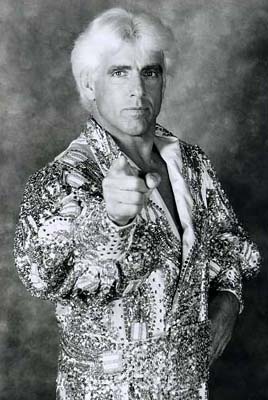
| Ric Flair 1997 |
 |
 |
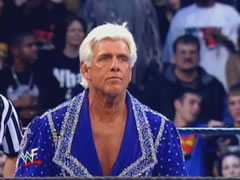 |
| Ric Flair meets Vince McMahon at the Royal Rumble 2002 |
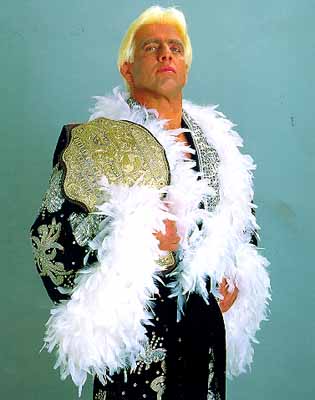
| Ric Flair as the WCW heavy Weight Champ |
