
Daisy"Trust me, I'm a scientist!"rat
(However, I am NOT a medical doctor. None of this is intended to be taken as medical advice as I'm not qualified to give such advice.
Challenge Information
Member Bios
Member Photos
Rankings
Links
Daisyrat's Fat Facts
Inspiration
Tip of the Week
Guestbook
Okay, maybe you didn't say it exactly like that.
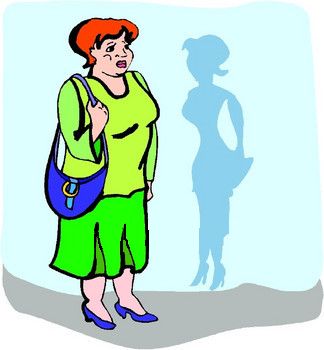
More likely, you've wondered why the heck food goes straight to your butt and why your face and arms got thin before your thighs did.
Here's why --
Fat is stored in the body in the form of triglycerides, with most in fat cells (adipocytes). However, fat is also stored within skeletal muscle cells as "intramuscular triglycerides." Fat, either is the form of adipocytes or intramuscular triglycerides is released for fuel through a process called lipolysis.
Typically, women have a higher percentage of body fat than men. A healthy range of body fat for women is 20-25%, a healthy range of body fat for men is 10-15%. People who carry most of their fat in their midsections have an android, or apple body type, which is most characteristic among males (although I'm female, as far as I know, and I'm a classic apple). Those who carry the bulk of their fat in their hips, thighs and butt have a gynoid, or pear body type which is typical of females. Hormones are generally thought to determine where fat is stored and in what order, which is why men and women typically show such different fat distribution.
What's a hormone, and what are receptors, you ask? In a nutshell, hormones are biochemicals which regulate darn near everything that happens in your body. Receptors are little thingies on your cells to which hormones must attach in order to work.
That's nice. So why does fat come off certain areas of your body before others?
There are two main enzymes that regulate lipolysis -- hormone sensitive lipase (HSL) and lipoprotein lipase (LPL). HSL is located in the fat cell and is stimulated by the hormone epinephrine (formerly, adrenalin). When HSL is stimulated, it acts to break apart triglycerides in the adipose tissue (tissue which contains adiptocytes and a few other things) and release free fatty acids and glycerol into the blood stream. Epinephrine binds to specific receptors on the fat cell, which in turn, activate HSL. Sensitivity to epinephrine can be enhanced through regular exercise, particularly aerobic exercise. Conversely, excess weight decreases the HSL responsiveness to epinephrine, meaning a higher concentration of epinephrine is needed to activate HSL.
Once in the blood stream, the free fatty acid molecules bind to albumin, a blood protein and the main transporter of free fatty acids. Free fatty acids are not water soluble and require a protein carrier to allow them to be transported to cells and within the blood stream. Once the free fatty acids are transported to a muscle cell, they are released from albumin and carried across the muscle cell membrane via "transporters". The number of free fatty acid transporters on a muscle cell membrane is known to increase with aerobic exercise which means the cell is now capable of using more fat for fuel. The glycerol molecule released from lipolysis is circulated to the liver for breakdown, and is either used as an intermediate in the breakdown of glucose or used to make more triglycerides.
LPL, the second enzyme of lipolysis, is located on blood vessel walls throughout the body. Both adipose tissue and the liver have large quantities of this enzyme. LPL acts on triglycerides carried by lipoproteins in the blood stream. Lipoproteins are special transporters that carry cholesterol and triglycerides through the blood stream to adipose tissue and body cells for fuel and other needs (i.e. structural). The triglycerides are broken down to free fatty acids and used as fuel by active tissues or diffuse into fat and liver cells where they are re-synthesized into triglycerides and stored. LPL controls where fat is stored and when it's relased.
Okay. Again -- why did the fat come off my face first and not my hips?
Basically, certain cells are more sensitive to our friend epinephrine than others. Adipocytes located in the abdomen, for example, contain more epinephrine receptors than adipocytes located on the hips and thighs. That's why you'll tend to lose stomach fat faster than hip fat.
But why do some cells have more receptors than other?
Here's an analogy -- you don't keep all your money in a sock under your bed, do you? (I hope you don't!) No -- most people will have some of their money in a checking account for quick access when they need it. The rest will be in investments or perhaps a retirement account -- money that might be needed some day, but not now. So it is with body fat -- even when consuming large quantities of carbohydrate resulting in an abundance of blood glucose, fat is still critical to a healthy body, even when it's not being used for fuel. Fat is a crucial structural component in cells, and as most of your cells are dying off and being replaced on a regular basis, fat is absolutely required. Without it, skin flakes and peels, hair falls out, gums bleed and so forth. Therefore, the body needs a supply of fat it can tap into with relative ease, just as you keep a certain balance in your checking account to pay bills.
Because the majority of our evolution occured when there was no certain food supply, our bodies adapted by creating areas in which fat could be stored for fuel -- just in case we couldn't find enough nuts, berries or woolly mammoths. It's in the body's best interest to protect these fat reserve, just as it's in your best interest not to tap into your 401K in order to take a luxury cruise. Therefore, these areas have fewer receptors and those receptors overall appear to be less sensitive to epinephrine.
Again, gender comes into play here. The fat 401K in women is considerably larger than our male counterparts because from a reproductive standpoint, we're less replaceable (sorry, guys). A woman can only bear so many children at a time, making it more critical to ensure her survival by providing her with a nice fuel reserve. A male, on the other hand, can sire hundreds of children, making them less valuable (reproductively!) as one man can do the job of a hundred easily.
So, that's how fat is metabolized, and why it metabolizes where it does. The important thing to remember is that eventually, it *all* comes off!!